Glass is the category where sellers most often get the order of operations backwards. A cabinet of old glassware looks uniform from across the room, and the instinct is to price the whole shelf by decade or by color. That does not work, because two pieces that look nearly identical can sit at opposite ends of the market. Some were made in the hundreds of thousands and handed out free with a bag of flour. Others were finished by hand in short runs, and a few were pressed decades later from the very same molds as the originals. Sorting vintage glassware worth money from the rest is entirely a question of which of those three things you are holding.
Vintage glassware worth money is identified in three steps rather than by color or age: establish the maker and pattern from the form and the mold evidence, date it while avoiding the mark trap and the color trap, then check completed sold listings for the same pattern in comparable condition. Finishing quality and pattern scarcity drive price far more than the decade.
Quick identification checklist
- Find the mold seams and follow them. Where they run, how many there are, and whether they were polished away tells you how the piece was made and finished.
- Check the base. A ground and polished base, a smooth fire-finished rim, and a piece with real heft all point toward better quality production than a thin, unfinished pressing.
- Name the pattern, not the color. The pattern is what buyers search for. The color is a variant of it.
- Look for a mark, but do not require one. Enormous quantities of collectible American glass left the factory with nothing but a paper label.
- Tap the rim and listen. A clear sustained ring generally indicates a denser, better finished body than a short flat tone. Use it as one data point, not a verdict.
- Inspect the rim and foot under strong light for chips, flea bites, and cloudiness. Interior haze from dishwasher use or mineral deposits is common and hard to reverse.
- Only then search sold prices. Identification first, valuation second.
Step one: identify what it actually is
Almost all American collectible glassware from the last century and a half falls into a few production families, and placing your piece in the right family narrows the search before you look for a single mark.
Pressed glass is formed by pushing molten glass into a mold with a plunger. It carries mold seams, and the pattern is molded into the body rather than cut or etched onto it. This family covers nineteenth century pattern glass, the mass-market Depression era tableware of the 1920s and 1930s, and a great deal of later production.
So-called elegant glass is also mold formed but is finished by hand afterward: seams ground away, rims fire polished, bases ground flat, and decoration frequently added by acid etching or wheel cutting. It is heavier, clearer, and better finished than mass-market pressed glass from the same decade, and it generally sits higher in the market.
Blown glass shows no plunger seams, often has an unevenly thick body, and may show a scar or a ground and polished area on the base where the piece was held during finishing. Art glass, cut glass, and studio work belong here.
Sorting into those three families takes a minute and immediately tells you whether the pattern you are chasing is a mass-market pattern or a hand-finished line.
Step two: date it, and avoid the two classic traps
Two errors account for most bad glassware identifications, and both are easy to avoid once named.
The mark trap. People treat an unmarked base as unidentifiable and a marked base as proof of age. Both are wrong. Most Depression era tableware carried only a paper or foil label, which came off in the first wash, so an unmarked piece is completely normal and says nothing about the maker. When a molded mark is present it is usually raised into the base, and it identifies the company but rarely a year. Meanwhile a modern country-of-origin mark or an acid-etched importer stamp is a genuine warning sign that the piece is a later product.
The color trap. Color is not a pattern, and it is not a date. The same mold ran in pink, green, amber, cobalt, and clear, sometimes across many years, so two pieces in different colors can be the identical pattern and two pieces in the same green can be unrelated. Worse, popular patterns have been reproduced since the 1970s in both the original colors and in colors that never existed originally. Naming the color first sends people down the wrong search path more than any other habit in this category.
What actually dates a piece is production evidence: how the seams run, whether the finishing was done by hand, the exact pattern and its documented production window, and, when present, the specific form of the maker’s molded mark. The hardest case is a reissue pressed from the original molds after a company changed hands, because the pattern itself is identical. That case is solved by finishing quality, not by pattern, and the first worked example below walks through it.
Step three: check sold listings, not asking prices
Once the piece has a family, a pattern, and a rough period, valuation becomes research rather than guesswork.
Filter to completed and sold results only. Active listings record what sellers hope for, which in glassware runs dramatically above what buyers actually pay, because the category is full of optimistic listings that never sell. Then match on four things at once: the same pattern, the same form (a dinner plate and a luncheon plate are different items), the same color, and comparable condition. A pattern match with a condition mismatch is not a comparable.
Read the cluster in the middle of the results rather than the top result. If a dozen examples sold, the useful number is where most of them landed and how tightly they grouped. High outliers usually hide something the listing does not state: a scarce color, a rare form in the pattern, an unusually complete set, or two determined bidders. Six to ten sold results is a market. One is an anecdote.
Two worked examples
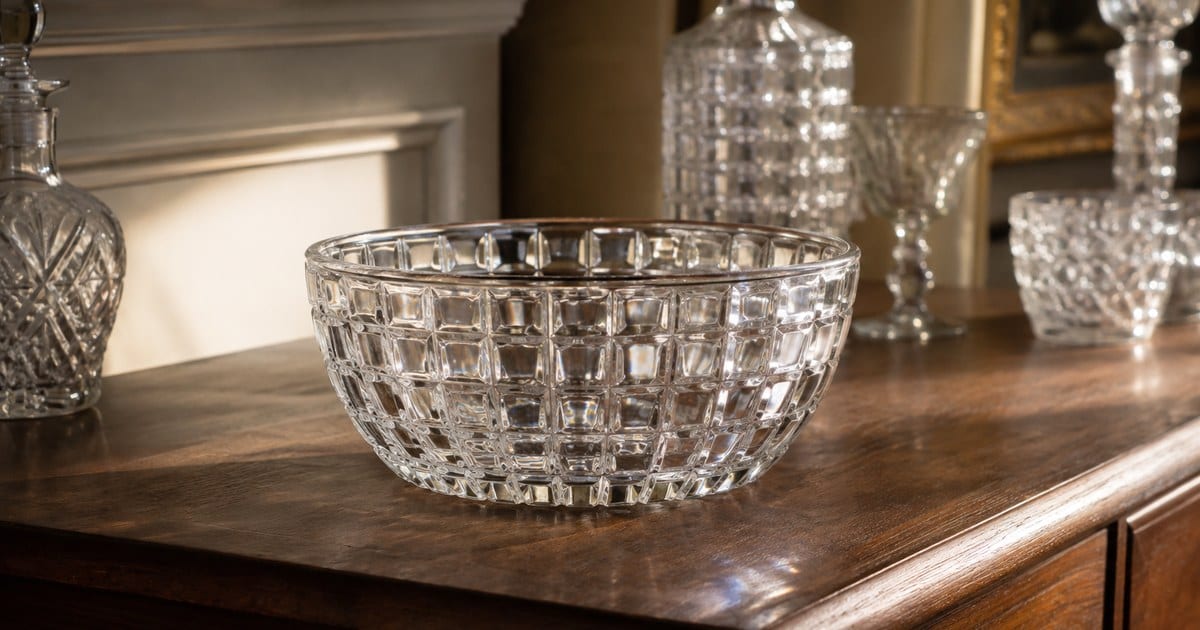
A heavy cube-patterned bowl from a china cabinet. The pattern is a grid of raised cubes and the piece feels substantial, so the instinct is to call it the well known Fostoria American line and stop there. That is exactly the wrong place to stop. Fostoria produced its American pattern from the mid 1910s until the plant closed in the 1980s. Indiana Glass made its own lookalike cube pattern, Whitehall, starting in the early 1960s, decades before Fostoria closed and with its own molds, not Fostoria’s. Only after Lancaster Colony acquired Fostoria in 1983 did some genuine Fostoria molds get folded into that Indiana line, at which point it was renamed American Whitehall. Similar shapes, different origin, and the distinction matters for value. Collectors separate them by finishing rather than by design: examples attributed to Fostoria commonly show three mold seams while the later Indiana pieces commonly show two, the Fostoria cubes have crisper corners where the Indiana cubes read slightly rounded, and Fostoria rims were fire polished smooth while many Indiana examples were left rougher with unground bases. Tapping the rim is a useful supporting check, since the better finished, denser body tends to ring longer. None of that is visible in a listing photograph taken from three feet away, which is precisely why the two get confused and why an accurate identification changes what the piece is worth.
A green pressed tumbler from a box of estate-sale glass. The color is striking and the glass is clearly old, so it goes straight to the “valuable” pile. Check the physical evidence instead. The tumbler is light in the hand, the walls are thin, the seams run unbroken from base to rim without any polishing, and the rim was never fire finished. That combination describes mass-market pressed ware, much of which was produced in enormous quantity and distributed as a premium: packed in oatmeal and flour, given away at gas stations, and handed out at movie theaters through the 1930s. Enormous numbers survived. Search the pattern in completed sales and you will typically find a long list of low, tightly clustered results, and the reason is supply rather than any defect in the glass. The right move is to identify the pattern precisely anyway, because a small number of forms within these common patterns are genuinely scarce, and the scarce forms are the only place the money is.
In both cases the valuation question came last. It only means anything after the piece has a pattern and a production window.
What separates vintage glassware worth money from a common piece
Scarcity within the pattern, not across the category. In most collected patterns the dinner plates, tumblers, and cups are common because everyone bought them. The scarce items are the awkward forms: covered pieces, lidded jars, pitchers, footed compotes, and serving items that broke or were bought in smaller numbers.
Finishing quality. Ground and polished bases, fire-polished rims, removed seams, and hand-applied etching or cutting all mark a higher production tier and a higher market tier.
Color rarity within that pattern. Some patterns ran mainly in one color and rarely in another, and the uncommon colorway can sit far above the standard one. This is a per-pattern fact, not a general rule about colors.
Condition, judged strictly. Chips at the rim and foot, flea bites, internal cracks, cloudiness from dishwasher etching, and worn decoration all cut hard. Cloudiness in particular is often permanent, and buyers price it that way.
Completeness. Lids present, sets intact, and matching sizes together. A covered piece missing its lid drops out of the collectible bracket almost entirely.
Reproduction pressure. Patterns that have been heavily reproduced carry a discount on unattributed examples, because buyers price in their own uncertainty.
Watch-outs and common mistakes
- Leading with color. It is the least informative thing about a piece and the most likely to send you to the wrong pattern.
- Assuming unmarked means worthless. Paper labels were the norm. Absence of a mark is expected, not suspicious.
- Buffing or polishing to remove haze. Interior cloudiness is usually etched into the glass, and aggressive treatment damages the surface further and is visible to buyers.
- Pricing a set from one high sold result. Outliers reproduce badly. Use the cluster.
- Splitting a complete set to sell faster. Complete sets in scarce patterns generally outperform the sum of the pieces.
- Ignoring later reissues from original molds. They are not fakes, they are legitimate later production, but they belong in a different price bracket and they look identical in a thumbnail.
- Calling everything old “crystal.” The word describes a glass composition and a finishing standard, not an age, and misusing it in a listing costs credibility.
Photo tips
- Photograph the base filling the frame, with light raking in from a low angle so any molded mark, seam, or grinding is legible.
- Shoot the piece against a dark plain background with light from behind and to the side. Glass photographed against white loses its pattern entirely.
- Take one close shot of the pattern itself, square-on, so the motif can be matched against pattern references.
- Trace the seams in a photo. Angle the piece so a seam line catches the light along its length, since seam count and seam handling are the core evidence.
- Document every flaw separately. Rim chips, foot bites, and interior haze each deserve their own frame, held against both a dark and a light background.
Common questions
How do I know if my vintage glassware is valuable or just old?
Identify the pattern and the production family first, then pull six to ten completed sold listings for the same pattern, form, color, and condition. Value concentrates in hand-finished lines, scarce forms within a pattern, uncommon colorways, and undamaged examples. Mass-produced tableware in a common pattern and used condition remains common regardless of how old it is.
Does unmarked glassware mean it cannot be identified?
No. Most collectible American glassware of the last century left the factory with a paper label that did not survive. Identification works from the molded pattern, the form, the seam layout, and the finishing quality instead. Matching the motif against documented pattern references is the standard method and it works without any mark at all.
How can I tell a reproduction from an original piece?
Compare manufacturing rather than design, because reproductions are often pressed from accurate molds or the original ones. Look at seam count and whether seams were polished, whether the rim was fire finished, whether the base was ground, how crisp the molded detail is, and how the piece feels for its size. Also check whether the color existed in that pattern originally. Stack several observations rather than relying on any single one.
Related guides
- Vintage Kitchen Items Worth Money: How to Identify Yours
- Vintage Toys Worth Money: What to Look For Before You Sell
- Where to Sell Antiques: Best Options Compared
- How to Use an Antique Value Estimator the Right Way
When to use the Antique Identifier app
The step that stalls people in glassware is naming the pattern, because pattern names are not guessable and there are thousands of them. Photograph the motif square-on, the base with the light raking across it, and the whole piece against a dark background, and let the app suggest a pattern name, a likely maker, and a production family. That gives you the exact search terms you need. From there, run the finishing checks above yourself and pull sold comparables in the same form and condition, which is the only route to a number you can trust.