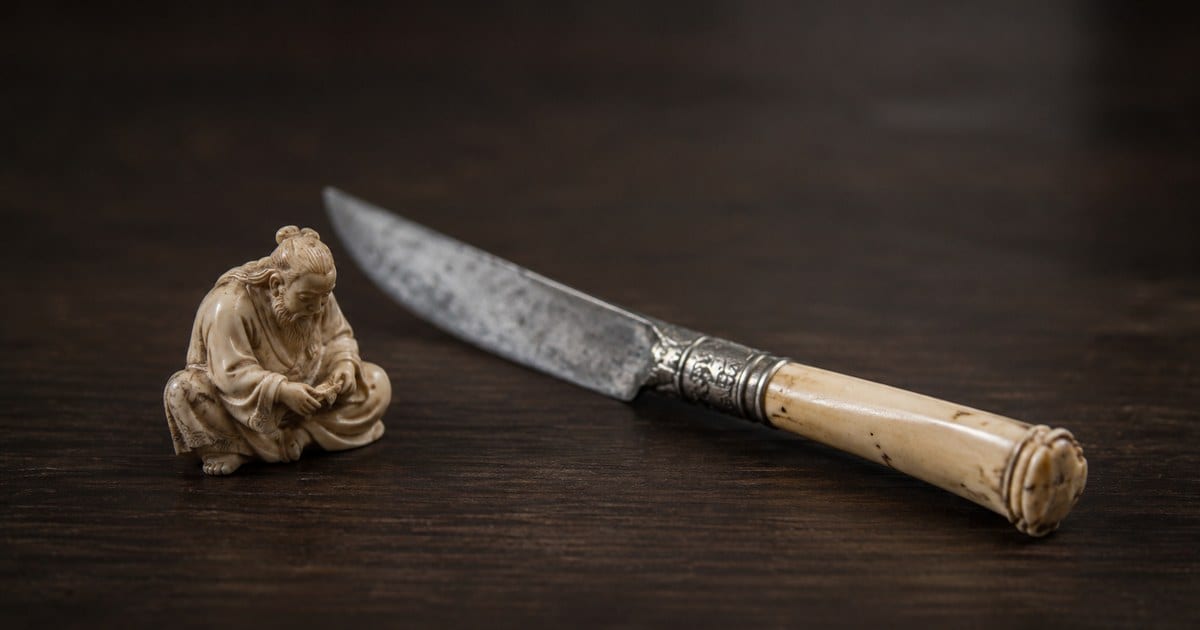
Most guides on how to tell ivory from bone show you two photographs side by side and expect the difference to be obvious. It is obvious once you know what you are looking at, and completely opaque before that, which is why a comparison image on its own rarely helps someone holding an unidentified cream-colored handle. The two materials are close in color, close in weight, and were used for many of the same objects across the same centuries. What separates them is internal structure, and structure is something you can check deliberately rather than squint at.
To tell ivory from bone, check three things. First, a cut or end-grain surface: ivory shows a faint cross-hatch of intersecting curved lines that bone lacks. Second, surface texture: bone shows small dark pits and dashes from its natural canal structure. Third, density: ivory feels heavier for its size and polishes smoother.
Quick identification checklist
- Find an end-grain or cut surface. The base of a handle, the sawn end of a billet, the underside of a knife scale. This is where the strongest evidence lives.
- Look for cross-hatch. Faint intersecting arcs forming a diamond or chevron pattern point to ivory.
- Look for pits and dashes. Small dark specks, short broken lines, and a slightly porous surface point to bone.
- Weigh it in your hand. Ivory generally feels denser and more substantial than a bone piece of the same size.
- Feel the polish. Ivory polishes to a smooth, faintly waxy surface. Bone tends to stay drier and slightly more absorbent looking.
- Rule out plastic first. Both natural materials feel cool on contact and warm slowly. Plastics and resins warm quickly and often show mold seams or repeating cast patterns.
- Check under ultraviolet light if you have it. Both materials fluoresce, but old repairs, fills, and plastic substitutes usually respond differently from the surrounding material, which makes UV useful for spotting composites.
Schreger lines: the cross-hatch that identifies ivory
The single most reliable visual tell for elephant and mammoth ivory is a pattern known as Schreger lines. Ivory grows in layers around a central axis, and where you cut across that growth structure the layers intersect to produce a faint lattice of curved lines, often described as looking like a very fine diamond mesh, engine turning, or a chevron pattern.
Two things matter about finding them. They appear on cross-grain surfaces, not along the length of a piece, so a long polished handle may show nothing until you look at its cut end. And they are subtle. On a well-polished antique the pattern can be a whisper rather than a statement, visible only when you tilt the piece against a raking light so the lines catch. Wetting the surface very slightly with a damp cloth sometimes brings them up, and a phone camera zoomed in on a well-lit end grain usually resolves them better than the naked eye does.
The angle at which those intersecting lines meet is itself used by specialists to distinguish material from different species, with mammoth ivory generally showing tighter angles than elephant ivory. That is a real distinction, but measuring it accurately is specialist work and not something to attempt from a phone photograph. For a home assessment, the useful conclusion stops at “cross-hatch present, therefore likely ivory.”
Haversian structure: what gives bone away
Bone is living tissue that carried blood, and it kept the plumbing. Running through bone is a network of tiny channels, and when a bone object is cut and polished those channels intersect the surface and leave marks.
What you see in practice is small dark pits, tiny broken dashes, and short streaks, usually running roughly parallel along the length of the piece and scattered irregularly rather than in a repeating geometric pattern. On old handles they often read as fine brown or black flecking, because organic residue and centuries of handling darken the channels. Under close inspection the surface has a faintly porous quality that ivory does not share.
This is the check that resolves most real-world cases, because it works on the outside surface rather than requiring an exposed end grain. If you can see scattered dark specks and short dashes across a cream surface, you are very probably holding bone. If the surface is uniformly clean with no pitting at all and you can find cross-hatch on a cut end, you are probably holding ivory.
How to tell ivory from bone by weight, temperature, and feel
Density is a supporting test rather than a decisive one, but it is worth learning because it costs nothing. Ivory is a dense material and generally feels heavier in the hand than a bone object of comparable size and wall thickness. It also takes and holds a smoother polish, with a slightly waxy or soapy quality to a well-worn surface. Bone is more likely to feel dry, a little chalkier, and slightly lighter.
Thermal behavior is genuinely useful, but for a different purpose than most articles suggest. Both ivory and bone feel cool when you first touch them and warm slowly, so the test does not separate them from each other. What it does separate is either natural material from modern plastic imitations, which come up to skin temperature almost immediately. Combined with a look for mold seams and for repeating identical grain patterns across supposedly separate pieces, the warmth check is a fast way to clear synthetic candidates out of the way before you start on the real question.
A hot-point test, touching a heated needle to a hidden spot, is sometimes recommended because plastic melts and smells acrid while natural materials char and smell like burnt hair. It works, and it also leaves permanent damage. Reserve it for pieces of no consequence, use an invisible location, and prefer the non-destructive checks on anything you care about.
Where each material typically shows up
Knowing the usual habitat of each material narrows the odds before you look at anything.
Ivory was the premium material and was used where thickness, fine carving, or a flawless surface mattered. Piano key coverings on older instruments are the most common domestic example, and ivory keytops are usually made in two pieces, a head and a longer tail, with a visible joint line across the key. Japanese netsuke, miniature portrait grounds, fan sticks, cane and umbrella handles, billiard balls, chess pieces, and fine carved figures are all categories where ivory appears.
Bone was the everyday material, plentiful and cheap, and it dominates the utilitarian end. Cutlery handles are overwhelmingly bone, as are most dominoes, dice, gaming counters, brush and mirror backs, corset busks, lace bobbins, and a great many buttons. Bone buttons in particular are common and often show their identity plainly, since the drilled holes and the back face expose the pore structure clearly.
Antler, horn, and various early plastics complicate the picture at the margins. Antler shows a distinctly spongy core, horn is layered and translucent at thin edges, and celluloid and later plastics give themselves away on the warmth and seam checks.
One factual note worth stating plainly: international and national wildlife trade rules restrict the sale, purchase, and shipment of elephant ivory in many jurisdictions, with varying exemptions for antique material and varying documentation requirements. Those rules differ significantly by country and sometimes by state or province. This article is not legal advice. If you intend to sell or ship a piece you believe is ivory, check the current rules that apply where you are and where the buyer is before you list it.
Watch-outs and common mistakes
- Judging by color. Both materials yellow with age and both can be bleached. Color tells you about handling history, not material.
- Looking only along the grain. Schreger lines live on cross-grain surfaces. Not finding them on a polished side proves nothing.
- Assuming a fine carving must be ivory. Skilled work exists in bone, antler, and horn, and fine carving is a skill signal rather than a material one.
- Missing composite objects. Knife handles, boxes, and furniture inlays frequently combine bone, ivory, horn, and wood in one piece, so test each element separately.
- Treating a home check as authentication. These tests stack evidence toward a likely answer. Definitive species identification is laboratory work, and for anything valuable or legally sensitive it is the right call.
Photo tips
- Shoot in soft, even daylight against a plain neutral background so the natural color reads accurately.
- Take one very close, steady frame of any cut or end-grain surface, angled so light rakes across it. This is the frame where cross-hatch becomes visible.
- Take a second close frame of a plain polished side to record surface pitting, flecking, and dash marks.
- Photograph any joint lines, seams, or points where two materials meet, since composites are common.
- Include a scale reference in one frame and note the actual weight, because density is part of the evidence and cannot be photographed.
Common questions
Can you tell ivory from bone without magnification?
Often yes, if the light is right. Bone’s dark pits and dashes are visible to the naked eye on most pieces, especially aged handles. Schreger lines on ivory are subtler and usually need a close look at an end-grain surface under raking light. A phone camera at maximum zoom, held steady with good side lighting, resolves both patterns well enough for a confident working call.
Are old piano keys made of real ivory?
Many older pianos have ivory keytops, though plastic replaced ivory in key covering during the twentieth century, so age alone does not settle it. Ivory keytops are typically two separate pieces per key, a shorter head and a longer tail, with a fine seam visible where they meet. A single continuous keytop with no seam and a uniform surface is more likely plastic.
Does ivory always look better or more valuable than bone?
Not automatically. Value in carved objects tracks the quality of the carving, the maker or school, the age, the subject, and the condition at least as much as the raw material. A superb bone carving beats a mediocre ivory one in most markets. Ivory also carries trade restrictions that reduce how freely it can be sold, which affects its practical marketability regardless of quality.
Related guides
- How to Identify Cameo Jewelry
- Antique Button Identification Guide
- Common Signs of Antique Reproductions and Fake Antiques
- Best Antique Identification App: What to Look For
When to use the Antique Identifier app
Material questions are a natural fit for a photo-based first pass, because the app is comparing your object against a very large body of documented examples rather than against the two pictures in a single article. Shoot the piece overall, add a close raking-light frame of any cut surface and a close frame of a polished side, and the app can suggest whether the object reads as ivory, bone, horn, antler, or an early plastic, along with a likely object type and period. Use that as a direction for the three-point check above, and get laboratory confirmation for anything valuable or legally sensitive.