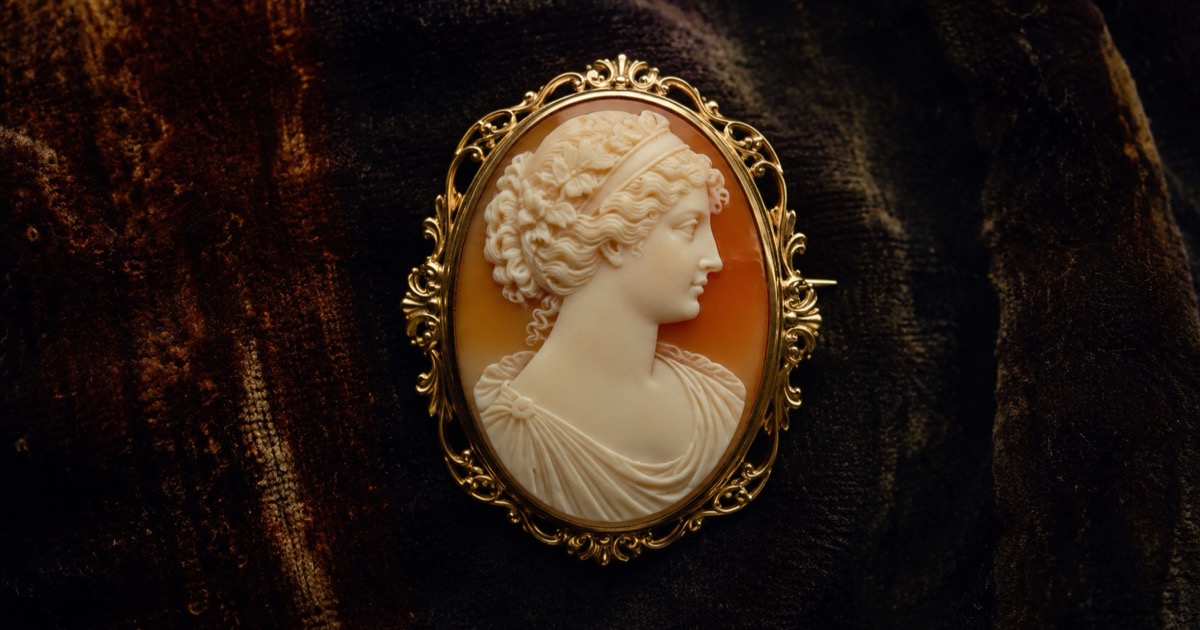
Cameo jewelry identification comes down to one central question before any others: what is the carved element actually made of? The answer determines whether you are looking at a piece of antique craftsmanship, a vintage pressed glass brooch, or a modern resin reproduction — and the answer is usually readable without any special equipment.
Cameo jewelry identification starts with the material of the carved portrait: genuine shell cameos glow with warm, translucent light when held in front of a flashlight and show a gently curved back, while glass and plastic block light and often carry a mold seam. Try the flashlight test first — it separates most carved shell from molded imitations.
Cameos appear in several forms, from classical nineteenth-century shell brooches to hardstone miniatures, Victorian lava carvings, and coral pendants. Each material leaves its own set of physical clues, and a systematic approach to reading those clues is the core skill in cameo jewelry identification.
Quick identification checklist
- Hold the cameo up to a flashlight beam from behind: shell transmits warm light with a slightly curved, translucent glow; glass and plastic do not
- Check the back of the carved element for curvature — shell naturally curves from the helmet shell it was cut from
- Look for a mold seam running along the edge of the portrait or around the oval: this indicates glass or plastic, not carving
- Examine fine details like hair strands and facial features under magnification — carved pieces show undercutting and tool marks; molded pieces have rounded, softened edges
- Read any marks on the metal frame: gold marks (10K, 14K, 18K, or carat stamps with UK hallmarks), silver marks, or base-metal maker’s stamps each tell part of the story
- Examine the clasp style — C-clasps (no safety catch) predate safety clasps, which were widely adopted in the early twentieth century
Material identification: the critical first step
Shell is the most common material for antique cameos, particularly from the Victorian era through the mid-twentieth century. The helmet shell (Cassis rufa and related species) has natural color layers — a darker orange-brown outer layer over a cream or white inner layer — that carvers exploit to create the raised portrait against a contrasting background. When you hold a shell cameo to a direct light source from behind, it transmits light with a warm, slightly amber glow, and you can often see the natural curve of the shell in the back surface. The back is typically unpolished and shows the inner shell texture.
Hardstone cameos — cut from agate, onyx, or sardonyx — are heavier than shell and cold to the touch. They do not transmit light. The color layers come from the banded structure of the stone itself. Sardonyx, with its rust-red and white layers, is the most classic hardstone cameo material. These pieces are generally harder to carve than shell, and quality hardstone cameos tend to be more expensive.
Lava cameos emerged as Italian souvenirs from the mid-nineteenth century. The material is grayish-beige, distinctly matte, and lightweight, with a pale, chalky appearance and fine carved detail.
Coral cameos are carved from red or pink coral, immediately identifiable by color, slightly warm to the touch, and showing a fine grain structure under magnification.
Glass and plastic: what molded pieces look like
Pressed glass cameo elements were produced in large quantities during the late nineteenth and early twentieth centuries as an affordable alternative. Glass cameos are identifiable by their weight (heavier than shell for the same size), their coldness to the touch, and most reliably by the presence of a mold seam — a faint raised line running along the edge of the oval or along the perimeter of the portrait. Glass does not transmit light the way shell does; it reflects it.
Celluloid and later plastic cameos run from the early twentieth century to modern resin reproductions made today to deceive buyers. These are lighter than glass, warmer to the touch than stone, and may show mold seams. Resin portrait details appear too uniform and softened — the fine undercutting of a carved shell piece is absent. A hot needle tip on an inconspicuous edge produces a burning plastic smell on celluloid and resin; shell and stone do not. Use this test only where prepared to leave a small mark.
Close inspection: undercutting and tool marks
On a genuine carved shell cameo of quality, close magnification reveals characteristics that molded pieces cannot replicate. The relief carving shows undercutting — the portrait’s chin, the edge of a drapery fold, or a piece of jewelry depicted in the scene will have a small undercut gap beneath it, making the raised element appear slightly three-dimensional when viewed from the side. Molded pieces cannot reproduce undercutting; everything is flush to the surface.
Tool marks — fine, directional scratches from the carving tools — are visible on the surface of carved pieces under magnification. These marks vary in direction as the carver worked different areas. Molded surfaces are smooth and uniform.
Subject matter and style as rough dating cues
The subject depicted on a cameo is a secondary but useful dating clue. Classical goddesses, mythological scenes, and female profiles in the Greek or Roman style are associated with Victorian and Edwardian production. The profile hairstyle and dress style on the figure often reflects the period of carving.
Habillé cameos — where the depicted figure wears a tiny real diamond, seed pearl, or gemstone set into the scene — are a specific Victorian-era form and generally indicate shell carving rather than molding.
Frame metal and clasp dating
The metal frame provides its own dating evidence. Gold frames stamped with karat marks (10K, 14K, 18K) or British hallmarks place the piece in a specific period and country of manufacture. Sterling silver frames with British hallmarks can be dated precisely using the date letter system. Base metal or rolled gold frames indicate more modest production or later manufacture.
C-clasps (a simple curved wire with no locking mechanism) predate safety clasps, which became standard in the early twentieth century. A C-clasp brooch is generally older, though C-clasps continued on inexpensive work longer than on quality pieces.
Watch-outs and common mistakes
- “Italian cameo” on a paper label does not guarantee carved shell — Italy also produces glass and resin cameos
- A gold-colored frame does not mean gold metal — test the frame separately from the cameo itself
- Modern resin reproductions are sometimes deliberately aged with surface treatments; the undercutting test under magnification is more reliable than surface appearance
- Oval glass or plastic elements set in genuine antique frames are found; the frame age and the cameo material can differ
- Lava cameos are sometimes confused with celluloid; lava is noticeably more absorbent and matte, with a mineral feel
Photo tips that improve identification
- Photograph the cameo from behind against a bright light source to show whether it transmits light (shell) or blocks it (glass, stone, plastic)
- Photograph the edge of the oval element at an angle to reveal any mold seam or to show the natural curve of shell
- Macro photography of the portrait face captures whether fine detail shows undercutting or rounded molded edges
- Photograph the clasp mechanism clearly, including any hallmarks or maker’s stamps on the frame reverse
Common questions
How can you tell if a cameo is real shell or plastic?
Hold it in front of a flashlight: shell transmits a warm, translucent glow while plastic blocks the light. Shell also has a naturally curved back from the helmet shell it was cut from, and under magnification a carved piece shows undercutting and directional tool marks. Plastic and resin pieces tend to show mold seams along the edge and uniform, softened detail.
What does a C-clasp on a cameo brooch mean?
A C-clasp is a simple curved wire catch with no locking mechanism, and it predates the safety clasps that became standard in the early twentieth century. A C-clasp generally points to an older brooch, though inexpensive work kept using C-clasps after better pieces had switched. Treat the clasp as one dating clue alongside the frame metal, marks, and the cameo material itself.
Are antique cameo brooches valuable?
Value varies widely with material, carving quality, and the frame. Hardstone cameos and finely carved shell pieces in gold frames sit at the upper end, while molded glass and plastic cameos in base-metal frames are common and modestly priced. Habillé cameos, where the figure wears a tiny set gemstone or pearl, draw extra collector interest, and condition and frame hallmarks affect any piece’s price.
Related guides
- How to Identify Antique Jewelry Markings
- Costume Jewelry Marks Identification: Trifari, Coro, and More
- How to Identify Bakelite: Simple Tests That Work
When to use the Antique Identifier app
Photograph the cameo face-on, then the reverse showing the back of the carved element and the frame hallmarks or stamps. A through-light shot showing translucency helps the app narrow the material type. The app can match the portrait style, frame design, and clasp configuration to known period pieces quickly. For cameos where a hardstone or high-karat gold attribution might affect value significantly, follow up with a specialist jeweler or gemological examination.