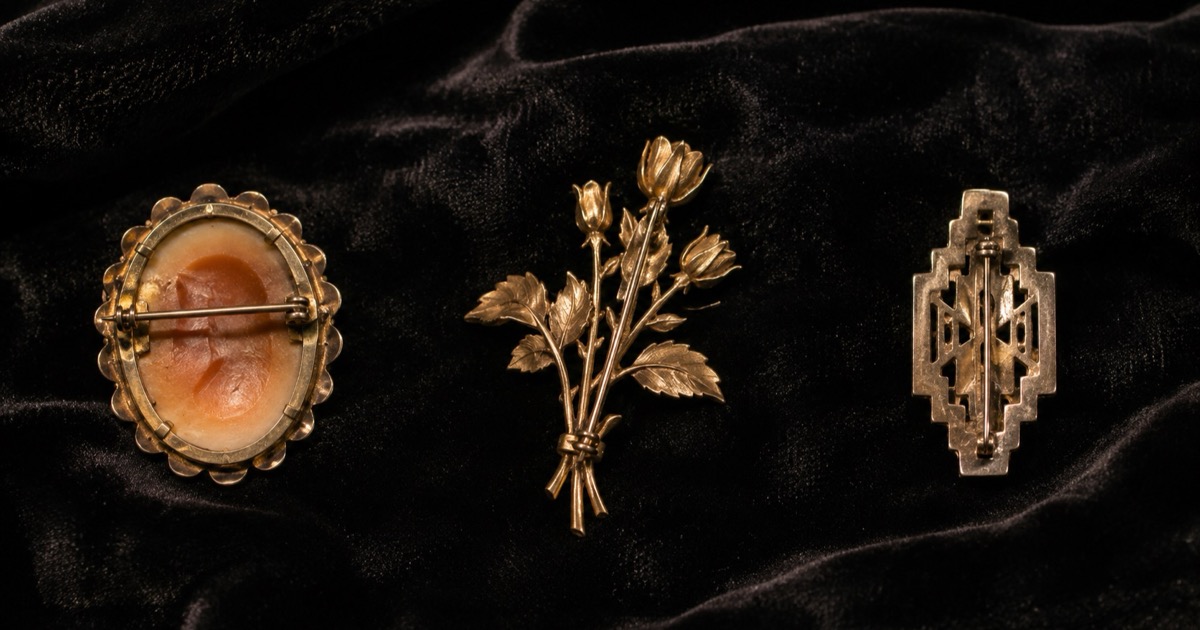
One of the most reliable ways to date a brooch is to flip it over, because the clasp mechanism on the back reflects the manufacturing standards and safety expectations of the era in which it was made. How to date a brooch by its clasp is genuinely learnable in an afternoon — the types are few, the progression makes sense, and once you can place a clasp type in its general era, you have a solid anchor to combine with materials and design.
To date a brooch, flip it over and identify the clasp: an open C-shaped catch with a long pin stem extending past the body points to Victorian or earlier work, while a hinged safety catch or rollover lock signals the 20th century. Check first that the clasp’s solder and patina match the back, since findings are often replaced.
By the end of this guide you will recognize the main clasp types from Victorian examples through to modern production, understand what each type suggests about age, know the trap of replaced findings, and understand how to weigh clasp evidence against the other signals a brooch provides.
Quick identification checklist
- Flip the brooch and look at the full pin stem: does it extend noticeably past the edge of the brooch body, or does it stay within the frame?
- Check the catch: is it a simple open C-shape, a tube catch with a hinged trombone-style barrel, an early safety catch with a simple hook, or a modern rollover/locking mechanism?
- Look at the hinge where the pin stem meets the body: is it a simple wrapped wire hinge, a tube hinge with a rolled metal cylinder, or a more mechanically refined construction?
- Check whether the pin tip has a safety guard or cap — this is a later feature.
- Examine the metal at the clasp components: does it match the rest of the piece in color, patina, and apparent age, or does it look newer and brighter?
- Assess whether solder marks or slight discoloration at the finding attachment points suggest the clasp has been replaced.
The C-clasp: the Victorian anchor
The simplest clasp type is a plain C-shaped catch — a small piece of metal bent into a C, soldered to the back of the brooch, into which the pin tip simply hooks. There is no mechanism to secure the pin: the tip rests in the C by tension, and the brooch relies on the pin’s stiffness and a reasonably snug fit to stay closed.
This open C-clasp is strongly associated with Victorian and early Edwardian brooches. Its simplicity made it cheap and easy to produce, and in an era when women’s dress fabrics were heavier and the pin typically passed through multiple layers of fabric, the basic catch was often adequate. The C-clasp is the single most useful dating signal a beginning jewelry collector can learn: see a C-catch and you have good grounds to place the piece in the Victorian to early 20th-century range, subject to the other evidence on the piece. C-clasps were also used on earlier pieces predating the Victorian era, but the 19th century is their peak.
The long pin stem is the companion tell to the C-clasp. Victorian brooches typically have a pin that extends noticeably beyond the outer edge of the brooch body — sometimes by a substantial margin. This extension gave the pin enough travel to pass through thick fabric and still engage the catch. When you see a long, over-running pin stem, you are almost certainly looking at a Victorian piece or a reproduction built to that style.
Tube hinges and trombone clasps
The next step in finding evolution is the tube hinge. Instead of the pin being simply bent and wrapped around a wire to form its pivot, a tube hinge is a rolled metal cylinder through which the pin’s pivot bar passes, creating a neater and more secure hinge joint. Tube hinges became common through the late 19th and early 20th centuries and are associated with better quality construction.
The trombone clasp — also called a torpedo clasp or barrel clasp — is a distinctively European mechanism that found favor in French and broader continental European jewelry through much of the late 19th and early 20th centuries. It consists of a cylindrical barrel into which a spring-loaded inner cylinder slides and locks. To open it, you pull the inner tube out slightly (like the slide of a trombone, which gives the mechanism its name) and then the pin tip can be inserted or released. When closed, the tip is captured inside the barrel.
Trombone clasps offer a significant improvement in security over the C-clasp — the pin tip is enclosed — and they are a useful signal of continental European manufacture or origin. A brooch with a trombone clasp is consistent with French, Belgian, or other European provenance from the late 19th through mid-20th century, though the mechanism was used more broadly.
Early safety catches and their evolution
The move toward safety in pin-back jewelry accelerated in the early 20th century. Early safety catches introduced a simple hinged hood or hook that flipped over the pin tip after it entered the catch, preventing the tip from jumping out accidentally. These early safety mechanisms are recognizable by their relative simplicity: a small hinged piece that must be manually pushed aside to release the pin.
Through the 20th century, safety catches became more mechanically refined. Rollover catches — where a rotating barrel element locks the pin tip — became the standard industrial solution by the mid-20th century. Modern rollover catches are highly secure, easy to operate, and extremely common on 20th-century and contemporary costume and fine jewelry alike. Their presence on a brooch does not exclude an attractive design or quality materials, but it does place the piece firmly in the post-Victorian era at minimum.
The progression, in summary: C-clasp is old; simple early safety catch is early 20th century; sophisticated rollover lock is mid-20th century and later. This is a general ladder, not an absolute rule — some later makers reproduced older clasp styles, and some early commercial jewelry used simplified findings.
The trap of replaced findings
Here is the most important caveat in brooch dating: clasps can and do get replaced. A Victorian brooch with a broken C-clasp may have been repaired at any point in its life with a more modern finding, giving it a newer-looking clasp on an old body. Conversely, an unscrupulous seller can add an old-looking finding to a later piece to imply greater age.
The way to detect this is to look at how the clasp attaches to the back of the brooch. Period findings were soldered on in period, and the solder and any oxidation or patina at the junction should match the rest of the back. A replaced finding often shows brighter, cleaner solder, a color difference between the finding’s metal and the brooch body, or a slight misalignment where the new finding was positioned over the old attachment point. Sometimes you can see ghost marks or faint outlines of the previous finding’s footprint.
This means a clasp dates the clasp, not necessarily the brooch. When the clasp has been replaced, you lose that dating evidence and must rely more heavily on the design, materials, and front-face evidence for the piece’s age.
Combining clasp evidence with materials and style
No single feature dates a brooch on its own. The clasp type gives you one strong bracket; the materials and construction give you another. A C-clasp combined with a gold-filled or yellow gold body, rose-cut diamonds or paste stones, and a naturalistic floral or mourning motif in the design — all of these pointing the same direction — builds a convincing Victorian case. A rollover catch on a piece with rhodium-plated silver-tone base metal and bold geometric Art Deco styling narrows clearly to the 20th century.
The back of a brooch is often more informative than the front: in addition to the clasp, it may show maker’s marks, hallmarks, patent dates, or country-of-origin stamps that directly date or locate the piece. Hallmarks on gold or silver provide concrete evidence; patent dates (more common on American costume jewelry) establish a definite earliest possible production date.
Reproductions and neo-Victorian jewelry made in later decades sometimes deliberately use C-clasps and long pin stems to evoke the period look. When the metal shows no patina, the stones are too bright, and the construction feels light for its apparent style, the clasp may be mimicking age rather than documenting it.
Watch-outs and common mistakes
- Reading the clasp type as the brooch’s date rather than as one piece of evidence — a replaced clasp is common and disrupts this logic entirely.
- Assuming a C-clasp alone proves Victorian origin without checking whether the design, materials, and construction are consistent.
- Missing the solder or color difference that signals a replaced finding.
- Overlooking the pin stem length as a separate indicator — a long over-running stem reinforces a C-clasp reading, while a trim stem raises questions even on a C-catch.
- Ignoring hallmarks or maker’s marks elsewhere on the back, which can directly resolve the question the clasp only approximates.
Photo tips that improve identification
- Photograph the full back of the brooch in even, diffuse light to show the clasp, hinge, and any marks or stamps clearly in a single frame.
- Shoot a close-up of the clasp mechanism itself, showing the catch type and how the pin tip engages it.
- Photograph the hinge end of the pin, since tube hinge vs. wrapped wire construction is most visible there.
- Capture any solder joints at the finding attachment points with a macro shot in raking light to show whether they match the surrounding metal in color and oxidation.
Common questions
Does a C-clasp always mean a brooch is Victorian?
No. The open C-catch was standard through the Victorian era, but it stayed in use on inexpensive and handmade jewelry well into the 20th century, and some modern reproductions use it deliberately. Treat a C-clasp as evidence pointing earlier, then confirm with the pin stem length, hinge construction, materials, and design style before settling on a date.
How can you tell if a brooch clasp has been replaced?
Look at the attachment points under good light. Fresh or differently colored solder, a catch or hinge that is brighter than the surrounding metal, and patina that stops abruptly around the finding all suggest a later repair. A replaced clasp dates the repair, not the brooch, so shift your dating weight to the hinge remnants, materials, and style.
What does a long pin stem sticking out past the brooch mean?
A pin stem that extends well beyond the edge of the brooch body is a classic Victorian-era tell. Long stems let the pin take a second pass through clothing or anchor in heavy fabrics for security before locking catches existed. Later brooches with secure safety catches keep the pin neatly within the frame.
Related guides
- How to Identify Cameo Jewelry
- How to Identify Antique Jewelry Markings
- Costume Jewelry Marks Identification: Trifari, Coro, and More
When to use the Antique Identifier app
Photograph the full front of the brooch alongside a clear shot of the full back showing the clasp and any marks. The app can help match the clasp type, design style, and any visible hallmarks or maker’s stamps to production eras and likely origins quickly. When the result suggests a high-value attribution — signed fine jewelry, a known maker’s piece, or a significant antique — treat that as a starting point for verification with a jewelry specialist or appraiser, not a final answer.