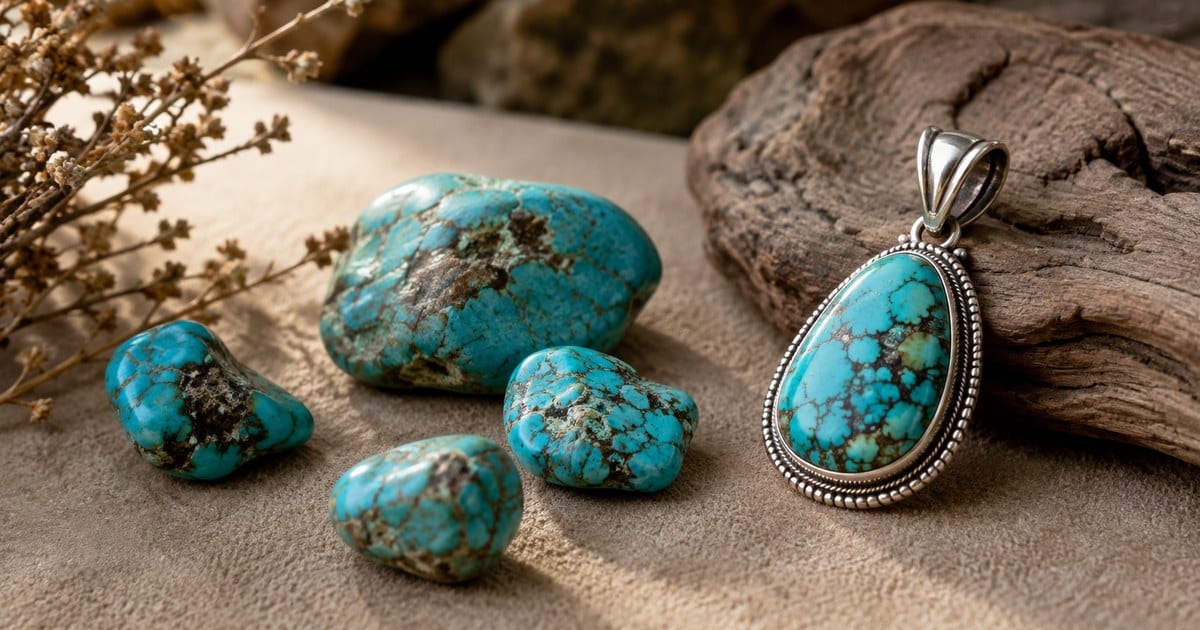
Most advice on how to identify real turquoise stops at one sentence: look at the matrix. That is a reasonable starting point and it is nowhere near enough, because the fakes that actually turn up at estate sales and thrift stores are not crude plastic beads. They are dyed howlite and dyed magnesite, two white stones with natural dark veining that mimic turquoise matrix convincingly once they take up blue dye. To sort those out you need a couple of simple physical checks alongside the visual read, and you need to understand that “real” turquoise itself comes in several grades of treatment, most of which are legitimate.
Real turquoise is a natural mineral that shows uneven color, a matrix of host rock that runs through the stone rather than sitting on the surface, and consistent color inside drill holes and chips. Dyed howlite and magnesite fakes give up color to an acetone swab, are noticeably softer, and often show pale material beneath a thin colored skin.
Quick identification checklist
- Look for uneven color. Natural turquoise varies in tone across a single stone and across a strand. Perfectly matched, uniformly bright beads are the first warning sign.
- Read the matrix in three dimensions. Genuine matrix is host rock embedded in the stone. It continues through chips and edges. Painted or printed veining stops at the surface.
- Look inside the drill hole. On a bead, a pale or white core under a colored skin means dyed material.
- Swab a hidden spot with acetone. Color transferring onto the cotton indicates dye.
- Test hardness discreetly. Howlite and magnesite are much softer than turquoise and mark easily.
- Weigh it in your hand. Plastic and resin imitations feel light and warm up fast against skin. Stone feels cool and dense.
- Check the price and the quantity. A large strand of uniform bright blue beads at a low price is very unlikely to be natural stone.
The four categories you are actually choosing between
Before testing anything, get the vocabulary straight, because “fake” covers several very different situations and they do not carry the same implications.
Natural turquoise is untreated stone, cut and polished and nothing else. It is the minority of what is sold, because turquoise as it comes out of the ground is often porous and soft enough that it would not survive being worn.
Stabilized turquoise is natural turquoise impregnated with a clear resin to harden it and keep it from absorbing oils and changing color. This is real turquoise. A large share of the American Southwest jewelry trade uses stabilized stone, and reputable sellers say so. Stabilization is a durability treatment, not a deception, though it does affect value relative to comparable natural material.
Reconstituted turquoise is crushed genuine turquoise mixed with a binder and pressed into blocks, then cut. There is turquoise in it, but it is a manufactured material rather than a stone, and it should be priced and described accordingly.
Imitations contain no turquoise at all. This is where dyed howlite, dyed magnesite, dyed chalk, and plastic “block turquoise” live. These are the ones the tests below are built to catch, and they are far and away the most common thing mislabeled as turquoise in the secondhand market.
How to identify real turquoise by its matrix
Matrix is the host rock the turquoise formed within, and it is the single most informative visual feature on the stone. In natural material the matrix is part of the stone’s structure. It runs into the body of the piece, not across its face. If a bead has a chip or an unpolished back, the veining should continue into the break at the same angle it shows on the surface. Matrix also polishes differently from the turquoise around it, because it is a different material with a different hardness, so under angled light you often see a very slight difference in surface level or sheen where a vein crosses the stone.
Matrix pattern varies by source. Some material shows a fine web of dark brown or black lines, sometimes called spiderweb, where the veining forms enclosed cells. Some shows broad irregular blotches. Some shows golden-brown veining rather than black. What matters is that the pattern is irregular, that vein widths change along their length, and that the veins branch and terminate the way cracks in rock actually do.
Faked matrix fails on exactly those points. Painted or printed veining sits on the surface, has an even width, often repeats across multiple beads in a strand, and terminates abruptly at a drilled hole rather than continuing through. On dyed howlite the veining is genuinely part of the stone, which is what makes it the harder fake, but the dye is not, and that is where the chemical check earns its place.
One important caution runs the other way. Some genuine turquoise has almost no matrix at all. Clean, near-uniform blue material with little to no veining exists in nature and is prized. So “no matrix” is not evidence of a fake, and “beautiful matrix” is not evidence of authenticity. Matrix is one input among several.
The acetone swab test for dye
This is the check most posts leave out and the one that resolves the common cases fastest.
Put a small amount of acetone or acetone-based nail polish remover on a white cotton swab. Choose the least visible spot you can reach: the back of a cabochon, the drilled end of a bead, the underside of a stone where it meets the bezel. Rub gently for a few seconds and look at the swab.
Blue or green color on the cotton means dye is coming off, which points to dyed howlite, dyed magnesite, dyed chalk, or dyed low-grade material. Natural and properly stabilized turquoise does not surrender color this way. Be aware of two limits. First, some pieces have been surface-waxed or oiled, and a swab may pick up a faint haze of that without any color. Judge on color transfer, not on the swab simply looking dirty. Second, acetone can dull a resin finish or attack an adhesive, so keep it away from glued settings, strung knots, and anything with a coating you care about, and always test somewhere hidden.
The drill hole check pairs naturally with this. Hold a bead up to a bright light and look into the hole. Dyed material frequently shows a pale, chalky, white or grey core with a thin band of color at the surface, because the dye penetrates only so far. Natural turquoise is colored throughout its body, so the interior of the hole reads the same as the exterior.
A discreet hardness check is the third leg. Turquoise sits in the middle of the hardness scale, hard enough to resist a steel point with real pressure. Howlite and magnesite are considerably softer and will take a mark from a steel pin or a knife tip with light pressure. Do this on a hidden surface only, accept that it is a mildly destructive test, and skip it entirely on anything set, signed, or valuable. If a stone marks like chalk, you have learned something decisive.
Why too-perfect color is a red flag
Color is where most buyers get led astray, because the fakes are engineered to look like what people expect turquoise to look like.
Natural turquoise runs across a wide range of blues and greens, and a single stone commonly shifts tone across its face. Copper content pushes it blue, iron pushes it green, and neither is a defect. The stone also darkens or greens with age and wear as it absorbs oils, which is why old jewelry often shows stones that are deeper and warmer than they started.
Dyed material is uniform by definition, because the dye bath does not know how to vary. An entire strand of beads in exactly the same electric blue, with the same saturation edge to edge, is the pattern to distrust. So is a blue that reads as slightly too vivid, almost plastic, especially in daylight. Plastic imitations go further and show the tells of molded material: air bubbles suspended below the surface, a seam line, identical matrix veining repeating bead to bead, and a warmth against the skin that stone does not have.
Weight is a useful cross-check on the plastic end. Pick up a strand and feel the mass. Genuine stone has a heft that resin does not, and it stays cool for a moment when you first touch it.
Stacking the evidence rather than proving a case
No single one of these checks settles the question, and you should be suspicious of any source that says otherwise. What they do is accumulate. Uneven color, matrix that continues into chips and edges, an evenly colored drill hole, no dye transfer on the swab, real hardness, and appropriate weight are six independent signals. When five or six agree, you have a confident working read. When three point one way and three the other, the honest answer is that you do not know yet.
For anything expensive, signed, or being resold as natural, the next step is a gemological laboratory, which can distinguish natural from stabilized and identify imitations with instruments rather than inference. Home tests are for sorting a table of estate-sale jewelry quickly and for avoiding obvious mistakes. They are not certification and they should never be described to a buyer as if they were.
Watch-outs and common mistakes
- Treating stabilized turquoise as fake. It is real turquoise with a durability treatment and it makes up much of the market. Describe it accurately rather than dismissing it.
- Assuming green means fake. Iron-rich natural turquoise is green. Some highly regarded material is distinctly green rather than blue.
- Running the acetone test in a visible place. Do it on the back or inside a drill hole. On a coated or glued piece, skip it.
- Reading a silver mark as proof of the stone. A genuine sterling setting with a maker’s mark tells you about the metal and the maker, not about what is set in it. Old sterling settings hold dyed stones regularly, sometimes as later repairs.
- Believing “no matrix” means imitation. Clean, low-matrix natural turquoise exists and is valued.
- Confusing a source name with a grade. Mine and locality names describe where material came from, not whether the specific stone in front of you is treated.
- Cleaning turquoise with solvents or ultrasonics as a habit. The stone is porous and treatments are vulnerable. Testing a hidden spot is one thing, routine cleaning is another.
Photo tips
- Shoot the stone in soft, indirect daylight rather than under warm indoor bulbs, which shift blue and green badly and make color assessment unreliable.
- Take one straight-on shot of the whole piece and one macro of a single stone filling the frame, so both the overall color range and the matrix detail are recorded.
- Photograph the drill hole of a bead against a bright background so any pale core shows.
- Capture the back and any chipped or unpolished edge, since that is where matrix continuity and interior color are visible.
- Add a raking-light shot across the surface so you can see whether matrix veins sit slightly proud of or below the polished turquoise.
- Include the setting, any hallmark, and the clasp in separate frames, because the metal evidence dates the piece even when the stone remains open.
Common questions
Does real turquoise always have matrix?
No. Some natural turquoise has very little visible matrix and reads as clean, even blue, and that material is generally well regarded. Matrix is useful evidence when it is present, because natural veining runs into the stone and continues through chips, but its absence proves nothing on its own. Judge color variation, drill-hole color, hardness, and dye transfer alongside it.
What is the difference between dyed howlite and real turquoise?
Howlite is a naturally white mineral with dark grey or black veining that takes blue dye readily, which makes it the most convincing common imitation. It is significantly softer than turquoise, so it marks easily with a steel point, and its color is a surface treatment rather than a property of the stone, so an acetone swab will usually lift color and a drill hole will often show a white core.
Is stabilized turquoise still real turquoise?
Yes. Stabilized turquoise is genuine stone impregnated with clear resin so it can be cut, polished, and worn without absorbing oils or crumbling. The great majority of turquoise in circulating jewelry is stabilized. It is worth less than comparable untreated natural material and it should be disclosed when selling, but it is not an imitation and it is not a fake.
Related guides
- How to Identify Real Jade (and Spot Dyed or Fake Jade)
- How to Identify Antique Jewelry Markings
- Costume Jewelry Marks Identification: Trifari, Coro, and More
- Sterling Silver Hallmarks: What the Marks Mean
When to use the Antique Identifier app
Turquoise jewelry is a category where the fast question at a booth is usually not chemistry but context: what style of piece is this, what tradition does the setting belong to, and is it worth spending five minutes on. Photograph the front of the piece in daylight, one stone close up, and the back with any hallmark visible, and the app can suggest what kind of piece you are holding and what era and style it resembles. That narrowing is the slow part when you are sorting a tray of mixed jewelry. Treat the result as a lead, then run the physical checks on the stone and read the metal marks yourself before you commit to a description or a price.