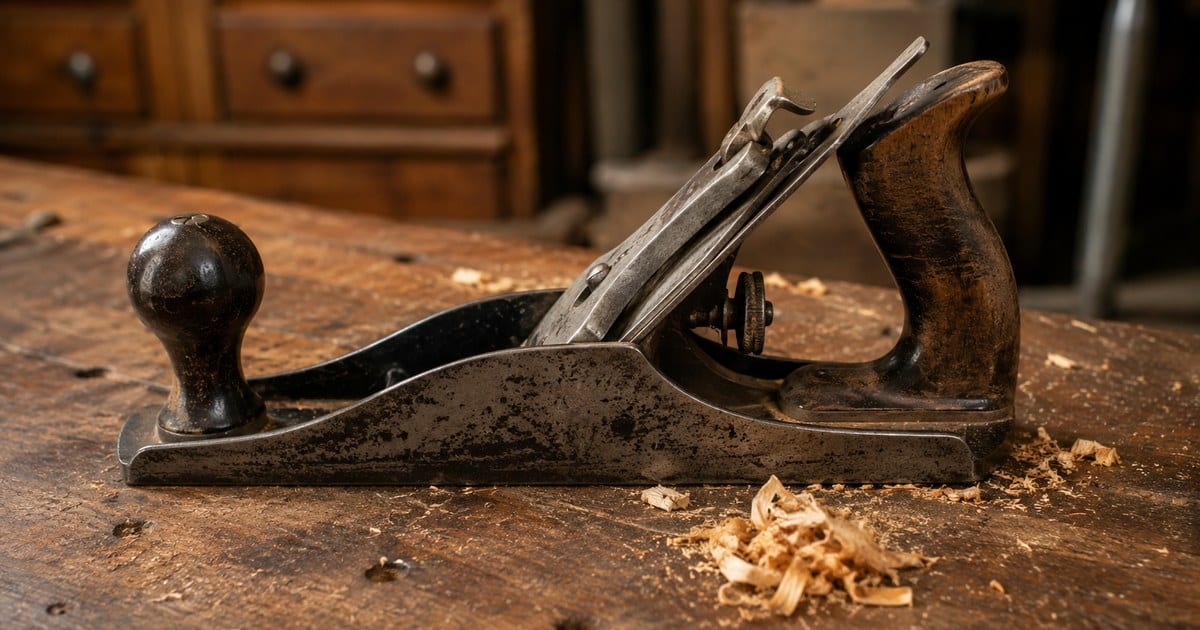
Old tools break the usual antiques logic in a way that catches sellers out. In most categories the buyer is a collector who wants an object to look at. In tools, a large share of the buyers are woodworkers and mechanics who intend to use the thing, which means working condition, completeness, and the presence of the parts that actually cut or grip matter enormously, while decorative appeal matters much less. That inversion is why a rusty crate from a garage can contain one item people compete for and thirty that nobody wants, and why the vintage tools worth money are rarely the ones that look oldest.
Vintage tools worth money are identified in three steps, not by age or rust: establish the maker and exact model from the castings and stampings, date it from small design features rather than from patent dates, then check completed sold listings for the same model in comparable condition. Completeness and usability drive price far more than apparent age.
Quick identification checklist
- Find every marking on the tool and write each one down verbatim. Makers stamped names, logos, model numbers, and patent dates in several places, and each is a different kind of evidence.
- Check the cutting or working part first. A plane iron, a chisel edge, a saw plate, or a wrench jaw that is worn out, reground badly, or missing sets a ceiling on value regardless of the maker.
- Confirm completeness. Missing knobs, totes, caps, adjusters, fences, cutters, or original wedges are the most common reason a tool sells cheap.
- Separate the model number from the date. A number cast into a tool is nearly always a size or model designation.
- Compare the logo form against documented sequences. Trademark logos were redrawn periodically, and that is one of the more reliable dating handles available.
- Judge rust honestly. Light surface rust is normal and expected. Deep pitting on a working surface is damage.
- Then check sold listings, filtered to sold only. Identification first, valuation second.
Step one: identify what it actually is
Start by naming the tool type precisely, because tool categories have vocabulary that search engines respond to and that beginners rarely use. A bench plane, a block plane, a molding plane, and a combination plane are four different things with four different markets. The same is true of hand saws versus back saws, or braces versus eggbeater drills.
Then find the marks. On cast-iron tools, look on the bed or body for raised lettering and cast numbers, on any removable cap for a stamped or cast logo, and on the blade or iron itself for a trademark. On wooden-bodied tools, look at the toe for a maker’s stamp struck into the end grain. On saws, look at the medallion in the handle and at the etched design on the blade near the heel. On wrenches and mechanical tools, look along the shank and on the flats.
Photograph and transcribe all of it before you form an opinion. Tool identification is cumulative, and the mark on the blade often names a different party from the mark on the body, because irons and blades were replaced routinely during a tool’s working life.
Step two: date it, and avoid the two classic traps
Two mistakes account for most bad dating in this category.
Patent dates are not manufacturing dates. Many cast-iron tools carry one or more patent dates raised into the body. Those dates tell you the earliest the design could have been produced, and nothing more. Manufacturers kept using the same castings for years, sometimes decades, after the patent was granted, so a tool showing an 1890s patent date can easily have been made well into the twentieth century. What is useful is the combination and count of the dates present, because manufacturers added and removed them over time, and that pattern is part of how documented dating studies work.
The cast number is a model or size number, not a date. A large number on the bed of a plane or the body of a wrench designates the size and model within the maker’s catalog. It is not a year, not a production count, and not a rarity code. Reading it as a date sends people looking for tools that never existed.
What actually dates a tool is the accumulation of small design features. Serious collectors use published type studies that track exactly this: how the adjustment mechanisms changed, whether a lateral adjustment lever is present and what shape it takes, how the frog or seat was machined, what the knob and handle profiles look like, what the fastener hardware is, and which form of the maker’s trademark appears on the blade and the cap. Any one feature is weak. Six of them together give a tight range, and that range is exactly what determines whether you have a common later example or an early one.
Step three: check sold listings, not asking prices
Tool listings are notorious for optimistic pricing, so the discipline here matters more than in most categories.
Filter to completed and sold results only, then match on four things: the same maker, the same model number, the same period as indicated by the design features, and comparable condition. Condition matching is not optional in this category. A complete, clean, usable example and a pitted, incomplete one of the identical model sit in different markets, because the first is bought by a woodworker and the second by someone hunting parts.
Read the middle of the distribution rather than the top sale. High outliers in tools usually reflect something specific and stated only in the photographs: an unusually early variant, an intact original decal or etch, original packaging, or a scarce size within an otherwise common line. Six to ten sold results give you a market. One gives you an anecdote.
Two worked examples
A bench plane pulled out of a grandfather’s toolbox. It is heavy, iron-bodied, has a wooden knob and rear handle, and reads Stanley on the blade, so the first instinct is to look up “Stanley plane value” and get a number. That number will be meaningless, because Stanley made bench planes across a very long period in many sizes and in more than one line, and those variables move the result enormously. Work through the tool instead. Read the cast number on the bed, which is the size. Then check how the frog seats: a Bedrock’s frog mates to a flat, machined area on the base casting rather than the arched ribs a Bailey uses, and on later Bedrocks that also shows up on the outside as flat, squared sides instead of the Bailey’s rounded ones - though early Bedrocks made before about 1911 still have rounded sides like a Bailey, so the frog seating is the discriminator that holds across the whole line. Bedrocks consistently draw a premium over the equivalent Bailey size in comparable condition. Then run the type-study features: the presence and shape of the lateral adjustment lever, how many patent dates are cast into the bed, the profile of the knob, and the exact form of the trademark stamped on the iron and on the lever cap. That combination brackets the production period. Finally check the working parts, because a plane with a badly reground or heavily used iron, a cracked tote, or a replacement cap has lost most of its premium no matter how early the body is. The value question only becomes answerable after all of that.
A hand saw off a garage wall. Saws look interchangeable to a beginner and are not. The dating handles are the medallion, the screw fastening the handle to the plate, and the etched design on the blade near the heel. Medallion wording on the major American makers changed across documented eras, and the medallion is generally the first thing collectors read. The etch is the second, and it is fragile: it sits shallow on the steel and disappears under rust, cleaning, and use, so a saw with a strong surviving etch is meaningfully more identifiable and more desirable than the same saw with a blank plate. Handle carving is the third handle, since earlier handles are typically more elaborately shaped than later production. Then check the plate itself, because a saw with a kinked, rusted, or badly filed plate has a limited market. The honest outcome for most garage saws is that they are common mid-century user tools in a crowded market. That is worth knowing quickly, so you can spend your research time on the one saw in the pile that has an early medallion and a legible etch.
In both cases the price question came last, after the tool had a maker, a model, a period, and an honest condition assessment.
What separates vintage tools worth money from a common one
Scarcity within the maker’s range, not across the category. Most sizes in most lines were produced in enormous numbers. Value concentrates in the sizes that sold poorly, the short-lived variants, and the specialty tools that few tradespeople bought.
Completeness. Combination planes with all their cutters and fences, braces with working jaws, and sets with their original box sit in a different bracket entirely from partial examples. Missing parts are the most common value killer in tools.
Usability. Because many buyers are users, a tool that can be put to work after a cleanup outperforms an identical tool that cannot. Straight soles, flat plates, sound handles, and intact threads all matter.
Original surface and markings. Surviving decals, etches, japanning, and clear trademark stamps raise a tool’s standing. Aggressive wire-wheeling and repainting remove exactly those features and are widely disliked by buyers.
Early production within a line. Where a documented type study exists, the earliest types generally draw more interest than the later ones, which is why the small feature checks are worth the effort.
Maker reputation and user demand right now. Working woodworkers drive a large share of this market, and the tools they actually use hold value more steadily than purely decorative pieces.
Watch-outs and common mistakes
- Cleaning aggressively before valuing. Wire wheels, sandblasting, and repainting destroy decals, etches, and japanning, and the damage is obvious and permanent.
- Reading a patent date as an age. It is an earliest-possible date, not a manufacturing year.
- Treating a cast number as a date code. It is a model and size designation.
- Assuming rust means old and clean means new. Rust records storage conditions. Some genuinely early tools survived indoors in fine condition, and plenty of recent tools rusted in a damp shed.
- Selling a set in pieces. Combination planes, socket sets, and boxed sets typically outperform the sum of the parts when complete.
- Ignoring replaced parts. Blades, handles, and caps were swapped constantly in working life, and a mismatched assembly should be described as such.
- Pricing from active listings. Asking prices in tools run far above sold prices, and the gap is wider here than in most categories.
Photo tips
- Photograph every marking close up with light raking across it from a low angle. Cast lettering, stamped trademarks, and medallion wording only become legible when the relief casts a shadow.
- Shoot the full tool square-on against a plain background, since profile and proportion carry real identification weight.
- Take a separate photograph of the working edge or surface. Iron condition, plate straightness, and jaw wear decide the condition grade.
- Angle a photograph along the sole or plate to show flatness, which buyers ask about constantly.
- Document every flaw individually. Cracks in handles, pitting, chips, and replaced hardware each deserve their own frame.
- Include a scale reference or the measured length in one shot. Size is part of the model designation in most tool lines.
Common questions
How do I know if my old tools are valuable or just old?
Identify the maker and exact model from the castings and stampings, place it in a period using small design features rather than patent dates, assess completeness and working condition honestly, then pull six to ten completed sold listings for the same model in similar condition. Value concentrates in scarce sizes, complete sets, early production variants, and tools that can still be used.
Should I clean rust off a vintage tool before selling it?
Light surface cleaning that leaves the original finish intact is generally accepted. Anything more is risky. Wire wheels, abrasive blasting, and repainting remove decals, blade etches, and factory japanning, and buyers price a stripped tool below an honest rusty one. If in doubt, photograph the tool as found and let the buyer decide how far to take it.
Does a patent date tell me when my tool was made?
No. A patent date establishes the earliest the design could have been produced. Manufacturers reused the same castings for many years afterward, so a tool can be decades younger than the date it carries. Dating in this category comes from the combination of design features, hardware, and trademark logo form, which published type studies track feature by feature.
Related guides
- How to Identify Antique Hand Tools
- Antique Pocket Knife Identification
- Where to Sell Antiques: Best Options Compared
- What Makes an Antique Valuable?
When to use the Antique Identifier app
A box of old tools is exactly the triage problem a photo-based first pass handles well. Shoot each tool square-on plus its markings in raking light, and let the app suggest the tool type, likely maker, and rough period for each one. That tells you which two items justify an hour with a type study and which twenty are common users. Treat the suggestion as a starting hypothesis, then confirm the promising ones against documented feature studies and completed sales before you list anything.