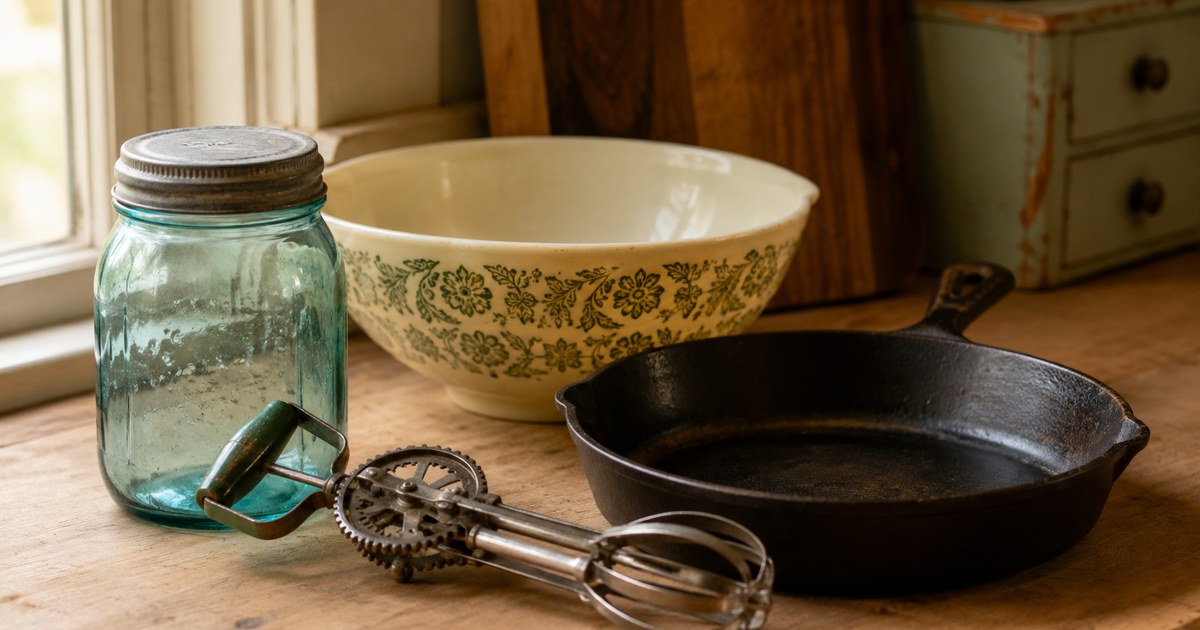
Search for vintage kitchen items worth money and you get the same list eight or nine times over: patterned Pyrex, cast iron, colored mason jars, enameled ware, a few retro appliances. The list is not wrong. It is just answering a question you have already answered for yourself, because you are standing in a kitchen holding something and what you actually want to know is whether the specific object in your hand is one of the good ones and how old it is. That second question is the one the listicles never take on, and it is the only one that changes what you do next.
Vintage kitchen items worth money are identified in three steps, not by brand name alone: establish what the object is and who made it, date it from logo form rather than from any date molded into it, then check completed sold listings in comparable condition. Rarity and condition drive price far more than category.
Quick identification checklist
- Find the mark before anything else. Turn the piece over and look for a maker name, a logo, a molded number, a pattern name, or an impressed set of letters. Good light and a close look beat guessing from the shape.
- Separate the mark from the date. A number or year on an object is very often a patent, a mold code, or a brand founding date, not the year of manufacture.
- Date from logo form, not from printed years. Ball, for example, changed its logo fairly frequently until about 1962, and logo form is the standard dating handle for its jars.
- Judge condition honestly and specifically. Chips, crazing, rust pitting, plate wear, faded printing, cracked handles, and missing lids all matter, and they matter more than most people expect.
- Note completeness. A lidded piece with its original lid, a nested set with all its sizes, or a boxed item with its packaging sits in a different bracket from a lone survivor.
- Check the pattern or line name, not just the brand. Within a single well-known brand, some patterns are common and some are genuinely scarce, and the gap between the two is wide.
- Then, and only then, look at sold prices. Identification first, valuation second. The reverse order is how people end up with a number that has nothing to do with what they own.
Step one: identify what it actually is
Start with the material and the manufacturing method, because those bracket the era before any mark does. Glass, glazed ceramic, enameled sheet steel, cast iron, aluminum, tinned steel, and early plastics each have their own visual signatures and their own rough date windows.
Then find the mark. On glass it is usually molded into the base. On ceramics it is a backstamp on the foot. On enamelware it may be burned into the enamel, as Lalance and Grosjean did on its earlier wares, or it may have been a paper label that has long since washed off. On cast iron it is raised or recessed on the underside. On appliances it is a metal plate or a stamped panel, often on the bottom or the back.
For the big kitchen categories the site covers separately, use the dedicated guides rather than a general rule: the Griswold skillet guide and the unmarked cast iron guide handle cast iron identification properly, and the Pyrex patterns guide handles Pyrex. Those categories each have enough tells to need their own treatment, and compressing them into a paragraph here would only make you less accurate.
Step two: date it, and avoid the two classic traps
This is where most people go wrong, and mason jars are the clearest illustration because two specific errors are near universal.
The 1858 date is a patent date, not a manufacturing date. A jar reading “PATD NOV 30TH 1858” is carrying John Mason’s patent date for the threaded screw-type closure. Jars kept carrying that wording for decades after 1858, so it tells you which closure system the jar uses, not when the jar was made. Jars bearing the date range from about 1858 to the mid-1910s, so one can easily have been produced fifty or more years after the date molded into it.
The number on the base is a mold number, not a date code. The number molded into a jar’s base identifies which mold on the glassmaking machine produced the jar. It has nothing to do with when the jar was made. Reading it as a year, a decade, or a production count is simply a misreading.
So what does date a jar? The logo form. The earliest Ball logo is the intertwined BBGMC monogram, standing for Ball Brothers Glass Manufacturing Company, found on jars made in Buffalo, New York from 1884, and those jars are rare. From there the Ball logo changed fairly frequently until about 1962, and matching the exact shape of the logo against a documented logo chart is the standard dating handle collectors use. Other features help a jar with no maker’s logo: earlier jars typically have a ground lip, and later machine-made jars from roughly 1900 to 1915 have a smooth lip. That is the method, and it generalizes: on almost any mass-produced kitchen object, the evolution of the maker’s logo is a better clock than any number stamped on the piece.
The same trap appears across the category. Patent dates on kitchen gadgets bracket the earliest possible date and nothing else. Brand founding dates worked into a logo are marketing, not manufacture. Mold and model numbers identify tooling, not years.
Step three: check sold listings, not asking prices
Once you know what it is and roughly when it was made, valuation becomes a research task rather than a guess.
The rule is to look only at completed, sold results. Active listings show what sellers hope for, which is a different and much higher number than what buyers paid. Filter to sold, then match on four things: the same maker, the same pattern or model, the same size or form, and comparable condition. A pattern match with a condition mismatch is not a comparable.
Read the spread rather than the top result. If ten examples sold, the useful information is the middle of that range and how tightly it clusters, not the single highest sale. High outliers usually reflect something the listing does not state plainly: an unusually scarce colorway, original packaging, a bidding war between two determined collectors, or a piece in genuinely exceptional condition. Anchoring on an outlier is the fastest way to a disappointing sale.
Sample enough of them. One sold listing is an anecdote. Six to ten sold listings for the same item is a market.
Two worked examples
The sequence is easier to trust once you have watched it run.
A blue glass jar from a basement shelf. The embossing includes “MASON’S PATENT NOV 30TH 1858,” and the instinct is to call it an 1858 jar. It is not. That line is John Mason’s patent for the threaded screw-neck closure, and jars carried it for decades after the patent itself stopped mattering, so it dates the closure design and nothing else. Turn the jar over and there is a number on the base. That is not a date code either; it marks which mold on the machine produced the jar. What can actually date the jar is the rest of the evidence: a maker’s logo such as a Ball script, which you can match against a published logo chart, along with the lip finish and the quality of the glass. If the jar carries no maker’s logo, the honest answer is a broad range, because without a factory mark it is often difficult to identify the glassmaker at all. Notice that the two most eye-catching marks on the jar were both dead ends, and the unglamorous logo shape or lip finish was the answer.
A speckled enamel coffee pot from an estate sale. Here the mark is the whole game, and the mistake is reading it loosely. Record the exact brand wording as it appears rather than paraphrasing it as “graniteware,” because “Agate Ware” and “Granite Iron Ware” were trade names, of Lalance and Grosjean and the St. Louis Stamping Company respectively, and Agate Ware became so widely used that it served as a generic name for all enamelware. Then check how the mark was applied. Most enamelware makers used paper labels that washed off, while Lalance and Grosjean marked its earlier wares with a blue, burned-in enamel brand, so a surviving burned-in mark is real evidence and a bare, unmarked pot is not dateable from a mark at all. The Henry Ford dates the introduction of enamel-coated ironware to 1874, which sets the earliest end of the range. The antique graniteware identification guide walks the brand sequence in full.
In both cases the valuation question never came first. It came after the object had a maker and a period, which is the only point at which sold listings mean anything.
What actually separates a valuable piece from a common one
Across every kitchen category, the same variables do the work.
Scarcity within the brand. Common patterns from a famous maker are common. The interest concentrates in short-run colors, promotional items, regional releases, and early production. Brand recognition gets a piece looked at, but scarcity is what moves it.
Condition, weighted by material. Glass is judged on chips, cracks, and how much the printed decoration has faded or dishwasher-worn. Ceramics are judged on crazing, staining, and hairlines. Enamelware is judged on chipping and rust bleed at the chips. Cast iron is judged on pitting, warping, and whether the cooking surface is smooth. A common item in outstanding condition often draws more interest than a scarcer item that has been used hard.
Completeness. Lids, matching sets, original boxes, instruction sheets, and accessories all raise an item’s standing, and their absence lowers it more than people expect.
Function. For anything mechanical or electrical, working condition is a threshold rather than a bonus. Non-working examples sell into a much smaller market of people wanting parts or display pieces.
Demand right now. Demand changes over time, which is another reason recent sold data beats an old price guide.
Watch-outs and common mistakes
- Treating a printed year as an age. Patent dates, founding dates, and design registration numbers are not manufacturing dates, and the mason jar 1858 case is the one that catches the most people.
- Reading mold numbers as codes. They identify tooling position, not dates or production runs.
- Pricing off the highest sale you can find. Outliers exist in every category and rarely reproduce.
- Cleaning aggressively before selling. Abrasive cleaning can strip printed decoration off glass, dull glaze, and take seasoning and patina off cast iron. Damage from over-cleaning is permanent and visible.
- Assuming old means valuable. Jars embossed with the 1858 patent date were made in volume for decades, which is one example of why age alone establishes very little.
- Ignoring the reproduction question. Reproductions of Mason’s patent jars have been made from the 1970s all the way to the present, so new-looking glass with no wear deserves suspicion.
- Confusing a brand with a line. Two pieces from the same famous maker can be very far apart in interest depending on which line and color they belong to.
Photo tips
- Photograph the base or underside first, filling the frame. Marks are the single highest-value image, and most identification failures come from a base shot taken too far away.
- Use raking side light for molded and impressed marks. Light from a low angle casts small shadows in the mark and makes it legible; flat overhead light erases it.
- Shoot the whole object against a plain background. Form and proportion carry a lot of identification weight, especially on unmarked pieces.
- Photograph the pattern or decoration close up. Pattern matching is how most glass and ceramic kitchenware gets attributed.
- Document condition deliberately. Take a separate photo of each chip, crack, rust patch, or worn area. If you go on to sell, these are the photos that prevent disputes, and if you are researching, they keep you honest about which sold comparables actually apply.
Common questions
How do I know if my vintage kitchen item is valuable or just old?
Identify the maker and specific line, date it from logo form rather than from any printed year, then pull six to ten completed sold listings for the same item in similar condition. Value concentrates in scarce colors, short production runs, complete sets, and strong condition. Common patterns in used condition from a famous maker are still common.
Does the 1858 date on a mason jar mean it is that old?
No. “PATD NOV 30TH 1858” refers to John Mason’s patent for the threaded screw closure, and jars carried that wording for decades afterward. It tells you the closure design, not the manufacturing year. To date a Ball jar, compare the exact form of the logo against the documented sequence of logo changes, which continued until about 1962.
What does the number on the bottom of a jar mean?
It identifies which mold on the glassmaking machine produced the jar. It is not a year, a date code, or a rarity indicator. Any dating has to come from the logo form, the closure type, the lip finish, and the quality of the glass instead.
Related guides
- Vintage Pyrex Patterns Identification
- Antique Mason Jar Identification: Dating Ball, Atlas, and Kerr Jars
- Antique Graniteware: How to Identify and Date Enamelware
- Where to Sell Antiques: Best Options Compared
When to use the Antique Identifier app
Photograph the base or mark in raking light, the whole object against a plain background, and any damage. The app reads those images to suggest the maker, line, and likely production window, which is the part of the process that stalls most people before they can research value at all. From there you have the exact search terms you need to pull sold comparables and see where your piece actually sits, instead of matching it against a generic list of categories.
Sources
- Minnetrista: How to Date a Ball Jar
- Glass Bottle Marks: Mason's Patent Nov 30th 1858 Fruit Jars, Summary
- Illinois State Museum: At Home in a Century of Progress, Lalance & Grosjean cake mold
- The Henry Ford: The Granite Iron Ware Cook Book, St. Louis Stamping Co., 1887