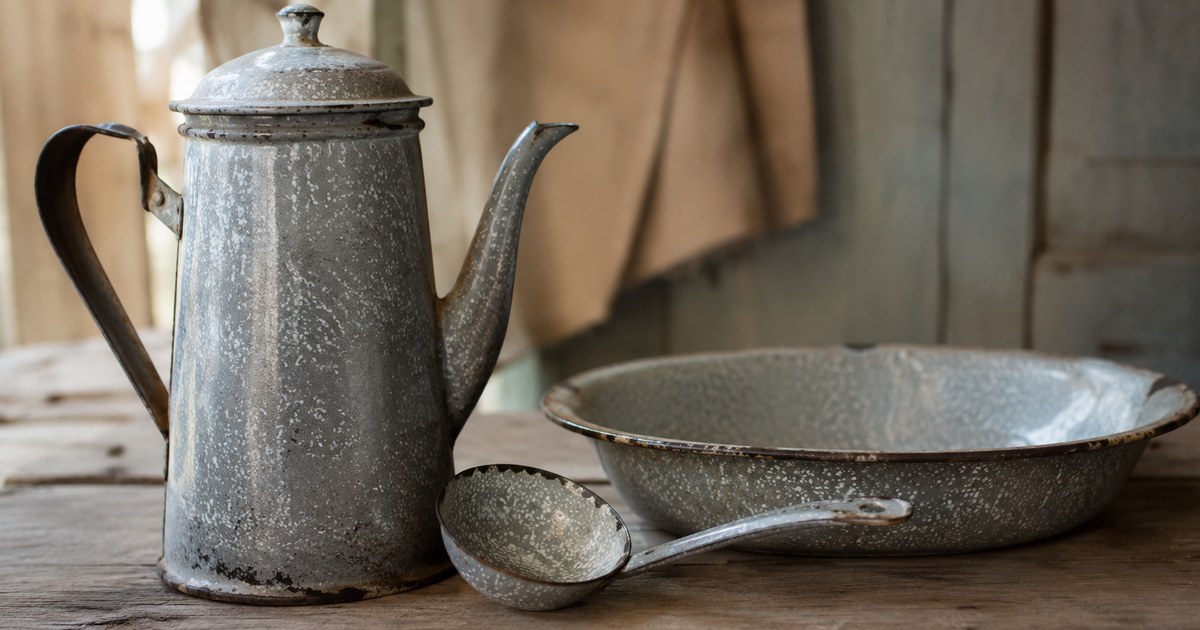
Antique graniteware gets treated as an anonymous category. Search for it and you get farmhouse decor listings, all mottled blue and gray, sold on look alone with no maker named and no date attached. That framing throws away the best dating tool the category has, which is the mark. Period American graniteware was branded, the brand names changed with the corporate lineage behind them, and those name changes are hard date brackets that almost nobody teaches. A coffee pot marked Granite Ironware and one marked Nescoware are not the same age, and the difference is not subtle.
Antique graniteware is enameled sheet metal kitchenware made across the Midwestern and Eastern United States from the 1870s, with the collectible period generally treated as ending around the Second World War, also sold as agateware and speckleware. Date it by the brand name in the mark first, then by construction: riveted handles, heavier gauge, and visible seams all point earlier than welded, lightweight modern work.
Quick identification checklist
- Find the mark before anything else. Look on the base, the underside of the rim, the inside of a lid, and the back of a handle mount.
- Read the brand name, not just the word graniteware. Granite Ironware, Royal Granite Steel Ware, Royal Granite Enameled Ware, and Nescoware are different eras, not synonyms.
- Check how the handle attaches. Riveted attachment points to earlier work. Welded attachment points later.
- Feel the weight and the gauge. Period pieces are noticeably heavier for their size than modern enamelware.
- Look for seams. Visible construction seams are an earlier trait; modern deep-drawn pieces are seamless.
- Judge the speckle pattern. Irregular, flowing period mottle reads differently from uniform machine-sprayed modern speckle.
- Check the handle material. Cast iron handles suggest the nineteenth century, wooden handles suggest roughly the turn of the century to about 1910.
- Look for a country-of-origin stamp. A modern import stamp settles the question immediately.
The marks, and the corporate lineage that dates them
This is the leverage the decor listings throw away. The dominant American graniteware lineage runs through one family of companies, and the brand names track its stages.
The Niedringhaus brothers had been in the St. Louis tinware trade since the late 1850s and incorporated the St. Louis Stamping Company in 1866. It began making the enameled ware in 1874. Frederick Niedringhaus developed the mottled enamel surface in 1875, and patents for enameling sheet metal ware followed in 1876 and 1877. The finish was named for the way it looks, a speckled surface resembling polished granite, which is where the trade name Granite Ironware came from and why the whole category ended up called graniteware. So the mark Granite Ironware places a piece in the earlier stamping-company era.
In 1899 the St. Louis Stamping Company and Granite Iron Rolling Mills merged with several other enameled-iron and tin producers to form the National Enameling and Stamping Company, NESCO. That merger is a hard dividing line. Marks tied to the consolidated company, including Nescoware and the NESCO name, sit after it. The NESCO roaster is a familiar find from the middle decades of the company’s run, though the roaster line itself continued for years, so the name places a piece after 1899 rather than pinning a decade.
The Royal Granite Steel Ware and Royal Granite Enameled Ware names are further brand stages within the same lineage. Be honest about what they buy you: unlike the 1899 merger, these two do not have well-published start and end years, so they will not give you a tight bracket on their own. What they do give you is a position in the sequence and a maker, which is more than “old enamelware” and enough to place a piece against dated catalog illustrations. That is why the exact wording matters. When you photograph a mark, capture the words in order and do not paraphrase. “Granite” alone is not the answer; the full brand phrase is, because Granite Ironware and Royal Granite Enameled Ware are different points in the same company’s history even though both read as “granite” at a glance.
One useful endpoint for the lineage: the Granite City plant ran from 1895 until its closure was announced in February 1956. That gives you an outer bound for anything carrying the corporate marks.
You will also find pieces marked by other American producers, and many pieces with no mark at all. An unmarked piece is common and not a problem. It just means construction becomes your primary evidence instead.
Telling period American ware from later and imported enamelware
Walk into any antique mall and period graniteware sits on the same shelf as mid-century European enamel, later Asian imports, and modern reproduction speckled camp cookware. They photograph almost identically. The differences are physical.
Handle attachment. Period pieces overwhelmingly use riveted handles and spouts, with visible rivet heads. Later manufacturing welds them, leaving a smooth joint with no fasteners. This is the single fastest sort.
Mark method. Period marks are typically in the glaze, applied as part of the enameling and visually integrated into the surface. Modern marks are frequently screen printed on top, sit proud of the surface, and can wear or scratch off in a way an in-glaze mark cannot.
Gauge and weight. Period sheet metal is heavier. Pick up a period coffee pot and a modern camp pot of the same size and the difference is obvious in the hand before you look at anything.
Speckle character. Period mottling is irregular, with flowing variation and areas of different density, because of how it was applied. Modern reproduction speckle is machine sprayed and reads uniform, with evenly distributed dots of consistent size. Once you have seen the two side by side the difference is hard to unsee.
Country-of-origin marking. Modern imports carry country-of-origin stamps as a matter of law. A clear modern origin stamp ends the inquiry.
Wear pattern. A hundred-year-old cooking vessel has base wear, rim chips exposing dark metal, and enamel loss concentrated at contact points. Even, all-over distressing that looks decorative rather than functional is worth questioning.
Construction dating within the period range
Once you are confident a piece is period American work, construction narrows it further.
Earlier pieces run heavier gauge, show visible seams where the body was formed and joined, and use riveted rather than welded attachments throughout. Nothing about that is a precise date, but it separates earlier from later reliably within the category.
Handle material is a soft chronological signal. Cast iron handles are typical in the nineteenth century. Wooden handles appear from about the turn of the century to roughly 1910, and a wooden handle in original condition is worth photographing carefully because it is uncommon to survive.
Color is the softest signal of all, and it is the one decor listings overuse. Early pieces tend toward blue or green with white spatters. Gray with white spatters is characteristic of around 1900. Treat color as one supporting input, never as a date on its own, because colorways were produced across long stretches and reproduced later.
What it is worth, in honest terms
No dollar figures, because the market for this category is condition-driven and moves. What holds true generally: marked pieces in a documented brand era tend to sell for more than unmarked ones, unusual forms such as molds, muffin pans, and colanders tend to attract more interest than plain basins, and intact original enamel commands a real premium over heavily chipped examples. Swirl and other distinctive colorways draw collector attention beyond the plain grays.
Condition governs almost everything. Enamel loss on a display piece matters less than on a piece someone intends to use, and interior chipping means a piece should not be cooked in regardless of age.
Watch-outs and common mistakes
- Treating all speckled enamel as antique. Modern reproduction camp cookware is produced continuously and looks the part.
- Reading “graniteware” as a maker. It is a category name, derived from a brand. The full brand phrase in the mark is the useful part.
- Assuming unmarked means fake. Plenty of period ware carried no mark, or a mark that has worn off the base.
- Scrubbing the base before reading it. Aggressive cleaning can take a worn in-glaze mark off entirely. Wash gently, dry, and photograph before you do anything more.
- Cooking in chipped pieces. Exposed base metal under old enamel is a practical reason not to use a period piece for food, separate from any value question.
- Dating from color alone. Colorways ran long and were revived. Color is supporting evidence at best.
- Confusing graniteware with granite-patterned modern ceramics. Different material entirely; graniteware is enamel on metal and a magnet will usually confirm a steel body.
Photo tips
- Shoot the base flat-on in even light with the whole mark in frame, including any surrounding text or numbers.
- Use raking light for worn marks. In-glaze marks that have faded often still leave a texture difference that side light reveals.
- Photograph the handle attachment close up so rivets or a welded joint are unambiguous.
- Capture a rim chip if there is one. The exposed metal edge shows gauge and body material at a glance.
- Shoot the speckle pattern close and flat so its regularity or irregularity is judgeable.
- Include a full profile of the piece for form, since the form itself carries identification weight for molds, pots, and pans.
Common questions
How can you tell if enamelware is antique or modern?
Check the handle attachment, the weight, and the mark. Period American graniteware typically has riveted handles, heavier gauge metal, visible seams, in-glaze marks, and irregular mottling. Modern enamelware has welded handles, lighter gauge, seamless bodies, screen-printed marks that sit on the surface, uniform sprayed speckle, and a country-of-origin stamp.
What is the difference between graniteware, agateware, and enamelware?
They are largely the same material described by different trade and collector names: enamel fused onto sheet metal kitchenware. Graniteware derives from the Granite Ironware brand name, agateware and speckleware describe the mottled surface, and enameled ware is the generic term. None of them identifies a specific maker on its own.
Is old graniteware safe to cook in?
Treat any piece with chipped enamel as display only. Once the enamel is broken the base metal is exposed, which is a practical hygiene and corrosion issue rather than an age issue. Undamaged period pieces can technically be used, but given their collectible value and the difficulty of assessing century-old enamel, most owners keep them off the stove.
Related guides
- How to Identify Unmarked Cast Iron Cookware
- How to Identify Griswold Cast Iron Skillets
- Jadeite and Fire-King Identification
- Common Signs of Antique Reproductions and Fake Antiques
When to use the Antique Identifier app
Photograph the base mark in raking light first, then the handle attachment, then the full form. The app reads faded in-glaze brand text that is hard to transcribe by eye, which matters here because the exact wording separates one brand era from another. Use it to place the mark, then confirm with the physical evidence: rivets, gauge, seams, and speckle character. The mark and the construction have to agree. When they do, you have a real date bracket rather than a guess based on how old the piece looks.