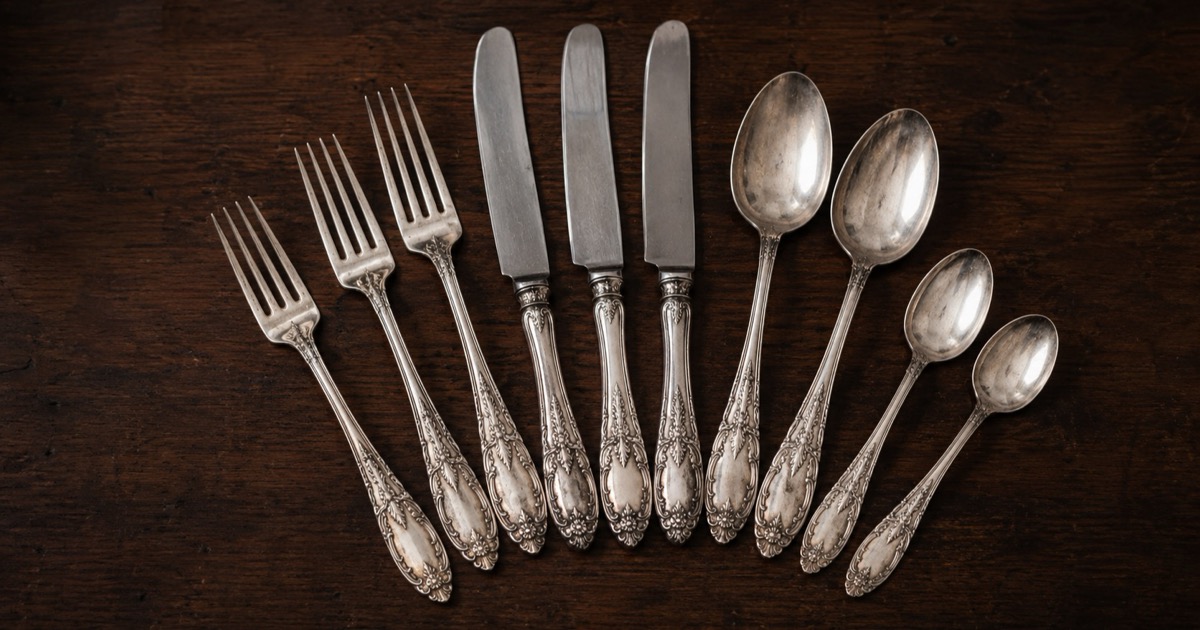
The number one confusion with 1847 Rogers Bros silverware is the date stamped right in the brand name. That “1847” is not the year your flatware was made—it is the year the Rogers Brothers company was founded, used as branding on every piece produced under the name for more than a century. A set stamped “1847 Rogers Bros” could have been made in 1890, 1920, 1950, or any number of other years; the founding date was carried as a prestige marker throughout the brand’s production history. Once that point is settled, actually dating your pieces becomes a matter of matching pattern names and mark variants to documented production records.
1847 Rogers Bros is American silver plate flatware, not sterling, and the “1847” in the mark is the brand’s founding date rather than a production year. The two key tells for dating are the pattern name stamped on the back of each piece and any “IS” or International Silver mark. Identify the pattern first, then match it to its documented introduction date.
1847 Rogers Bros remains among the most commonly encountered American silver plate flatware at estate sales, thrift stores, and antique malls. Understanding its marks, patterns, and honest value position helps anyone who inherits a set or finds one decide what they actually have.
Quick identification checklist
- The “1847” means the brand, not the date. This is the foundation of everything else; pieces marked 1847 Rogers Bros were produced across a very wide date range.
- Look for “IS” or the International Silver name. By the early twentieth century, 1847 Rogers Bros was part of International Silver Company; pieces may bear both the pattern-brand mark and an “IS” or “International Silver” mark.
- Check for quality grade markings. Marks like “XS Triple” or “A1” indicate the plating grade; heavier plate grades were marketed as more durable.
- Identify the pattern. The pattern name is usually stamped on the back of each piece; matching it to known pattern introduction dates is a reliable way to establish a production window.
- Assess the plating condition. Silver plate wears through at use points—the bowl of spoons, the tines of forks—revealing the base metal beneath. Condition governs almost all practical value.
- Count and check completeness. A full service for eight or twelve in a recognized pattern has more practical value than a partial set or mixed pieces.
The Rogers brothers and International Silver: the history thread
The Rogers Brothers—William, Asa, and Simeon—were among the early American practitioners of electroplating silver onto base metal, a technology that emerged in the 1840s and made silver-surfaced flatware accessible to the middle class. The “1847” brand established by this founding activity carried considerable commercial prestige, and the mark was eventually absorbed—along with many competing silver plate brands—into the International Silver Company when that conglomerate assembled much of the American silver plate industry in 1898.
International Silver operated the 1847 Rogers Bros name as a brand within its larger portfolio, continuing production under the familiar mark for decades. This is why pieces bearing “1847 Rogers Bros” may also show “International Silver” or “IS” marks or the company’s other marks from the consolidated era. The brand continued producing flatware under the name well into the twentieth century, with new patterns introduced at intervals to match changing tastes.
Understanding this lineage means that the mark “1847 Rogers Bros” on a piece tells you the brand identity but not the production date. You need additional information—pattern identification and mark variant analysis—to narrow the date range.
Mark variants and what they indicate
The specific text and symbols appearing alongside “1847 Rogers Bros” evolved over time, and while a complete mapping of every variant is a specialist exercise, certain patterns are well established in the collector literature.
Pre-consolidation pieces (before 1898) bear the Rogers brothers marks without International Silver involvement. Post-consolidation pieces may show “IS” as part of the mark or within a logo, or “International Silver” written out. The presence or absence of International Silver branding is a broad dividing line.
Plate grade designations like “XS Triple” appeared on pieces marketed as heavier-plated, and “A1” indicated a standard grade. These are quality claims, not dates, but they help characterize the piece’s original market positioning.
Anniversary and commemorative marks were added to some later production runs, indicating specific packaging or marketing programs and providing additional date anchors for those variants.
The honest approach: if precise dating matters, match your mark variant to a specialized silver reference like Rinker’s “Silverplated Flatware” or similar guides that document mark evolution with dates. A photograph of the complete back marking is essential for this comparison.
Patterns as dating anchors
The most reliable dating method for 1847 Rogers Bros flatware is identifying the pattern. The company introduced patterns at specific points in time and often phased out older patterns; a known introduction date gives you an earliest-possible production year, and if the pattern was discontinued, a latest-possible year as well.
Some of the most commonly encountered patterns include:
First Love — introduced in 1937, one of the most popular mid-century patterns, with a flowing floral and ribbon motif. Pieces from this pattern date no earlier than 1937.
Eternally Yours — introduced in 1941, another widely produced floral pattern with an elaborate engraved-style decoration. Sets in this pattern date from 1941 forward.
Daffodil — introduced in 1950, a lighter, more stylized mid-century floral that reflects postwar design sensibilities.
Adoration — introduced around 1930 (references differ on the exact year), characterized by its rose and ribbon decoration.
Identifying the pattern involves reading the pattern name stamped on the back of the piece (most 1847 Rogers Bros pieces are pattern-stamped) and matching it to the introduction date in a reference. A complete set in a single well-documented pattern with consistent marks narrows the date range considerably.
| Pattern | Approx. introduction |
|---|---|
| First Love | 1937 |
| Adoration | c. 1930s |
| Eternally Yours | 1941 |
| Daffodil | 1950 |
Note: This table reflects widely cited introduction dates from collector references and is not comprehensive; always verify against current specialist references for precise dating.
The honest value conversation
1847 Rogers Bros is silver plate—a base metal (typically a copper alloy) with a deposited silver surface. It is not sterling silver and contains no significant intrinsic silver value. This is the most important value point for anyone who inherits a set expecting it to be worth its weight in precious metal.
The actual market value of silver plate flatware is determined primarily by:
Completeness and condition. A full service for eight or twelve, with matching serving pieces, in good original condition with minimal plate wear commands the most interest. Incomplete sets with worn pieces have limited resale appeal.
Pattern desirability. Some patterns have active replacement demand from people completing inherited sets; others do not. Patterns with continuing replacement demand may hold modest resale value; obscure patterns in partial sets have very little.
Sentimental and replacement value. For many people, the primary value of a 1847 Rogers Bros set is completing or replacing a family pattern. Replacement pieces can be found through online pattern-matching services and specialist dealers.
Resale market reality. At thrift stores, estate sales, and online, individual silver plate pieces typically bring a few dollars each; complete boxed sets in popular patterns may bring more but rarely command prices that justify the weight of precious metal assumptions.
Condition is the dominant variable in every transaction: bright, minimally worn pieces in a popular pattern in their original case are the ceiling of market value. Heavily worn pieces revealing base metal at the tines or bowl are near-worthless as resale items, though they may still serve as everyday table flatware.
Monograms and their effect
A very large proportion of 1847 Rogers Bros flatware was sold with monogramming—individual initials or family crests engraved at the time of purchase. Monogrammed pieces are nearly impossible to resell at meaningful prices because the engraving is personalized and cannot practically be removed without damaging the piece. If you inherit monogrammed flatware that you do not plan to use personally, the realistic resale value is very low. The sentimental value to family members who share the monogram initials is a separate consideration.
Watch-outs and common mistakes
- “1847” is not a production date. Repeat this to yourself when evaluating pieces; the confusion is pervasive and affects price expectations.
- Silver plate has no precious-metal melt value worth pursuing. Unlike sterling silver, which is worth melting if condition is poor, silver plate contains so little silver that “scrap” transactions are not meaningful.
- Monogrammed pieces have very limited resale. Beautiful condition is irrelevant if the initials are not yours; plan accordingly.
- Pattern mixing reduces set value. Sets assembled from multiple patterns look like matched flatware to a casual glance but have lower value to pattern collectors and replacement buyers who want uniformity.
- “Rogers” alone does not mean 1847 Rogers Bros. The Rogers name appears on many silver plate brands from different companies; check the full mark to confirm which Rogers entity you are looking at.
Photo tips that improve identification
- Photograph the full back of one piece with all marks visible. This is the single most useful image for identification: the brand name, quality grade, “IS” or International Silver indicator, and pattern name are all typically on the back of a single spoon or fork.
- Use raking light for pattern detail. The engraved or embossed pattern decoration on the handle is often subtle; raking light from the side makes the decorative motif read clearly in a photograph.
- Show plate wear condition. A photo of the bowl of a tablespoon at the wear point—where silver has thinned or worn through to base metal—communicates condition accurately for remote evaluation.
- Photograph representative pieces from the set, not just one. If multiple pattern names appear (indicating a mixed set) or marks vary, showing several pieces together reveals this immediately.
Common questions
Is 1847 Rogers Bros silverware real silver?
No. 1847 Rogers Bros is silver plate—a base metal, typically a copper alloy, with a thin deposited silver surface. It contains no meaningful intrinsic silver value, so it is not worth pursuing as scrap the way sterling is. Its market value comes from completeness, condition, and pattern desirability, not precious-metal content.
How do you tell when 1847 Rogers Bros silverware was made?
The pattern name stamped on the back of each piece is the most reliable dating anchor: patterns were introduced at documented dates, such as First Love in 1937 and Daffodil in 1950, giving an earliest-possible year. The presence of “IS” or International Silver marks points to production after the 1898 consolidation, and specialist mark references narrow things further.
Is 1847 Rogers Bros the same as other Rogers silverware?
No. The Rogers name appears on flatware from several different companies, because multiple firms traded on the family’s reputation in early American electroplating. “1847 Rogers Bros” is one specific brand, later operated by International Silver Company. Check the complete mark—including the “1847,” any “IS” indicator, and grade stamps—to confirm which Rogers entity made your pieces.
Related guides
- Silver Plate vs Sterling Silver: How to Tell the Difference
- Antique Silverware Patterns Identification
- Silver Makers Marks Identification: How to Read Maker Stamps
When to use the Antique Identifier app
Photograph the back of a representative piece showing the full mark, then a shot of the handle showing the pattern decoration, and a condition shot of the most worn piece in the set. The app can match the mark text, plate grade indicators, and pattern name to the 1847 Rogers Bros catalog quickly—confirming the brand, suggesting a production window, and helping frame realistic value expectations. For large sets being considered for sale or insurance documentation, matching the pattern through a specialist replacement service confirms both identity and any market demand.