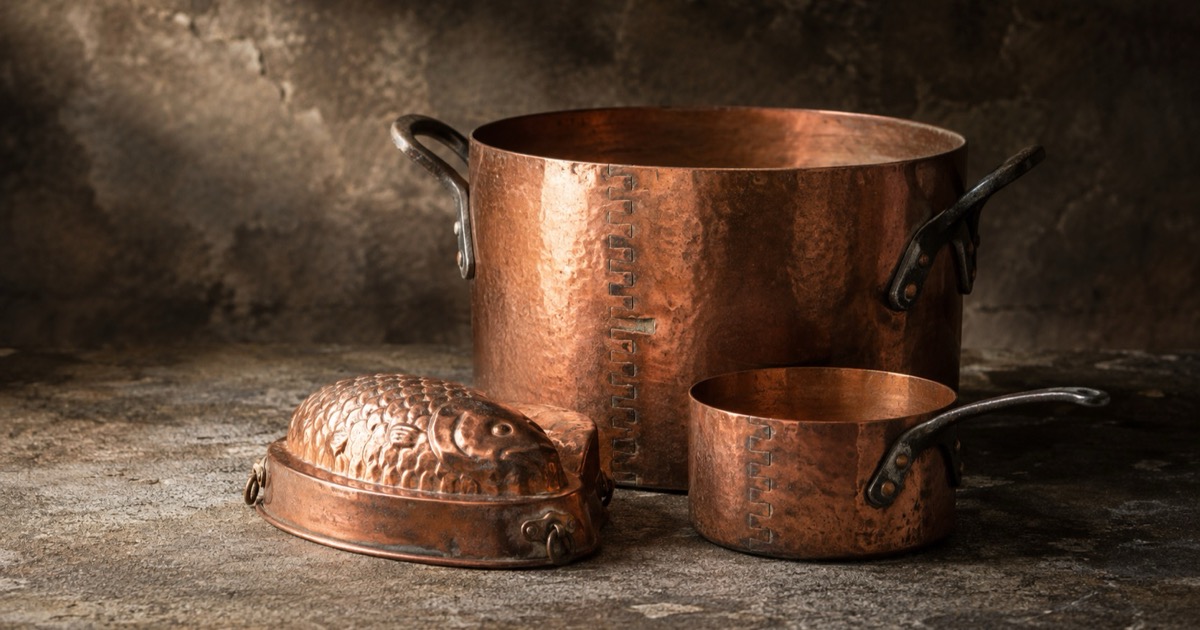
Antique copper identification is built on construction details that are largely invisible once a piece has been polished to a mirror shine — which is why examining copper before any cleaning, and certainly before any aggressive buffing, gives you the most evidence to work with. The way a pot was seamed, how the handle was attached, whether hammer marks were applied by hand or stamped in, and how heavy the wall gauge feels all point toward an era of manufacture and a method of production that decorative reproductions simply do not replicate.
To identify antique copper, look for a dovetailed seam running up the body, hand-planished hammer marks that vary slightly rather than repeat, iron handles riveted through the wall, and a tin-lined interior. Heft is the quickest first test: genuine cookware copper is heavy-gauge and rigid, while decorative reproductions feel light and slightly flexible in the hand.
By the end of this guide you will know how to read body seams and hammer marks, what tin lining signals about age and use, which maker stamps appear on serious cookware, how to separate functional old copper from the lightweight “antiqued” decorative pieces that fill antique malls, and how to think about cleaning and value honestly.
Quick identification checklist
- Examine body seams: hand-raised and early machine-raised pieces often show a dovetailed or lapped seam along the body, visible as a textured line running vertically.
- Check the hammer marks on the exterior: hand-planished copper shows slightly irregular marks that overlap in organic patterns; machine-stamped “hammer” texture repeats uniformly.
- Identify the handle material: early functional copper cookware typically used iron, wrought iron, or cast brass handles, attached with rivets you can see on the interior wall.
- Look inside for tin lining, its condition, and signs of re-tinning.
- Weigh the piece in your hands; genuine heavy-gauge cookware copper is substantially denser than decorative thin-spun pieces.
- Check the base and handle for any stamped or engraved maker marks.
Construction as the primary age tell
The most reliable evidence of age and quality in copper is how the piece was made. Before factory machinery made seamless formed vessels practical, smiths raised flat sheet copper into shape by hammer, joined the body with a seam, and attached the handle with iron rivets visible on the interior wall.
A dovetailed seam — where the two sheet edges are interlocked in notched tabs before being hammered flat — is the classic detail of early hand-raised copper. You can feel the slight ridge along the body seam. This technique appears on well-made French, English, and American professional copper from the nineteenth century. Later machine production eliminated the seam by spinning or pressing from a single disc, but seamless bodies also exist on fine nineteenth-century hand-raised work, so seamlessness alone does not date a piece.
Hand-planished hammer marks on genuinely hand-worked copper overlap in slightly variable organic patterns — consistent with human rhythm, not mechanically exact. Decorative copper made to look old uses stamping dies that press repeating patterns; the marks are too even and identical across sections.
Tin linings and re-tinning
Interior tin lining on copper cookware is a practical necessity, not a luxury: copper in contact with acidic foods produces harmful compounds. Functional pieces intended for actual cooking were almost universally tinned, and re-tinning — stripping and re-applying the tin lining — was routine maintenance, not restoration. A piece showing evidence of one or two re-tinnings is not damaged; it is a piece that was actually used. Fresh bright tin is silver-white; older tin darkens toward matte gray. Worn-through patches where copper shows are a sign of heavy use. A fresh re-tin on an otherwise old piece does not disqualify it, though it removes one layer of interior age evidence.
Maker stamps on serious cookware
French professional copper — associated with the Villedieu-les-Poêles copper-working tradition in Normandy and Parisian culinary suppliers — often carries maker stamps punched near the handle rivet or on the base. These may include maker initials, town marks, or capacity measures in liters. French copper from the late nineteenth and early twentieth century is the category most likely to carry a legible, attributable stamp. English and American copper used similar practices less universally; many pieces from regional coppersmiths were never marked at all.
As a contrast: Revere Ware, the American copper-clad cookware brand, carries its own stamped mark and is collectible in its own right, but its thin copper cladding over stainless or aluminum cores makes it immediately distinguishable in hand from heavy-gauge professional copper.
Gauge and weight: cookware copper versus decorative copper
Pick up the piece. Genuine heavy-gauge copper cookware has substantial wall thickness and a weight noticeably greater than you expect for the size; the walls resist flexing. Decorative “antiqued” copper — mass-produced in the mid-to-late twentieth century for wall décor — is thin-spun, light, slightly flexible, and often has an applied patina or lacquer rather than natural aging. It was never meant for cooking and carries no tin lining. The weight difference between a genuine copper saucepan and a decorative piece of the same visual size is large enough to feel immediately.
Verdigris, cleaning cautions, and value framing
Verdigris — the green-blue patina on copper surfaces — is surface chemistry, not damage. Do not clean a piece before you have examined and documented it. Patina and the natural darkening of recessed hammer marks contribute evidence about age and use. Aggressive polishing removes this evidence and can flatten dovetail and planishing details permanently. If cleaning is necessary, gentle technique with appropriate agents is far safer than machine buffing.
Heavy-gauge hand-raised French or English copper cookware in genuine condition — with original or cleanly re-tinned lining, original iron handles, and legible maker stamps — occupies the top of the market. Decorative copper from the mid-twentieth century sells at a significantly lower price point. The gap between categories is wide enough that confusing them is a costly mistake in either direction.
Watch-outs and common mistakes
- Machine-stamped “hammer” texture is a modern production technique; do not confuse it with hand-planishing.
- Lacquered decorative copper looks like old patina until you try to scratch it with a fingernail; lacquer gives a plastic-like resistance.
- Re-tinning is normal maintenance, not restoration; do not deduct heavily for a cleanly re-tinned interior.
- Soft solder seams that are visibly melted and smooth are a sign of decorative or later manufacture, not early hand work.
- Copper-clad cookware (Revere Ware and similar) is not the same as solid-copper cookware; examine the body edges and any chips to see the core material.
Photo tips that improve identification
- Photograph body seams with raking light coming from the side so the seam texture casts a small shadow and reads clearly.
- Capture interior surfaces to show tin condition, including any worn-through patches and signs of re-tinning.
- Take a close-up of any maker stamp or punched mark from directly above under strong directional light.
- Photograph hammer marks in natural or raking light so the faceted surface texture reads; flat overhead light will wash it out.
Common questions
How can you tell antique copper from a reproduction?
Weight and construction give it away. Genuine old cookware copper is heavy-gauge, rigid, and tin-lined, with riveted iron or brass handles and hammer marks that vary in an organic, human rhythm. Decorative reproductions are thin-spun, light, and slightly flexible, show mechanically repeating “hammer” texture from a stamping die, and often wear an applied lacquer patina that resists a fingernail like plastic.
Is a re-tinned copper pot worth less than one with its original lining?
Generally no. Re-tinning was routine maintenance on working copper, the way resoling is for good boots, so evidence of one or two re-tins shows the piece was genuinely used rather than damaged. A fresh re-tin does remove one layer of interior age evidence, which is why the seams, handles, and exterior surfaces carry more weight in identification.
Should you polish antique copper before selling it?
No. Patina, darkened recesses in the hammer marks, and surface verdigris are evidence of age and use that buyers and identifiers rely on, and aggressive polishing or machine buffing can flatten dovetail and planishing details permanently. Examine and document the piece first, and if cleaning is truly needed, use gentle technique with appropriate agents rather than a buffing wheel.
Related guides
- How to Identify Antique Brass
- Antique Brass Makers Marks Identification
- How to Identify Unmarked Cast Iron Cookware
When to use the Antique Identifier app
Photograph the whole piece, a close-up of any maker stamp or seam detail, and a shot of the interior showing tin condition. The app can help narrow likely origin and period, which directs you toward the right reference for that type of copper. If the result suggests French professional copper or a named English maker, use that as a starting point for deeper verification against documented examples.