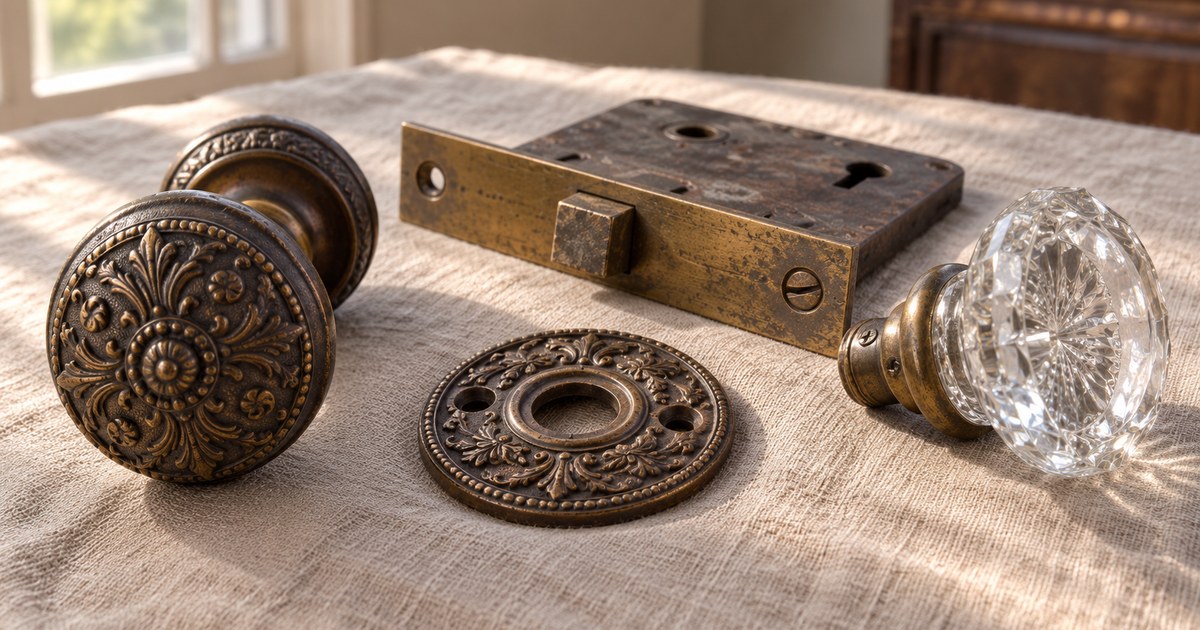
Almost every guide to antique doorknobs starts with decoration: this rosette pattern means Victorian, that material means Edwardian, glass means the First World War. Decoration is the least reliable signal available. Popular patterns stayed in production for decades, were revived repeatedly, and are cast again today in the same materials by companies selling to restoration buyers. A knob that looks like 1885 may genuinely be 1885, or it may be 1925, or it may have been made last year. What actually separates them is the mechanical system the knob belonged to and the physical evidence of a century of use.
Antique doorknobs are identified by working from the hardware system rather than the ornament: which lock the knob served (rim lock or mortise lock), how the knob attaches to the spindle, whether the rosette and escutcheon are cast or stamped, and where the maker mark sits. Decorative style and material narrow the range only after those mechanical questions are answered.
Quick identification checklist
- Determine the lock type. A knob that served a surface-mounted rim lock sits in a different era and a different hardware logic than one made for a lock mortised into the door edge.
- Look at the spindle attachment. A threaded shank tightened by a set screw, a swaged or swivel spindle, and a knob cast integral to its rod are three different construction approaches and the single most informative detail on the piece.
- Decide cast or stamped. Cast rosettes and escutcheons have weight, crisp undercut detail, and a visible casting character. Stamped ones are thin, hollow-backed, and shallow in relief.
- Look for the mark somewhere other than the knob. Check the lock case, the faceplate, and the back of the rosette before concluding the set is unmarked.
- Read any patent date as a floor, not a date of manufacture.
- Inspect the throat and the shank for wear. A century of turning leaves polish, slack, and thread wear that new hardware cannot fake convincingly.
Start with the lock system, not the ornament
Doorknobs are one component of a hardware set, and the set tells you more than the knob does. Rim locks, mounted on the face of the door in a visible case, were the common fitting through the middle decades of the nineteenth century, and they carried on in cheaper, rural, and retrofit work long after that. Mortise locks, recessed into the edge of the door, became mainstream by mid-century, and that shift is what brought in the matched ornamental brass or bronze rosette and escutcheon as a designed pair. If your knob came out of a rim lock, or has the short shank and proportions of one, you are working in a meaningfully earlier world than a mortise-set knob with a matching escutcheon plate.
The attachment is the next question. Most nineteenth-century knobs use a threaded shank running onto a square spindle, secured by a set screw through the side of the shank. Others use a swaged or swivel spindle arrangement, and some knobs are cast integral to their rod as a single unit. These are genuine construction differences, and they persist regardless of what the surface decoration looks like. Note the thread pitch and quality, the shape of the set screw and its slot, and whether the shank is a separate ferrule fitted to the knob or part of the same casting.
Material and style: useful, but only as a soft signal
Once the mechanics are settled, material and style refine the picture. Mineral knobs, the dense white and mottled ceramic type associated with Bennington, Vermont and Albany, New York, are documented on interior doors from the 1850s. Wooden knobs emerge in the 1880s, though wooden escutcheons proved fragile in service and survive less often. The 1870s are the documented high-water mark for sophistication in American door hardware, and by the 1880s and 1890s stamped metal was increasingly replacing cast material, with a corresponding decline in quality. Glass knobs are the clearest illustration of why material is weak evidence. Published date ranges for pressed and cut glass knobs vary widely from one reference to the next, and glass knobs were produced in quantity well into the twentieth century, so a glass knob on its own tells you very little. Use the mounting and the lock set to place it, and treat any confident single date range you read for glass knobs with suspicion.
A word on a persistent myth: so-called “mercury glass” mirrored knobs contain no mercury despite the name. The silvered interior is a glass and coating effect, not a mercury one.
Collectors organize the decorative side of the field using Dr. Blumin’s classification system, which is the basis of the Antique Doorknob Collectors of America photo library. That library is the practical way to put a name to an ornamental pattern once you know roughly what era you are in.
Where the maker mark actually lives
This is where most readers get a wrong answer. The maker mark usually is not on the knob. It is stamped on the lock case, cast or stamped on the faceplate, or struck on the back of the rosette where nobody looks. People told to check the knob find nothing, conclude their hardware is anonymous, and stop.
Take the set apart before you decide. Back out the set screw, slide the knob off the spindle, and look at the inside face of the rosette. If you still have the lock, its case and faceplate are the most likely place for a maker name. Dated manufacturer trade catalogs then give you hard anchors to compare against, and several are documented and well known: Wm. M. McClure & Brother 1860, Sargent & Co. 1871, Russell and Erwin Mfg. Co. 1874, Branford Lock Works 1881, and Yale & Towne 1897. Matching a marked pattern to a catalog in which it appears is one of the few ways to date architectural hardware with real confidence.
The patent date trap
A patent date stamped on hardware is the date of the patent, not the date of manufacture. This is the most common beginner error in the category and almost nobody corrects it. Manufacturers kept stamping a patent date on products for as long as the patent had commercial value, which in practice meant decades. “PAT. 1878” tells you the piece was made in 1878 or later. It does not tell you the piece was made in 1878, and it is entirely ordinary for such a stamp to sit on hardware produced twenty or thirty years afterward.
Use patent dates the way you would use a copyright date on a reprinted book: as an earliest-possible boundary that has to be combined with other evidence to become a date range.
Reproduction tells
Reproduction Victorian hardware is made today in cast brass, bronze, glass, and porcelain, sold openly for restoration work, and then resold secondhand with the original context lost. The tells are mostly mechanical and physical rather than decorative.
Threads on modern reproductions are crisp, uniform, and machine-clean, without the slight rounding and burnish that comes from a century of being run on and off a spindle. The finish is even across the whole piece, where genuinely used hardware wears unevenly: bright where a palm gripped it, darker in the recesses. The throat where the spindle turned should show wear. On a knob that spent a hundred years on a working door, it does. Weight is another giveaway, since many reproductions use lightweight zinc alloy rather than the bronze or heavy brass of period castings. Pick up a known-old knob and a suspect one in the same hand and the difference is usually obvious immediately.
Watch-outs and common mistakes
- Dating by pattern alone. Ornamental patterns were revived and reissued, so pattern gives you a design vocabulary, not a year.
- Concluding “unmarked” without removing the knob. The mark is often on the rosette back, faceplate, or lock case.
- Reading a patent date as a manufacture date. It is a floor only.
- Assuming glass means wartime rationing. Glass knobs span a long period and were made for aesthetic reasons as well as material ones.
- Judging value from decoration. Condition, completeness of the set, and whether the matching escutcheons and lock survived matter more than how ornate the face is.
- Cleaning before documenting. Aggressive polishing removes the wear evidence that distinguishes old hardware from new, and it is not recoverable.
Photo tips
- Shoot the face of the knob straight on in soft, even light, filling the frame, so the pattern is legible for comparison against a classification library.
- Photograph the shank and set screw from the side, and the throat opening head-on, since attachment method and wear are the evidence that decoration cannot supply.
- Remove the knob and photograph the back of the rosette and the lock faceplate, which is where any maker name or patent date is most likely to be.
- Include one frame with a ruler or coin beside the knob for scale, because rosette diameter and knob size are part of the comparison.
Common questions
How can I tell if my doorknobs are antique or reproductions?
Check the mechanics and the wear rather than the pattern. Genuine old knobs show thread wear, an unevenly worn finish, and polish in the throat where the spindle turned. Reproductions have crisp uniform threads, an even applied finish, no throat wear, and often noticeably lighter zinc alloy in place of cast bronze or heavy brass.
Where is the maker’s mark on an antique doorknob?
Usually not on the knob itself. Look on the lock case, the lock faceplate, and the back of the rosette after removing the knob from the spindle. Many complete sets that appear unmarked from the outside carry a clear maker name on one of those surfaces, which can then be matched to a dated trade catalog.
Does a patent date on door hardware tell me when it was made?
No. It marks the date of the patent and establishes only the earliest possible manufacture date. Makers continued stamping the same patent date for many years after issue, so a knob reading “PAT. 1878” could easily have been produced in the 1890s or later. Combine it with lock type, construction, and maker marks to build a range.
Related guides
- How to Identify Antique Hand Tools
- Antique Brass Makers Marks Identification
- How to Identify Antique Brass
- Where to Find Markings On Antique Furniture
When to use the Antique Identifier app
Door hardware is a strong fit for a photo-first pass because the decorative patterns are numerous, highly distinctive, and well documented, but very hard to search for in words. Photograph the knob face, the back of the rosette, and any mark you find on the faceplate or lock case, and the app can suggest which pattern family and material you are looking at, which is the step that turns “old brass knob” into something you can actually research. Use that suggestion as a starting point, then confirm it against the mechanical evidence and, where a maker name turns up, against dated trade catalogs.