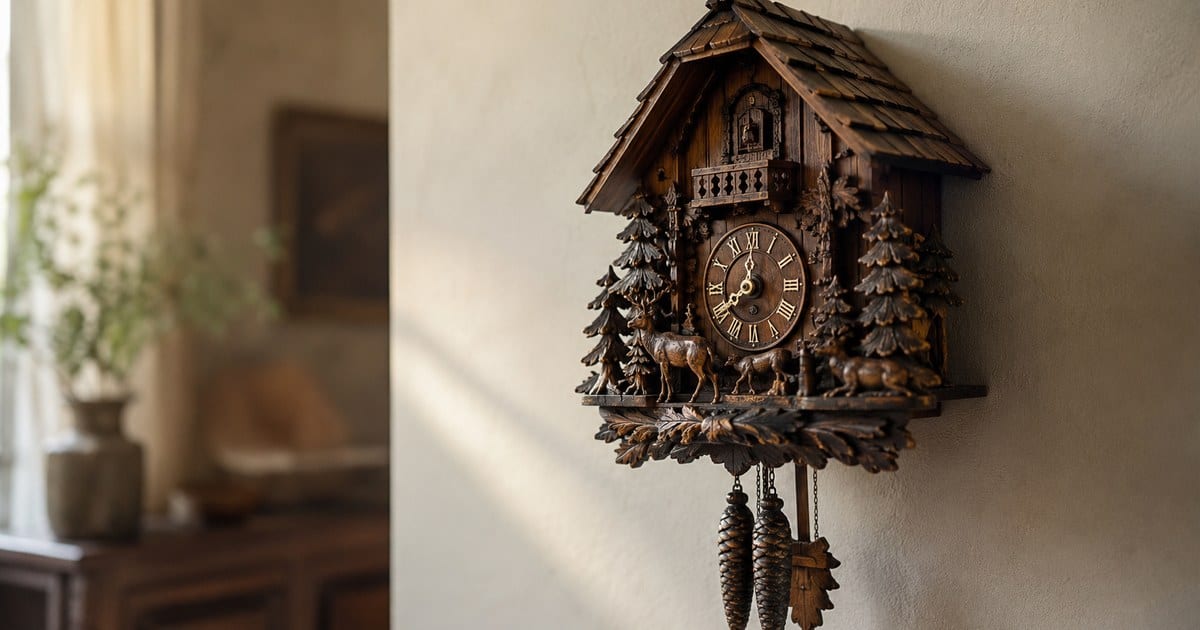
Cuckoo clock identification usually gets taught backwards. Most guides start with the carving, because carving is what people photograph, and then tell you to check inside the case for a paper label. That advice works perfectly on the small share of clocks whose label survived a century of dust, heat, and moving vans. On everything else it leaves you exactly where you started. The faster and more reliable route is to open the back and look at the movement first, because the movement is structural, hard to fake casually, and tells you more about age and origin than any amount of foliage on the front.
The cuckoo clock’s exact origin is disputed and predates the Black Forest trade, but the Black Forest region of southwest Germany popularized and industrialized the design starting in the eighteenth century, and the region still makes most quality examples. To identify one, check the movement first: a weight-driven mechanical movement with pinecone weights indicates traditional manufacture, while a battery quartz movement means later mass production. Then read the case style and any maker stamp on the movement plates.
Quick identification checklist
- Open the back door and look at the movement before anything else. Brass plates, gears, a chain or cable drive, and hanging weights mean mechanical. A plastic box with a battery compartment means quartz.
- Count the weights. Two weights usually means timekeeping plus cuckoo. Three usually means a music box has been added, which points to later tourist-market production.
- Look for a stamp on the brass movement plate. Movement makers marked their plates, often with a name and a number, and that stamp survives when paper does not.
- Read the case style. A carved railway-house form, a chalet with figures, a hunting scene with game and antlers, and a clean geometric case each belong to different periods and different markets.
- Check the country wording anywhere it appears. “Germany” alone, “Made in Germany,” and “West Germany” carry different date implications.
- Feel the carving. Hand carving leaves tool facets and small asymmetries. Pressed or machine-routed decoration is uniform and repeats exactly.
- Look at the bellows and pipes. Two wooden whistle pipes with leather-topped bellows is the traditional construction. A speaker grille is not.
Black Forest origin versus later imports
The Black Forest clockmaking trade grew out of a farmhouse winter industry in the eighteenth century and became a serious export business through the nineteenth, centered on towns such as Triberg and Schonach. That regional concentration never really broke. Even today, most of the mechanical cuckoo clocks worth owning come from a handful of Black Forest workshops, and the movements inside them come from an even smaller number of specialist movement makers in the same region.
What changed is the volume of everything else. From the middle of the twentieth century onward, cuckoo-styled clocks were produced in large numbers for the souvenir and gift trade, some assembled in Germany from bought-in parts, many made elsewhere entirely. These are not fakes in any dishonest sense, they are just a different product. The identification question is which category you are holding.
The clearest origin signals sit on the movement. A genuine Black Forest mechanical movement is built from two brass plates separated by pillars, with visible wheels, a chain or cable running down through the case, and a stamp on one plate. Import and gift-market clocks more often use a compact sealed unit, plastic components, a wound spring rather than weights, or a battery. The decorative pinecone weights on a quartz clock are usually hollow ornaments hanging on cosmetic chains rather than the drive for anything, and lifting one tells you immediately.
Wood is the second signal. Traditional cases are linden or a similar carving wood, solid and comparatively heavy for their size, with the grain visible through a stain rather than a printed finish. Lightweight cases, thin plywood back doors, and applied resin ornaments that look carved from a distance all point away from Black Forest workshop production.
Case style as an era clue
Case style is genuinely useful for dating, as long as you treat it as a range rather than a year.
The carved traditional case, sometimes called the railway-house form, descends from a mid-nineteenth-century design idea: a clock shaped like a small railway guard’s house, with a gabled roof and a decorated dial surround. Over the following decades this evolved into the deeply carved style everyone pictures, with oak leaves, a bird perched at the peak, and sometimes a full hunting scene of game, a rifle, and antlers. Heavy hand-carved hunting cases are a nineteenth and early twentieth century tradition that continued as a premium line afterward.
The chalet case is later and different in spirit. Instead of carved foliage it presents a miniature Alpine building with a shingled roof, painted shutters, small figures, a woodchopper or a beer drinker, and often a music box that runs dancers around a platform. Chalet clocks belong overwhelmingly to the twentieth century and skew toward the postwar tourist market. They can be well made or very cheaply made, and the movement will tell you which.
Then there are the modern cases: pared-down geometric forms, flat painted panels, art-deco-influenced shapes, and contemporary designer reinterpretations that keep the mechanical movement and throw out the foliage entirely. These are recent, and some of them are high quality. A clean modern case with a proper eight-day weight-driven movement is a current premium product, not an antique, and it should not be described as one.
Two details cut across all the styles and help refine the date. Carved bone or celluloid hands and a bone-numeral dial ring are older-tradition features. Plastic hands and a printed dial belong to later production.
Cuckoo clock identification by movement type
Before you spend any time on style, the movement sorts your clock into broad eras in about ten seconds.
A quartz movement is a hard ceiling. Battery-driven cuckoo clocks are a late twentieth century development onward, so a quartz clock cannot be an antique no matter how convincingly the case is carved. Most quartz examples also use a recorded or electronic cuckoo call and a light sensor that shuts the bird off at night, both of which are modern conveniences and both of which are easy to spot.
Among mechanical movements, weight-driven is the traditional construction and spring-driven is the exception. Weight-driven clocks run on chains or cables with weights, usually shaped as pinecones and often cast iron clad in brass. Whether the clock is a one-day movement, wound daily, or an eight-day movement, wound weekly, is a specification rather than a date, but eight-day movements are generally the more expensive product in any era.
Movement construction narrows things further. Wooden movement plates and wooden gearing belong to the older Black Forest tradition and indicate real age, though these are uncommon in general circulation and often in rough condition. Brass plates are the standard for later mechanical work. The plate stamp is the piece of evidence most people miss: movement makers marked their plates with a name and a model number, and that number typically encodes whether the movement is a one-day or eight-day type. Photograph the stamp and you have something searchable even with no case label at all.
When the paper label is missing or unreadable
This is the common real-world case, and it is where most cuckoo clock identification advice stops being useful. Original paper labels were glued inside the back door or on the inside rear wall of the case, and they are frequently gone, torn, water-stained, painted over, or replaced with a repair shop’s sticker.
Work the following order instead.
Start with the movement plate stamp, since it is the closest thing to a signature the clock still has. Clean it gently with a dry brush and photograph it in raking light so the shallow stamping reads.
Next, examine the label ghost. Even a removed label usually leaves a rectangle of clean wood, dried adhesive, or a different shade of aging on the surrounding surface. The size and position of that rectangle is itself informative and tells you the clock was originally labeled.
Then read the construction of the case. Look at how the boards are joined at the corners, whether the back door is solid wood or thin ply, whether the roof shingles are individually applied or molded as one piece, and whether the applied carvings are pinned and glued separately or cast as a single decorated front. Workshop production shows separate applied elements, small inconsistencies between matching sides, and hand-fitted joints. Volume production shows uniformity.
Finally, read the carving itself as evidence. Genuine hand carving has facets left by the gouge, undercuts that vary in depth, and left-right pairs that are similar rather than identical. Machine-routed or pressed decoration repeats exactly, has rounded, soft detail, and often shows the same motif at the same depth on both sides of the case.
Any surviving country-of-origin wording, whether on a label fragment, stamped in the wood, or cast into a metal fitting, is worth recording. Wording that names West Germany places the clock inside the postwar decades before reunification, which is a useful bracket to have when nothing else is legible.
Watch-outs and common mistakes
- Equating heavy carving with age. Deeply carved cases have been produced continuously for well over a century, including now. The carving tells you the style tradition, not the year.
- Trusting decorative weights. Ornamental pinecones hang on quartz clocks too. Lift one and see whether it has the mass to drive anything.
- Assuming a replaced movement voids the clock. Movements were swapped routinely by repairers. A newer movement in an older case is common and affects value rather than identity, but you should describe it honestly when selling.
- Treating a shop sticker as a maker label. Retailer and repairer labels are frequently mistaken for factory labels. A factory label names the maker and usually the model.
- Ignoring the music box. A third weight and a dancing platform point to a specific mid-century-onward market segment and are a fast way to date a clock that otherwise looks traditional.
- Buying without hearing it. The two-note call comes from two wooden pipes and bellows. A thin electronic chirp from behind a grille is a different clock entirely, whatever the case looks like.
Photo tips
- Open the back door and photograph the full movement square-on in bright, even light, close enough that the wheels and plates are sharp.
- Take a second movement shot at a raking angle so the shallow plate stamp catches a shadow and becomes readable, since stamped brass rarely photographs well head-on.
- Photograph the inside of the back door and the rear case wall even if you see no label, because adhesive ghosts and faded remnants show up in a photo more clearly than to the eye.
- Shoot the full front of the case straight-on against a plain background, then one raking-light close-up of the carving so tool marks and undercuts are visible.
- Include the weights and the pendulum in one frame, and photograph the dial ring and hands close up so the numeral material and hand style can be assessed.
Common questions
How do I tell if my cuckoo clock is really from the Black Forest?
Look at the movement rather than the case. Traditional Black Forest clocks use a weight-driven brass-plate mechanical movement with a chain or cable drive, real driving weights, and two wooden whistle pipes with bellows for the call. A stamp on the movement plate naming a maker and model number is the strongest single piece of evidence. Solid carving wood and hand-fitted case joints support the read.
Does a quartz movement mean my cuckoo clock is worthless?
Not worthless, but not antique. Battery movements are a late modern development, so a quartz clock is recent regardless of how traditional the case looks. Some quartz clocks are decent decorative objects and sell steadily, they simply belong in a different price tier than mechanical Black Forest work and should be described accurately.
What if there is no label anywhere inside the case?
That is the normal situation on older clocks. Photograph the movement plate stamp, look for the rectangle of clean wood or dried glue where a label once sat, then assess case construction and carving quality. Country-of-origin wording stamped or cast anywhere on the clock, especially wording naming West Germany, brackets the period even with no maker name at all.
Related guides
- Antique Clock Makers Marks Identification
- Mid-Century Modern Furniture Identification
- Stickley and Mission Furniture Identification
- Best Antique Identification App: What to Look For
When to use the Antique Identifier app
Cuckoo clocks reward a fast first pass because so much of the work is visual comparison against a style tradition you may not know well. Photograph the front of the case straight-on, the carving in raking light, and the open movement, and the app can suggest which case tradition and which construction family your clock resembles. That is exactly the narrowing step that is slow when you are working from a cold start with no label to search. Use the result as a starting point, then confirm it against the movement plate stamp and sold listings for clocks of the same construction rather than treating it as a final attribution.