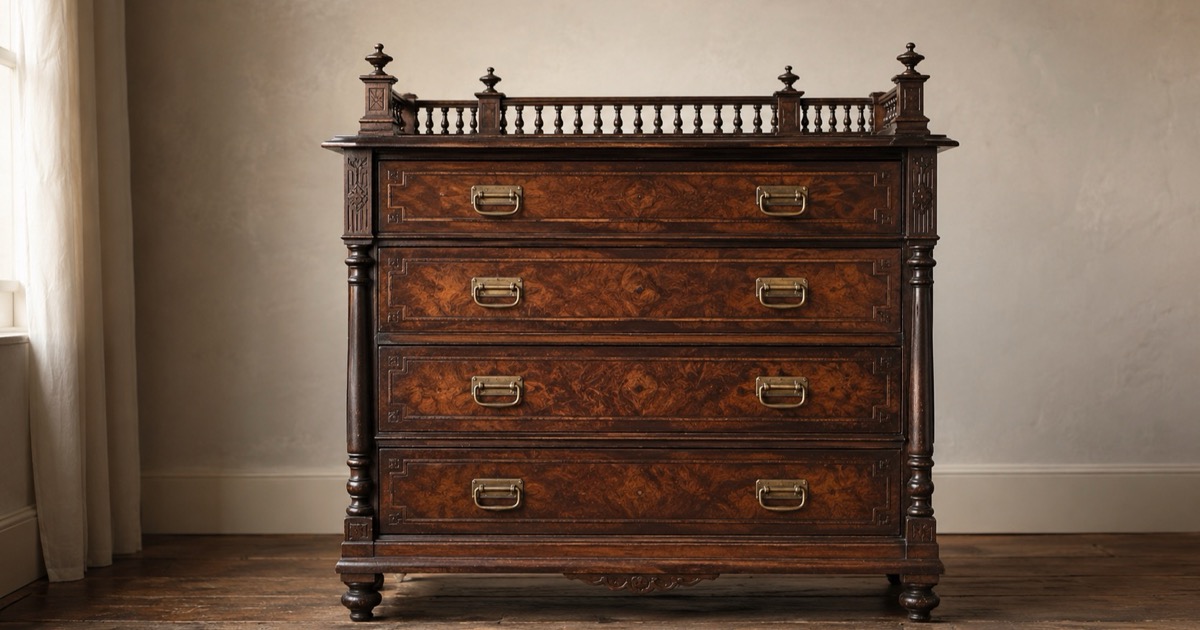
Eastlake furniture identification is usually straightforward once you know what to look for, because the style has a visual signature almost entirely unlike the other Victorian furniture categories surrounding it. Where Rococo Revival furniture curves, swells, and carves roses, and Renaissance Revival uses heavy classical moldings, Eastlake furniture is flat, geometric, incised, and deliberately rectilinear—a reform aesthetic that self-consciously rejected Victorian excess. The pieces are common at antique malls and estate sales, affordable, and often underestimated by people who do not recognize the style.
Eastlake furniture is a rectilinear American Victorian style of roughly 1870–1890, identified by shallow geometric lines incised into flat wood surfaces, rows of turned spindles, burl walnut panels, and angular brass bail pulls. Run a fingertip across the decoration first: ornament cut into the wood, rather than raised carving, is the single most reliable tell.
The name comes from the English designer and writer Charles Locke Eastlake, whose 1868 book “Hints on Household Taste” argued for honest construction, simple geometric ornament, and rejection of the machine-carved excesses of mid-century furniture. American manufacturers in the 1870s and 1880s adapted his principles loosely—sometimes very loosely—into a commercially produced style that was marketed as modern and reform-minded, and the resulting furniture dominated middle-class American parlors and bedrooms.
Quick identification checklist
- Incised parallel lines and geometric carving. The primary decorative motif is shallow lines cut directly into the wood surface in geometric patterns—parallel grooves, cross-hatching, simple interlocking shapes. This is incised work, not raised carving.
- Rectilinear form. Eastlake case pieces, beds, and chairs are boxy and upright with minimal curves; the silhouette is architectural rather than organic.
- Turned spindles. Galleries on sideboards, headboards, and what-not shelves typically feature rows of turned wooden spindles—lathe-turned rounded vertical elements.
- Burl walnut panels. Drawer fronts and door panels in walnut examples frequently feature applied burl veneer panels with a highly figured grain.
- Rectangular brass hardware. Drawer pulls are typically bail pulls with rectangular or geometric backplates rather than the round or oval escutcheons of earlier styles.
- Spoon carving. Some higher-end Eastlake pieces include small spoon-shaped or sunflower-motif incised carvings alongside the geometric line work.
The visual vocabulary in detail
The most reliable single indicator of Eastlake furniture is the incised decoration. Run a fingertip across a decorated surface: Eastlake ornament is cut into the wood, leaving a recessed line or groove. This is physically different from the raised carving of earlier Victorian styles where wood is removed around a motif to leave it standing proud. The result is a crisp, almost architectural pattern of lines, cross-hatching, and simple shapes that looks more medieval or Japanese-influenced than European classical.
Turned spindles are the second signature element. Long rows of small lathe-turned spindles appear in the upper gallery sections of sideboards, along headboard and footboard rails, and as decorative elements in chairs and shelving. The turning profiles are simple—not the elaborate bulbous turnings of later Colonial Revival work.
Panel construction uses flat surfaces with incised ornament rather than the fielded and molded panels of earlier case furniture. Burl walnut was the premium finish of the walnut period; the swirling, highly figured grain of burl provides visual richness that substitutes for surface carving. Ebonized (black-stained) details appear on higher-end pieces as accent elements, typically highlighting turned elements or framing panels.
Woods, hardware, and period variants
Walnut and burl walnut dominate the early Eastlake period (roughly 1870 to the early 1880s). Burl walnut veneer panels were a prestige marker and appear on quality bedroom sets, parlor furniture, and sideboards. Cherry also appears, particularly in New England-made examples. As American furniture production shifted in the late 1880s and early 1890s, oak became the dominant wood, continuing into the Arts and Crafts era that followed.
Brass hardware on Eastlake pieces is characteristically angular. Bail pulls—the swinging loop handle—attach to rectangular or geometric backplates rather than the round or oval plates of earlier styles. The overall effect reads as functional and geometric rather than decorative and ornate. Some pieces use simple turned wooden knobs as a budget alternative to brass.
Marble tops appear on Eastlake sideboards and dresser cases, particularly in bedroom sets. The marble is typically white or grey and sits in a rectilinear gallery frame. Marble-top Eastlake pieces are among the most commonly encountered examples and are in strong demand for use as functional furniture.
Factory production and labeling
The vast majority of Eastlake furniture found today was factory-produced, primarily by Midwestern manufacturers in cities like Grand Rapids, Michigan—then the center of American furniture production. These pieces were made efficiently for the middle-class market and were not labeled in the way that custom furniture might be. Retailer stencils occasionally appear on the backs of drawers or inside case pieces, identifying the store rather than the factory, but such markings are incidental and do not establish the factory of origin.
The practical implication for identification is that you cannot look for a manufacturer’s mark to confirm Eastlake attribution. The identification rests entirely on the stylistic evidence: incised geometric ornament, rectilinear form, turned spindles, burl panels, and rectangular hardware.
Distinguishing Eastlake from related styles
Colonial Revival, which gained momentum from the 1880s onward, is the most common confusion. Colonial Revival furniture also uses turned elements but favors Pilgrim-century and Federal-era references—cabriole leg revival, splat-back chairs, highboys, and Windsor chair forms—rather than Eastlake’s flat incised geometric decoration. Colonial Revival typically lacks the incised line work and instead emphasizes turned and carved elements with historical European references.
Renaissance Revival (roughly 1860–1880) sometimes appears alongside Eastlake in estate contexts because the two overlap in date. Renaissance Revival is immediately distinguishable by its massive, heavy forms, applied architectural moldings, cartouches, and figural carved elements—nothing resembling the flat incised geometry of Eastlake.
Arts and Crafts furniture follows Eastlake chronologically and shares the reform-minded rejection of Victorian excess, but the two are visually distinct. Arts and Crafts (including Mission style) uses mortise-and-tenon construction with exposed joinery as the primary ornamental feature, plain quartersawn oak surfaces, and minimal incised decoration. If a piece has visible tenons and plain grain emphasis rather than incised lines and burl panels, it is Arts and Crafts.
Earlier handmade pieces are rarely confused once you understand the construction context. Eastlake is almost always factory-made with machine-cut incised decoration; the lines have a mechanical precision. Hand-carved Victorian furniture from custom shops shows tool marks and organic variation in its carving that is immediately different.
Market framing and value context
Eastlake furniture was produced in large quantities for the middle-class market and a great deal of it has survived. This means the style is genuinely plentiful at antique malls and estate sales, and prices are generally accessible. Complete bedroom sets—bed, dresser, washstand—in good condition sell steadily to buyers who want the look for actual use. Marble-top pieces command a modest premium.
The style is not particularly fashionable among high-end collectors, which keeps prices reasonable. Individual case pieces commonly sell at accessible three-figure prices; complete bedroom sets in good condition bring more. Condition is the dominant variable: original hardware, intact veneer, and unmarked marble surfaces matter much more than minor variations in maker or specific design.
Eastlake is an honest choice for someone who wants genuinely antique Victorian furniture at a practical price point. The pieces are well-constructed by factory standards of the period, the visual identity is consistent and easy to learn, and the form is functional for modern use.
Watch-outs and common mistakes
- Not every incised piece is Eastlake. Japanese-influenced Aesthetic Movement furniture also uses incised line work and turned elements; the distinction lies in overall form and the specific vocabulary of motifs.
- Replaced hardware is common. Rectangular brass bail pulls are not hard to source; hardware replacement does not disqualify a piece but should be noted when pricing.
- Veneer lifting and splitting is endemic. Burl walnut veneer applied in the 1870s–1880s with period adhesives often shows lifting at edges and corners. Assess the extent before purchase for use; repair is possible but adds cost.
- Ebonized details may have faded or been refinished. Original ebonizing was sometimes lost in later refinishing campaigns; check protected surfaces (undersides of shelves, interior faces) for evidence of original finish.
- Marble top replacements are common. Not all marble on an Eastlake piece is original; examine the frame fit and any wear patterns to assess whether the marble is period or replaced.
Photo tips that improve identification
- Shoot a flat decorated surface under raking light. The incised line work is the defining feature; a low-angle light source reveals the depth and pattern of the incising with a clarity that straight-on flash photography obscures.
- Document the hardware. Photograph both the pull face and the backplate; rectangular backplates are a positive period indicator and photographing them documents whether hardware is period or replaced.
- Capture the full silhouette. A straight-on shot of the piece showing its overall rectilinear profile and turned gallery elements is useful for style confirmation.
- Check and photograph the back of a drawer. Secondary wood species, hand-cut vs. machine-cut dovetails, and any stenciled retailer marks are all visible on drawer backs and provide supporting evidence for period and origin.
Common questions
Is Eastlake furniture worth anything?
Eastlake furniture survives in large quantities, so prices stay accessible: individual case pieces commonly sell at three-figure prices, with complete bedroom sets and marble-top pieces bringing more. Condition is the dominant variable—original hardware, intact burl veneer, and undamaged marble matter far more than minor design differences. It is a good value for buyers who want usable antique Victorian furniture.
How do you tell Eastlake from other Victorian furniture?
The defining feature is incised decoration: shallow geometric lines, grooves, and cross-hatching cut into flat wood surfaces, paired with a boxy, upright silhouette. Rococo Revival curves and carves raised roses, and Renaissance Revival uses heavy applied moldings and figural carving, so the flat, linear, almost architectural look of Eastlake stands apart once you have seen the contrast.
Did Eastlake furniture makers mark their pieces?
Almost never. The vast majority was factory-produced, mainly in Grand Rapids and other Midwestern centers, and left the factory unmarked. Occasionally a retailer’s stencil appears on a drawer back or inside a case, but it names the store, not the maker. Identification rests on stylistic evidence—incised ornament, turned spindles, burl panels, and rectangular hardware—rather than on any label.
Related guides
- Victorian Furniture Identification
- Identifying Antique Furniture Styles: Shape, Feet, and Joinery
- How to Date Furniture by Dovetail Joints
When to use the Antique Identifier app
Photograph the piece straight on to show its overall form, then a close-up of the incised decoration under raking light, and finally any hardware. The app can match the visual signature of the incised geometric ornament, turned spindles, and rectangular hardware to the Eastlake pattern quickly—helpful when you are at an estate sale and want confirmation before committing. For pieces being considered for significant purchase, hands-on examination of veneer condition, hardware originality, and structural integrity remains important.