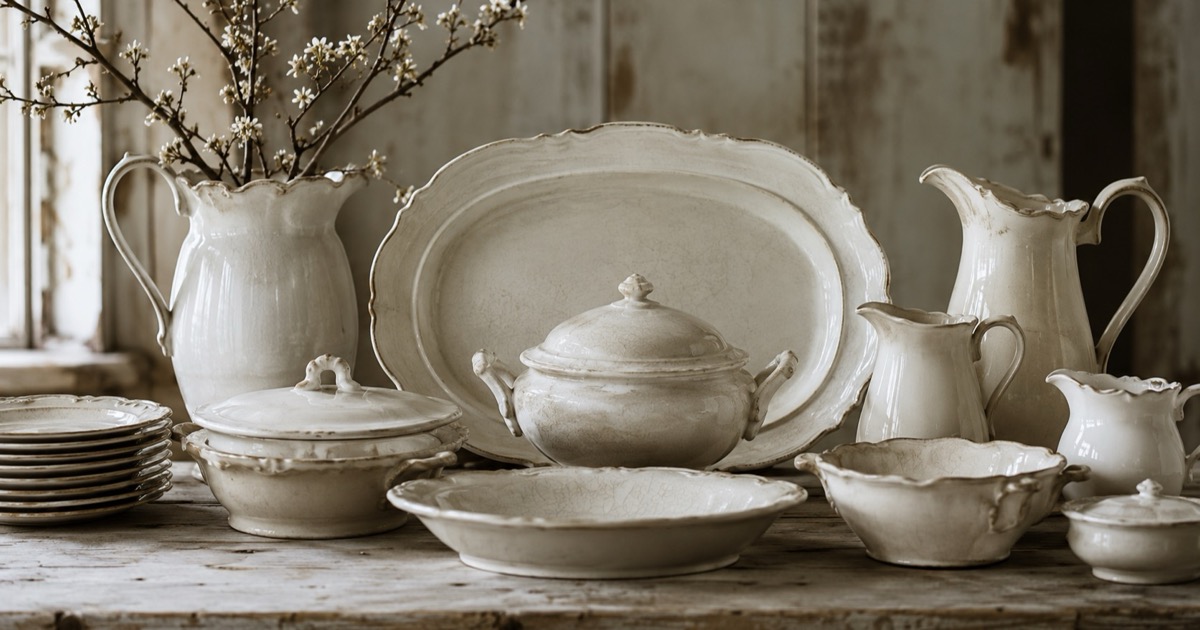
Ironstone china identification comes down to a few checks you can run in under a minute: the wording in the backstamp, the weight and opacity of the body, and the character of the glaze. By the end of this guide you will be able to recognize the classic ironstone marks, separate ironstone from porcelain with confidence, and judge whether a piece dates to the Victorian heyday or a much later revival.
To identify ironstone china, flip the piece and read the backstamp: wording such as “Ironstone China,” “Royal Ironstone China,” or “White Granite” is the clearest tell, and the body is heavy and fully opaque, never glowing like porcelain against a light. Start by photographing the mark and comparing it against known Staffordshire makers such as Mason’s and Meakin.
The skill is worth having because ironstone survives in enormous quantities. It was the workhorse tableware of nineteenth-century households on both sides of the Atlantic, which keeps most pieces affordable — and makes the early or unusual examples easy to overlook if you do not know what the marks are telling you.
Quick identification checklist
- Flip the piece and look for wording such as “Ironstone China,” “Royal Ironstone China,” “Stone China,” or “White Granite.”
- Hold it to a strong light: true ironstone is fully opaque, never translucent like porcelain.
- Feel the weight — ironstone is noticeably heavier and thicker-walled than porcelain of the same size.
- Look for maker cartouches from Mason’s, J. & G. Meakin, Alfred Meakin, or Johnson Brothers, often beneath a crown or royal arms.
- Check for a diamond-shaped English registry mark or an “Rd No” number that brackets the design date.
- Note crazing and tea-colored staining, which matter more to value than most sellers expect.
What ironstone actually is
Ironstone is a dense, durable earthenware engineered to look like porcelain and survive like stoneware. The origin story runs through Staffordshire: in 1813 Charles James Mason patented his “Patent Ironstone China,” a heavy, tough body sold as affordable china for everyday use. The name was marketing genius more than chemistry — there is no meaningful iron in the recipe — and rival potteries quickly offered their own versions under names like stone china, granite ware, and white granite.
By the middle of the nineteenth century, Staffordshire potters were shipping plain white ironstone across the Atlantic by the ton. These undecorated services, often with molded wheat, ribbed, or paneled gothic shapes, furnished farm kitchens throughout the United States and Canada, which is exactly why so much of it surfaces at estate sales today.
Marks to look for in ironstone china identification
Most ironstone announces itself. British makers stamped the body name prominently, usually under a crown or royal arms cartouche with the firm’s name nearby. Mason’s used a crown above a banner reading “Mason’s Patent Ironstone China.” Johnson Brothers and many competitors used “Royal Ironstone China” with the royal arms, and J. & G. Meakin and Alfred Meakin marked enormous quantities destined for the American market.
| Mark wording | What it usually tells you |
|---|---|
| ”Mason’s Patent Ironstone China” | Mason’s body, made from 1813 onward — the cartouche continued for decades |
| ”Royal Ironstone China” with royal arms | Standard late-Victorian export wording used by Johnson Brothers, Meakin, and others |
| ”Stone China” or “White Granite” | Competing trade names for the same class of ware |
| Diamond registry mark | Design registered between 1842 and 1883 |
| ”Rd No” plus a number | Design registered in 1884 or later |
| ”England” or “Made in England” | Roughly 1891 onward; “Made in” wording is mostly twentieth century |
Two cautions. A registry mark dates the design registration, not the individual piece, which may have been produced for years afterward. And American potteries copied British-style arms and wording to sell their own white granite, so a royal arms cartouche alone does not prove English manufacture.
Ironstone versus porcelain: the sixty-second test
Hold the piece up to a bright bulb. Porcelain transmits light — even a thick porcelain plate glows faintly at the rim. Ironstone stays completely opaque no matter how strong the light. The weight test agrees: ironstone sits heavier in the hand than porcelain of the same size, with thicker walls and a sturdier foot.
Look at any chip honestly. An ironstone chip exposes a fine, stone-like, off-white body rather than the glassy, almost sugary fracture of porcelain. Glaze tone differs too: ironstone tends toward warm white, gray-white, or cream, where porcelain reads colder and glassier.
Tea leaf, copper lustre, and decorated variants
Plain white was never the whole story. Tea leaf ironstone carries a small copper-lustre sprig — folklore says a lucky tea leaf — in the center of each piece, often with copper bands at the rim. Dozens of Staffordshire firms made it, with Anthony Shaw and Alfred Meakin among the names collectors see most, and some American potteries joined in. Copper lustre banding also appears on its own, without the sprig.
Ironstone bodies also carried transfer printing. Flow blue, mulberry, and the great mid-century romantic scenes were usually printed on ironstone-grade earthenware, so a single piece can be both ironstone and transferware at once. When the printed pattern rather than the body is your question, research that side separately.
The farmhouse boom and honest value expectations
White ironstone moved from junk-shop shelf to magazine page when farmhouse decorating made stacks of white pitchers and tureens a styling staple. The demand is real but concentrated: large hollowware — pitchers, ewers, covered tureens, footed compotes — and early paneled or gothic shapes sell far better than flatware. Dinner plates survive in such quantity that clean nineteenth-century examples often bring modest money.
Condition and form dominate. A crisp early jug with light crazing will usually outsell a stained, chipped rarity, and tea leaf has its own dedicated collector market. Treat any single-piece price you see online as a hypothesis to test against sold examples, not a promise.
Living with crazing and stains
Crazing — the fine network of glaze cracks — is normal on old ironstone, and the brown staining that follows comes from decades of food, grease, and moisture wicking into those cracks. Many collectors lighten staining with long, patient soaks in household-strength hydrogen peroxide over several days. Avoid chlorine bleach: it can drive salts into the porous body and contribute to flaking glaze later. Skip the dishwasher and the oven entirely, since heat shock widens crazing, and dry any soaked piece thoroughly before storing it away.
Watch-outs and common mistakes
- The word “ironstone” never went away. Plenty of 1960s and 1970s tableware from England, the United States, and Japan says “ironstone” in the mark — useful ware, but not Victorian.
- “Wedgwood & Co” on ironstone is a different firm from Josiah Wedgwood & Sons, and the resemblance was intentional.
- A royal arms backstamp is decoration, not proof of English origin or of quality.
- Crazing is not evidence of age by itself; some twentieth-century glazes crazed within a few years.
- Tureens and lids separate over a century of use — confirm that pattern, maker, and fit truly match before paying a complete-piece price.
Photo tips that improve identification
- Shoot the full backstamp straight-on so the wording and cartouche detail fill the frame.
- Use raking side-light to record crazing and staining honestly — identifiers and buyers both need to see it.
- Photograph hollowware in profile; paneled, gothic, and wheat-molded shapes are dating evidence in themselves.
- If there is a chip, take one close-up showing the exposed body color.
Common questions
Is unmarked ironstone china worth anything?
Yes, unmarked ironstone sells regularly, especially plain white hollowware in early paneled, gothic, or wheat-molded shapes. Many smaller Staffordshire and American potteries left pieces unmarked, so collectors judge them on form, body, and condition instead. Large pitchers, tureens, and compotes carry the demand; unmarked flatware survives in such quantity that it usually brings modest money.
How can you tell ironstone from porcelain?
Hold the piece against a strong light: porcelain glows faintly at the rim, while ironstone stays completely opaque. Ironstone is also heavier and thicker-walled than porcelain of the same size, and a chip exposes a stone-like, off-white body rather than a glassy fracture. Glaze tone helps too — ironstone reads warm white or cream, porcelain colder and glassier.
What does “Royal Ironstone China” on the bottom mean?
It is a late-Victorian trade wording, usually printed with a royal arms cartouche, that British firms such as Johnson Brothers and the Meakin potteries used on export tableware. It signals the durable ironstone body rather than royal endorsement, and American potteries copied the wording and arms, so the phrase alone does not prove English manufacture — check the maker’s name in the mark.
Related guides
- Transferware Identification
- Antique English China Marks Identification
- Old China Marks Identification: What Backstamps Really Tell You
When to use the Antique Identifier app
Photograph the whole piece, then take tight, well-lit shots of the backstamp and any lustre or molded detail. The Antique Identifier app narrows the likely type, era, and maker quickly, which turns a vague “old white china” into a specific search. If it points to something early or unusually valuable, treat that as a prompt for deeper verification against marks references, not as a final answer.