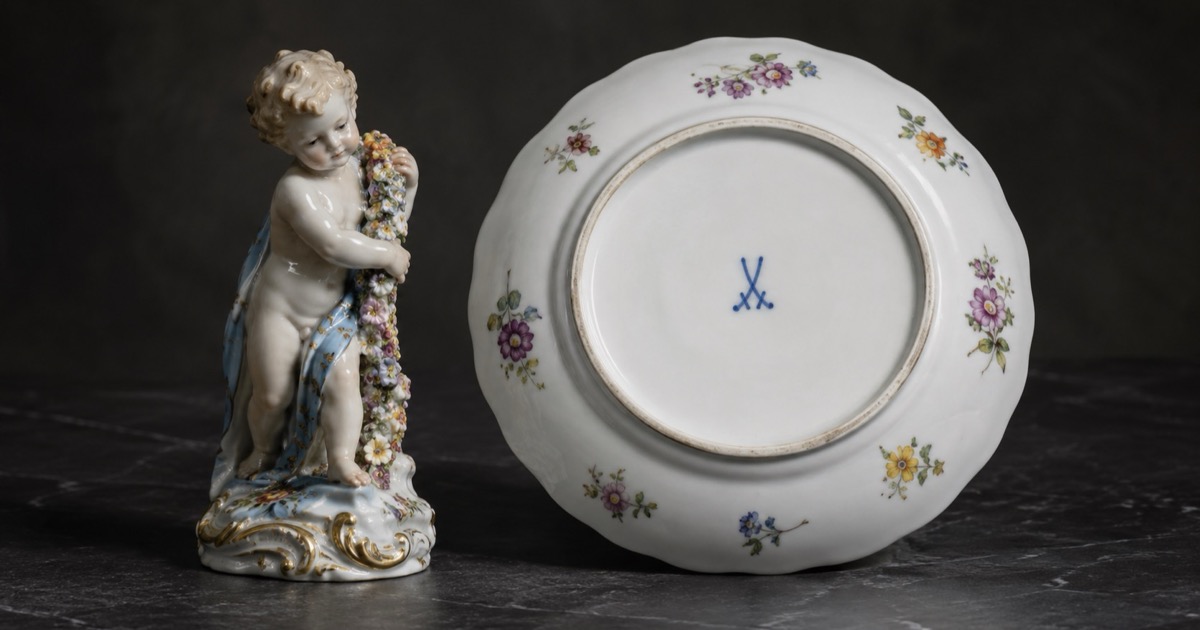
Meissen marks in the form of two crossed swords in underglaze blue have been applied to porcelain made at the Meissen factory in Saxony since the early 18th century, making them among the most recognized marks in the antiques world — and among the most widely imitated. Understanding what genuine marks look like, how they changed across periods, and what other details corroborate factory origin is essential before drawing any conclusion about a piece.
Genuine Meissen marks are crossed swords painted in underglaze blue, sitting beneath the glaze rather than on top of it, often accompanied by incised form numbers in the clay. Check first whether the mark is underglaze, then compare the sword shape to documented period variants, since sword-style marks were copied by many other factories.
This guide walks through the structure of the crossed-swords mark, period variations that are broadly documented, other marks that appear alongside the swords, what cancellation strokes mean, and the substantial imitation problem that makes crossed-sword-style marks unreliable on their own.
Quick identification checklist
- Locate the mark: genuine Meissen marks are underglaze blue, applied before glazing and fired, so they sit under the glaze surface
- Check the swords’ shape and proportion: the hilts, pommels, and relative curvature are all period-diagnostic details
- Look for incised form numbers on the base, often a two- or three-digit number scratched into the clay before firing
- Check whether the swords have a cancellation stroke through them — one or more lines that devalue the piece as a factory second
- Assess the word “Meissen” if present: the factory name written on a piece is not itself a factory mark and appears on some reproductions
- Examine paste quality and modeling refinement under magnification
The underglaze-blue crossed swords
The crossed-swords mark has been Meissen’s primary factory mark for the better part of three centuries, but it has not remained static. Collectors and specialists refer to broad periods characterized by changes in the swords’ shape, the presence or absence of additional elements, and variations in how the hilts, guards, and blade curves are rendered.
A few broadly documented period markers appear in the standard literature:
Early 18th-century marks tend to be simply drawn, sometimes with variation between pieces from the same decade, reflecting hand-painting by different decorators.
A “dot period” is recognized in the second half of the 18th century, during which a dot was placed between the sword hilts. Specialists associate this with a period of factory management and artistic direction change.
A “star period” is associated with marks bearing a star (asterisk-like symbol) near the hilt area, generally placed in the later 18th century.
Later 19th-century and 20th-century marks show their own documented variations in the curvature of the blades and the shape of the pommels.
The important caveat: the precise visual differences between period marks are subtle enough that confident period attribution from the mark alone requires specialist reference. Published collector guides and auction-house reference charts show photographic comparisons that are far more reliable than verbal description. If you are trying to date a piece by mark period, consult a dedicated Meissen reference rather than relying on a general description.
Incised and impressed marks
Alongside the painted swords, Meissen pieces frequently carry additional marks in the clay itself:
Incised form numbers are scratched or cut into the unfired clay before the first firing. These are model or pattern numbers that allow the factory to track which mold a piece came from. They are typically one, two, or three digits, sometimes with letters, and appear on the base.
Impressed marks were made by pressing a stamp into the soft clay. Various factory management periods used impressed marks for production or quality-control tracking.
These additional marks do not prove factory origin on their own — they can be faked — but their absence on a piece that otherwise appears to be factory production is worth noting, and their presence in an appropriate style is a corroborating detail.
Cancellation strokes: factory seconds
One of the more practically useful marks to recognize is the cancellation stroke: one or more lines, typically also in underglaze blue or incised, drawn through the crossed swords. This is the factory’s own notation that a piece did not pass quality inspection and was sold as a second, typically without decoration or at a reduced price.
Common reasons for cancellation include glaze flaws, kiln accidents, or slight distortion. Cancelled pieces are genuine Meissen factory porcelain — they were made there — but they left the factory explicitly as rejects. Some were later decorated outside the factory, and a decorated cancelled piece can be misleading to a buyer who interprets “decoration” as quality.
The commercial significance: a cancelled piece is less valuable than a non-cancelled piece with the same apparent form and decoration. A seller who describes a cancelled piece simply as “marked Meissen” without disclosing the cancellation is presenting incomplete information.
The imitation problem: many factories used sword-like marks
The Meissen crossed-swords mark was copied extensively from the 18th century onward. A partial list of factories known to have used marks that resembled crossed swords or that could be confused with them includes operations in Thuringia, Bohemia, France, England, and later in Japan and elsewhere. Some of these were deliberate copies; others were simply two-line or two-stroke marks that happen to resemble swords to an untrained eye.
The word “Meissen” written on a piece is not a Meissen factory mark. Some reproductions and tourist pieces bear the place name as text, which is legally and practically different from the factory’s own applied mark.
When examining a crossed-sword-style mark, the relevant questions are:
- Is the mark underglaze (under the glaze surface) or overglaze (on top of the glaze, sometimes even painted on after purchase)?
- Does the exact sword shape, proportions, and style match documented Meissen period marks, or does it only vaguely resemble them?
- Do the overall paste quality, modeling, and decoration style match the claimed period?
Hard-paste quality cues
Genuine 18th- and 19th-century Meissen is hard-paste porcelain of consistently high quality. Physical cues that are broadly associated with authentic factory production:
Crisp modeling. Applied elements — flowers, figures, handles, finials — show clean edges and fine detail that holds up under close examination. Mold seams on copied pieces are often more visible.
Fine, controlled painting. Period decoration on Meissen was executed by trained painters. The brushwork on authentic pieces is precise and confident; copies often show hesitant outlines, slightly off-register colors, or simplified pattern elements.
Paste color and translucency. Authentic Meissen hard-paste porcelain has a cool, slightly translucent white body when viewed with strong backlighting at thin points. The paste feels dense and smooth at any unglazed foot rim.
Glaze fit. Period glaze sits tightly on the body with a fine, even surface. Reproductions sometimes show slightly thick or uneven glaze pooling.
None of these cues individually proves factory origin, and skilled reproductions can mimic several simultaneously. They are best read as a suite.
When a piece deserves specialist verification
The combination of Meissen’s prestige and the breadth of the imitation problem means that self-identification from the mark alone is genuinely risky for any piece of apparent value. Specialist verification is worth pursuing when:
- The piece appears to be 18th century based on mark style, paste, and decoration
- The asking price or insurance value is significant
- The mark is difficult to read clearly or appears overglaze
- The decoration does not match the period implied by the mark (suggesting later outside decoration)
Auction houses with ceramics departments, certified appraisers with German porcelain experience, and established dealers who specialize in Meissen can provide documented opinions.
Watch-outs and common mistakes
- Assuming any crossed-sword mark is Meissen: dozens of factories used similar marks, and the Meissen mark has been copied since the 18th century
- Reading an overglaze mark as factory-applied: some pieces have marks added outside the factory after purchase, including on blanks that were factory-made but sold undecorated
- Ignoring cancellation strokes, which materially affect both authenticity narrative and value
- Treating the word “Meissen” written as text as equivalent to the factory’s applied mark
Photo tips that improve identification
- Photograph the base under strong raking sidelight to show the mark’s texture and whether it sits in or on the glaze surface
- Use backlighting through thin walls or the base to show paste translucency and color
- Photograph any incised marks at an angle to show the cut depth and character
- Include a detail shot of the most refined painted element to document painting quality
Common questions
What do the lines through the Meissen crossed swords mean?
One or more strokes cut or painted through the crossed swords are the factory’s own cancellation marks, indicating the piece failed quality inspection and was sold as a second. Cancelled pieces are genuine Meissen porcelain, but some were decorated outside the factory later, and they are worth less than comparable non-cancelled pieces. A seller should disclose a cancellation.
How can you tell a real Meissen mark from a fake?
Start with position: genuine marks are painted in underglaze blue, so they sit beneath the glaze surface rather than on top of it. Then compare the exact sword shape and proportions to documented period marks in a Meissen reference, and check that paste quality, modeling, and painting match the period the mark implies. Sword-style marks were copied by many factories, so the mark alone never settles the question.
What do the numbers scratched into the bottom of Meissen porcelain mean?
Incised numbers cut into the clay before firing are form or model numbers that told the factory which mold a piece came from. They are usually one to three digits, sometimes with letters, and they corroborate factory production without proving it on their own, since they can also be imitated.
Related guides
- Antique Porcelain Marks: How to Read Backstamps
- How to Identify Wedgwood Marks and Date
- Royal Doulton Marks Identification
- Common Signs of Antique Reproductions and Fake Antiques
When to use the Antique Identifier app
Photograph the full piece, then add a tight close-up of the base mark, the foot rim paste, and the finest detail of any painted decoration. The app can identify the mark type and suggest period ranges quickly, helping you decide whether the combination of mark, form, and decoration is consistent. Treat any result suggesting significant age or value as a prompt for specialist verification rather than a final answer.