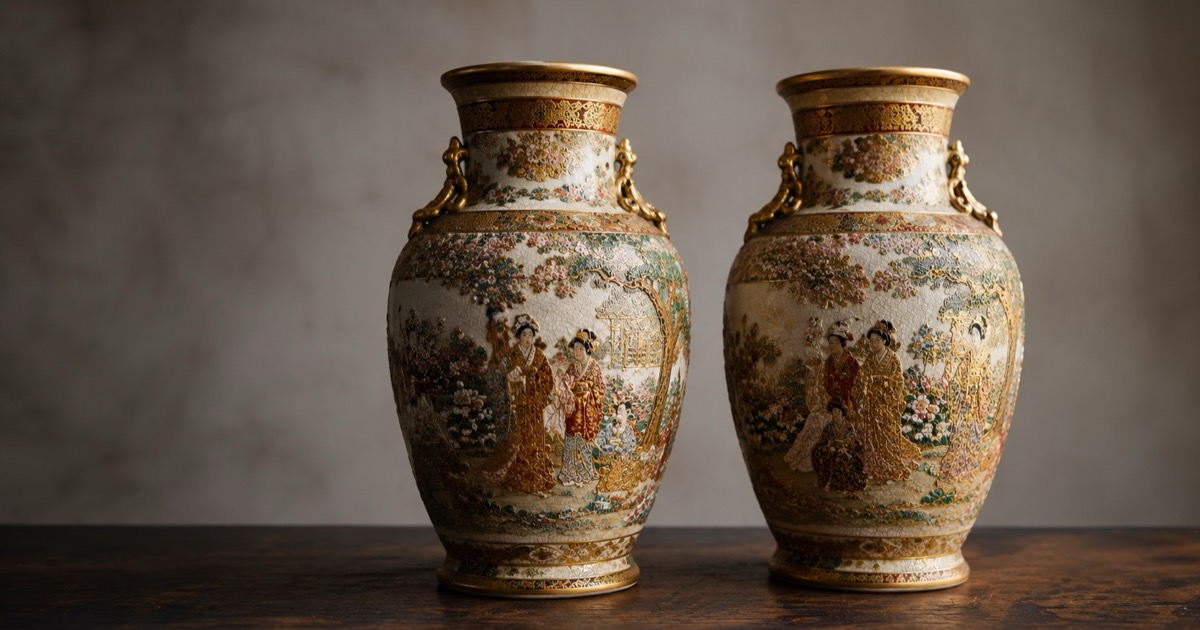
Satsuma pottery identification starts with recognizing one of the most distinctive looks in Japanese ceramics: a finely crackled cream or ivory earthenware body smothered in raised enamel decoration and glittering gilt. The style became a global sensation during the Meiji period (1868–1912), and pieces from that era remain highly sought after. The challenge is that the Satsuma name also covers decades of progressively cheaper export ware and later reproductions, so reading the evidence correctly matters.
Satsuma is Japanese earthenware with a cream or ivory body covered in fine all-over crazing and decorated with raised enamel and generous gilt. To identify a piece, confirm the crackled earthenware body first — true Satsuma is never smooth white porcelain — then check the base for the Shimazu circle-and-cross crest and a painted workshop signature.
By the end of this guide you will be able to place a piece in its rough era, understand what the Shimazu crest and painted signatures do and do not tell you, and distinguish quality Meiji craftsmanship from the mass-market output that followed.
Quick identification checklist
- Confirm the body: true Satsuma is earthenware with a fine, all-over crazing visible in good light — not smooth porcelain.
- Look for raised enamel (moriage-style beading) and gold gilt on the decoration, not flat printed transfers.
- Find the base: look for the Shimazu clan crest (a circle enclosing a cross), painted signatures in Japanese script, and/or a gilt cartouche naming a workshop.
- Assess the figure and face work: Meiji-quality pieces show minute, precise brushwork in faces; later tourist pieces show blurry, crowded “thousand faces” with loose, repetitive strokes.
- Check whether any English text is painted on the base — “Made in Japan” points to 1921 onward, and “Made in Occupied Japan” to 1945–1952.
- Note the palette: Meiji export ware favors rich cobalt, deep red, and lavish gold; later pieces often run to muddy or thin-looking color with gold that flakes easily.
The classic Satsuma look
Genuine Satsuma earthenware is off-white to pale buff in color and covered in a fine network of crazing lines across the entire glaze surface. Run a finger across the unglazed base — it feels slightly gritty, not glassy like porcelain. This crackled ground is the canvas for dense, highly detailed painted decoration.
The signature decorative vocabulary includes scenes of courtiers, warriors, or immortals in gardens, bordered by geometric patterns and stylized chrysanthemums. The finest Meiji work layers multiple colors of enamel in tiny raised dots and lines, giving the surface an almost textile quality. Gilt is applied generously and on quality pieces retains good adhesion and luster after more than a century.
The Meiji export era versus later output
The Meiji period represents the first and most celebrated wave of Satsuma production aimed at Western buyers. Workshops in Kyoto (which produced much of what the West calls “Satsuma”) competed to supply international expositions and wealthy collectors. Pieces from this era show exceptionally fine detail, balanced compositions, and ambitious scale.
After the Meiji period, and increasingly through the Taisho and early Showa decades, production scaled up for tourist and souvenir demand. Compositions grow repetitive, the “thousand faces” motif (a dense field of small human heads) appears as a quick crowd-filler rather than a carefully composed scene, gilding thins, and overall execution coarsens. These pieces have their own collector following but are valued differently.
The Shimazu crest and what it tells you
The Shimazu clan crest — a circle with a cross inside it — appears on the base of a very large percentage of pieces called Satsuma. Its presence is often misread as a hallmark of quality or authenticity, but it functions more like a regional style marker than a maker’s guarantee. By the late Meiji period the crest had been widely adopted across many workshops and subsequently copied on lower-grade export ware.
What the crest alone cannot tell you: the specific workshop, the date, or the quality tier. What it can confirm: the piece is at least claiming affiliation with the Satsuma tradition. Use the crest as a starting point, not a conclusion.
Reading signatures and workshop marks
Many Satsuma pieces carry painted signatures in Japanese script, often inside a gilt cartouche on the base or near the foot rim. These signatures name the workshop or artist. Kinkozan is among the best-documented Kyoto Satsuma workshops, known for fine figure painting and precise gilding; pieces bearing this name in a legitimate cartouche consistently attract strong collector interest.
On high-quality pieces, the signature is painted with the same precision as the rest of the decoration. On tourist pieces, signatures may appear sloppily applied or inconsistent with surrounding work. Because signatures can be copied, treat a name as supporting evidence — a piece needs to earn it through quality, not just carry the label.
The quality spectrum: museum-grade to tourist ware
Satsuma spans an enormous range. Museum-caliber Meiji pieces display portraiture with individually rendered facial expressions, costumes with microscopic textile detail, and gilding that remains sharp and three-dimensional — these require expert appraisal.
Mid-range export pieces are competently executed: figures readable, faces distinct, but lacking the obsessive detail of top-tier work. These form the bulk of what appears in antique shops and estate sales.
Tourist ware shows crowded compositions, indistinct faces, thin or peeling gold, and a body that may feel coarser than Meiji pieces. “Thousand faces” pieces (backgrounds packed with small, nearly identical faces) fall in this category when execution is poor, though highly detailed “thousand faces” by skilled artists exist at higher quality levels.
20th-century reproductions and “Royal Satsuma” ware
From roughly the mid-20th century onward, a category of ware sometimes marketed as “Royal Satsuma” or similar trade names emerged. These pieces often have a harder, whiter body than authentic Meiji earthenware, suggesting a porcelain or semi-porcelain paste rather than true earthenware. The crazing, if present, may appear artificially induced or uniformly distributed in a way that differs from the organic crackle of genuine old glaze.
Decoration on these pieces tends toward bright, slightly plastic-looking enamels, and gilt often appears thin and flat. The Shimazu crest may appear alongside English text or country-of-origin marks that were legally required in different periods. “Nippon” (used for US-market imports from 1891 to 1921), “Japan” or “Made in Japan” (1921 onward), and “Made in Occupied Japan” (1945–1952) all serve as date brackets when they appear.
Watch-outs and common mistakes
- Assuming the Shimazu crest guarantees Meiji-era origin or high quality — many pieces with the crest are 20th-century tourist ware.
- Confusing a hard white porcelain body for authentic Satsuma earthenware — real Satsuma is softer, cream-toned, and distinctly crackled.
- Reading “Nippon” as an authenticity indicator rather than a date bracket for US-market imports before 1921.
- Overlooking English text on the base, which immediately narrows the date range in ways the decoration alone cannot.
- Treating a signature or workshop name as definitive without considering whether the overall execution matches a genuine piece’s quality level.
Photo tips that improve identification
- Photograph the base flat-on under bright, even light to capture the full crest, signature, and any painted text clearly.
- Use raking side-light on the decorated surface to show raised enamel work (moriage) in relief — flat photos under direct overhead light flatten this detail.
- Capture the crazing pattern close-up; its fineness and distribution are diagnostic, and a macro shot makes them legible for comparison.
- Photograph the foot rim and unglazed body areas separately — body color and texture are key to distinguishing earthenware from porcelain imitations.
Common questions
What does the circle with a cross mean on Satsuma pottery?
That is the Shimazu clan crest, the emblem of the family that ruled the Satsuma domain. It marks a piece as belonging to the Satsuma tradition, but it is not a maker’s mark or a quality guarantee. By the late Meiji period many workshops used it, and it was widely copied on lower-grade export and tourist ware afterward.
How can you tell real Satsuma from a reproduction?
Start with the body. Genuine Satsuma is soft, cream-toned earthenware with fine, organic crazing across the glaze; many reproductions use a harder, whiter porcelain-like body with crazing that looks uniform or artificially induced. Then judge the painting — precise faces and sharp raised gilt point to quality work, while blurry crowded figures and thin flat gold point to later mass production.
Is Satsuma pottery valuable?
It varies enormously by quality tier rather than by the Satsuma name itself. Finely painted Meiji-era pieces with precise faces, layered enamel, and intact gilt attract strong collector interest, especially with a documented workshop signature such as Kinkozan. Tourist-grade pieces with crowded compositions and flaking gold are common and trade modestly, so condition and execution drive the outcome.
Related guides
- Nippon Porcelain Marks Identification
- Antique Porcelain Marks: How to Read Backstamps
- Antique Vase Identification Marks
When to use the Antique Identifier app
Photograph the whole piece first, then take tight detail shots of the base marks, any signature cartouche, and a close-up of the decorative surface showing the enamel and gilt texture. The app can quickly narrow down the style era, flag workshop-name candidates, and distinguish major quality tiers — which is especially useful when you are working through a collection and need to prioritize which pieces warrant deeper specialist attention. Treat any high-value identification as a prompt to consult a Japanese ceramics specialist rather than a final answer.