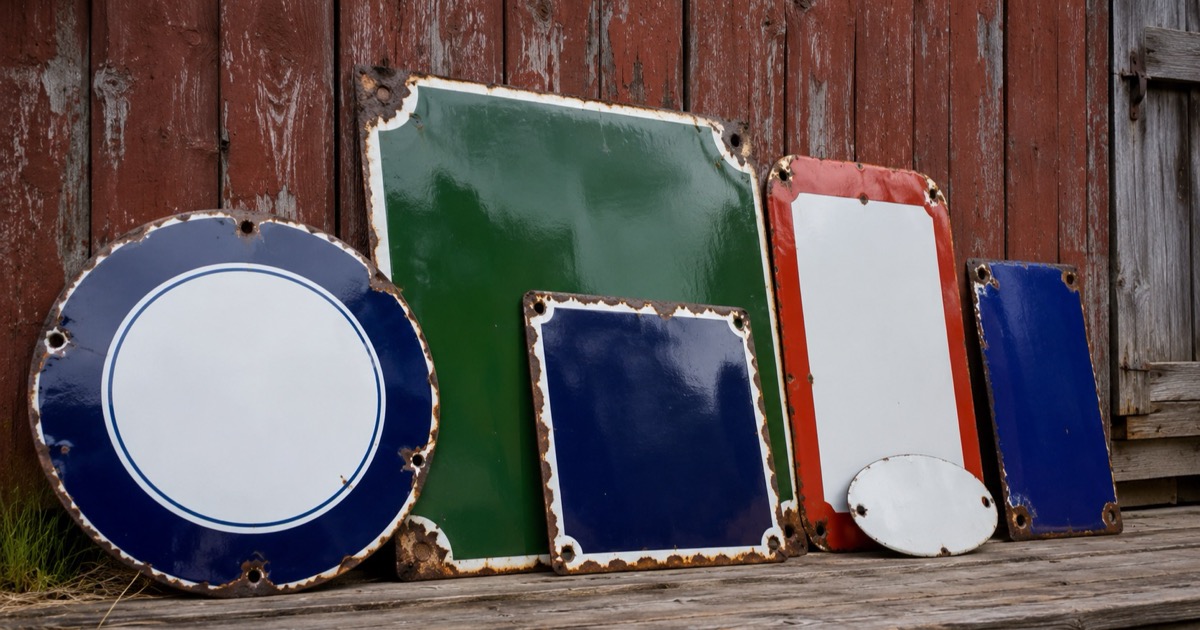
Vintage advertising signs represent one of the most actively reproduced and faked categories in the entire antiques market, which makes identification skills essential before any purchase. The good news is that genuine porcelain-enamel signs carry their age in ways that are difficult to convincingly fake — construction details, mounting wear, chip character, and edge stamps that reward close inspection. By the end of this guide you will be able to distinguish genuine porcelain-enamel signs from modern printed tin and aluminum, recognize the most reliable age indicators, and understand the scale of the reproduction problem.
Genuine vintage advertising signs are porcelain enamel fused to heavy steel, and the most diagnostic tells are chip edges showing layered enamel over a pale steel substrate and directional wear around the grommet holes. To check a sign, inspect a chip edge under bright light and lift it — period porcelain on steel is noticeably heavy.
Porcelain-enamel advertising signs were the dominant outdoor and point-of-sale advertising medium for American businesses from roughly the 1890s through the mid-twentieth century. Their durability — the enameled surface could survive decades of outdoor exposure — also makes authentic survivors genuinely old and increasingly scarce, which drives the collector market and, inevitably, the reproduction industry.
Quick identification checklist
- Examine any chip edge under bright light: genuine porcelain enamel shows distinct white or gray steel substrate beneath the colored enamel layers, with visible layer depth at the chip edge.
- Check grommet holes and mounting hardware: period signs show rust migration, wear rings, and distortion around grommets consistent with actual hanging use.
- Look at the back of the sign: period steel backs show genuine rust patterns, old paint or primer, and sometimes edge-stamp markings from the manufacturer.
- Assess the graphic quality: period commercial printing used specific lithographic and screen-printing techniques visible under magnification; modern digital-print reproductions show pixel structure.
- Feel the edges: genuine porcelain-enamel signs have a slightly raised, shelved enamel edge where the coating terminates; the feel is distinct from flat printed surfaces.
- Check for an edge or back stamp from the sign manufacturer — these appear on many genuine period signs.
Porcelain-enamel construction vs modern alternatives
Understanding how genuine porcelain-enamel signs were made is the foundation of all identification work.
A period porcelain-enamel sign starts with a heavy-gauge steel blank. The surface is cleaned, and successive layers of vitreous enamel — powdered glass fused to the metal at high temperature — are applied and fired. Color layers are built up through multiple firings. The result is a glass-on-steel surface that is extremely hard, weather-resistant, and completely non-absorbent. This construction is visible in two key ways: at chip edges, where you can see the distinct white or pale gray steel substrate beneath the enamel layers (sometimes showing a very thin dark flux layer at the steel interface), and at sign edges, where the enamel terminates in a slightly raised, shelved profile rather than ending flush.
Modern printed tin signs — the most common reproduction type — are thin-gauge tin or aluminum with a lithographed or screen-printed surface, sometimes with a clear coat. They are lightweight, sound tinny when tapped, and show a completely flat printing surface with no layer depth at edges. Under magnification, modern digital printing shows the characteristic dot or pixel pattern of digital output. Period commercial printing shows a different dot pattern from letterpress or early screen processes.
Modern aluminum signs are similar to printed tin but often even lighter. They carry none of the construction characteristics of porcelain enamel.
Grommets, mounting holes, and honest wear
How a sign was mounted and how that mounting has aged are among the most reliable period indicators.
Genuine period signs that were actually used outdoors accumulate consistent wear at mounting points. Grommets — the metal reinforcing rings around hanging holes — show rust migration into the surrounding enamel, wear discoloration from chains or wires, and sometimes distortion from the weight of the sign over years. The rust should be genuine surface rust with a consistent spread pattern, not applied rust-look paint.
The holes themselves often show chipping and wear from contact with mounting hardware. This wear is directional — concentrated at the lower edge of the hole where the sign’s weight pulled it against the fastener year after year.
Reproduction signs often have clean, perfect grommets with no rust migration and evenly distributed artificial distressing that looks applied rather than accumulated. Close inspection usually distinguishes mechanically applied rust simulation from the irregular, reactive patterns of genuine long-term exposure.
The sign’s back is another honest witness. Period signs show genuine corrosion patterns that follow the steel structure and any imperfections in the enamel coating. Applied aged coatings on modern reproductions tend to show more uniform patterns and may look painted on rather than grown.
Edge stamps and maker marks
Many period porcelain-enamel signs carry edge or back stamps identifying the sign manufacturer. These stamps appear in paint or enamel on the sign back or along the edges and typically include the manufacturer’s name or trade name, city of manufacture, and sometimes a date or job number.
Ingram-Richardson (often abbreviated “Ing-Rich”) was one of the largest American porcelain sign manufacturers and appears frequently on period examples. Veribrite Signs is another manufacturer name that appears on documented period signs. Many other regional manufacturers also stamped their work. The presence of a documented manufacturer stamp is positive evidence of period production — but it is worth noting that stamps have been faked on reproduction signs as well, so a stamp is supporting evidence rather than conclusive proof.
The absence of an edge stamp does not rule out a genuine sign; many period signs were unstamped, and the stamp may have been on an area that has since rusted or been damaged.
The reproduction and fantasy-sign problem
The scale of reproduction and fantasy advertising sign production is enormous, and it extends beyond simple copies of genuine period signs into entirely invented categories.
Direct reproductions copy the design of a genuine period sign using modern materials and printing. These are often sold as “decorative reproductions” through retail channels, but they circulate in the secondary market and at flea markets with provenance misrepresented, sometimes deliberately.
Fantasy signs are an even more problematic category: signs made to look period-authentic for brands, products, or businesses that never actually produced porcelain-enamel advertising signs in that form. A sign depicting a rural American product with period-style graphics may be entirely invented — the brand never used that sign type, or the brand itself may be fictional. Fantasy signs are valueless as antiques regardless of how convincingly old they appear, but they regularly surface at antique markets with inflated prices.
Artificially aged reproductions are the most deceptive category. These are typically aluminum or steel signs with applied surface treatment to simulate porcelain enamel chips, rust, and age. The chip edges are painted rather than structural, and close examination at the chip reveals flat paint on a smooth substrate rather than the stepped enamel-on-steel profile of genuine porcelain. The enamel “chips” often have identical profiles, suspicious placement, or too-even distribution.
Period graphics and typography as era clues
Authentic period signs used commercial art and type conventions specific to their production era. Letterforms, illustration styles, color palette choices, and printing techniques all evolved across the decades that porcelain-enamel signs were in production.
Art Deco lettering and graphic conventions are consistent with 1920s–1940s production. Earlier signs show Victorian-era type and illustration styles. Post-WWII production reflects mid-century commercial art conventions. Signs purporting to be from a specific era but showing anachronistic typography or illustration styles deserve scrutiny — a claimed 1920s sign with a typeface that wasn’t in commercial use until the 1950s is a contradiction.
Reproduction artists sometimes combine elements from different eras, creating a sign that doesn’t quite look right to an experienced eye. Building familiarity with documented period signs is the best defense.
Condition grading culture among sign collectors
Sign collectors have developed a condition grading vocabulary that directly affects pricing and trading. Understanding this vocabulary prevents confusion and misrepresentation.
The most common grading system runs from 9.5 (near-perfect, essentially unused condition) down through numbers reflecting progressively more chips, rust bleed, fading, and structural damage. An 8 or above is typically considered excellent; below 6 describes a sign with significant wear or damage. Specific grades and their descriptions vary somewhat between dealers and auction houses, but the general scale is widely used.
Chips — areas where enamel has separated from the steel — are the most common defect and the primary value reducer. A few small chips in inconspicuous areas (edges, corners) are expected and tolerable; chips in the main graphic field significantly affect grade. Chip color matters: a chip showing white or pale gray substrate is normal; chips showing heavy rust penetration indicate more significant steel damage.
Rust bleed — rust migrating from the steel through or around the enamel — is the second major defect. Minor edge rust is common and expected; heavy rust bleed into the graphic field is more serious.
Fading of the enamel colors, particularly in reds, can occur with long outdoor exposure. Contrast the color in protected areas (under mounting hardware, along edges) with the main field.
Watch-outs and common mistakes
- Treating artificial chipping as proof of age — reproduction signs are routinely artificially distressed; the chip edge structure, not the number of chips, is the reliable test.
- Relying on seller provenance stories — “from a barn in Iowa” is unverifiable and widely repeated for reproduction signs; construction and condition evidence matters more than story.
- Ignoring sign weight — genuine porcelain enamel on heavy steel is noticeably heavier than modern printed tin or aluminum; lift the sign if possible.
- Missing the fantasy-sign category — if you cannot find any reference to a brand or business ever having used a porcelain-enamel sign of this design, that is a significant caution sign.
- Assuming old rust means old sign — rust can be applied; look for the directional, reactive patterns of genuine long-term exposure versus uniformly applied rust-look finishes.
Photo tips that improve identification
- Photograph any chip edge at a very close angle with raking light — this is where the enamel layer structure is visible and where genuine period construction differs most clearly from painted reproductions.
- Capture the back of the sign fully in flat light to show rust patterns, old paint, and any edge or manufacturer stamps.
- Photograph grommet holes from a close angle to capture wear, rust migration, and distortion patterns.
- Shoot the full sign at a slight angle in bright light to capture the surface sheen — genuine vitreous enamel has a glass-like reflectivity distinct from lacquered tin.
Common questions
How can you tell if a porcelain sign is old or a reproduction?
Look at a chip edge under bright light: a genuine sign shows stepped layers of glassy enamel over a white or pale gray steel substrate, while artificially aged reproductions show flat paint on a smooth surface. Weight is a second quick check, since porcelain enamel on heavy-gauge steel is much heavier than printed tin or aluminum. Honest wear around grommet holes — rust migration and directional chipping where the sign hung — is hard to fake convincingly.
What is a fantasy advertising sign?
A fantasy sign is a modern sign made in a period style for a brand or product that never actually used that sign type — or for a brand that never existed at all. They are made to look authentically old and regularly surface at flea markets and antique shows with inflated prices. Because the design has no historical original, a fantasy sign has no antique value no matter how convincing the aging looks.
Do chips and rust make a vintage sign worthless?
No, some wear is expected on a sign that genuinely spent decades outdoors. Collectors grade condition on a scale where small chips at edges and corners are tolerated, while chips and rust bleed in the main graphic field reduce grade more seriously. Ironically, the structure of a chip is also useful evidence — a real chip exposes the layered enamel-on-steel construction that reproductions cannot replicate.
Related guides
- Common Signs of Antique Reproductions and Fake Antiques
- How to Photograph Antiques for Identification
- Antique Price Guide: How to Estimate What It’s Worth
When to use the Antique Identifier app
Photograph the full sign face, a close shot of any chip edge showing the substrate, the back with any stamps, and the grommets. The app can help identify the brand, suggest a production era from the graphic style, and flag known reproduction types. For any sign identified as a rare brand or high-grade example, use the app identification as a starting point and verify against sign collector references and specialist dealers before purchase.