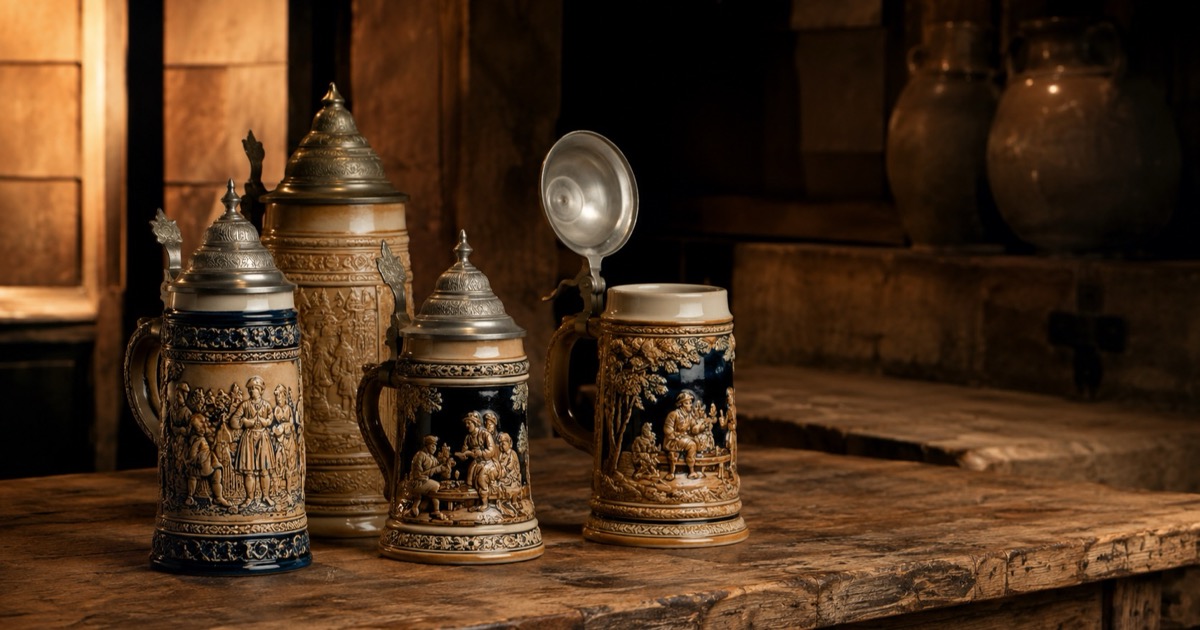
Antique beer stein identification starts at the base. The marks, numbers, and construction details on the bottom tell you far more than the decorative scene on the side: once you know how to read them, you can date many pieces within a decade or two, identify the maker, and recognize the fakes that flood the souvenir and collector markets.
To identify an antique beer stein, turn it over: the maker’s mark and mold number on the base — such as Mettlach’s castle-and-Mercury mark — plus the country-of-origin wording are the most diagnostic tells. “Germany” alone suggests 1891 to 1914, while “West Germany” is postwar, so photograph the base and read the wording first.
This guide covers the marks and construction details that matter most, with emphasis on the German makers who defined the form and the country-of-origin wording that gives you a reliable date ladder.
Quick identification checklist
- Examine the base for incised, stamped, or printed marks — maker’s marks, mold numbers, and country-of-origin text.
- Look for the Mettlach castle/tower mark combined with a mercury figure and a four-digit mold number if you suspect a Mettlach piece.
- On porcelain steins, hold the base up to a light source: an image visible through the bottom indicates a lithophane.
- Examine the pewter lid: check the hinge construction, the style of the lid’s surface, and the thumblift shape for signs of period construction.
- Read the country-of-origin text carefully: “Germany” alone, “Made in Germany,” “West Germany,” and “Western Germany” indicate different production periods.
- Check a regimental stein’s roster panels and roster lid carefully — reproductions of regimental steins are extremely common.
Base marks and major maker identification
The base of an antique German stein is the primary identification document. Several major producers used consistent marking systems that are well documented.
Mettlach (Villeroy & Boch) is the most famous and most collected German stein maker. Genuine Mettlach pieces carry an incised mark with a stylized castle or tower image alongside a Mercury figure, a text reference, and a four-digit mold number that corresponds to the documented Mettlach catalog. A date code allows production year identification for most pieces. Mettlach is also the most widely faked German stein maker — marks have been applied to reproductions — so a valid mold number cross-checked against catalog records is essential for authentication.
Gerz (Simon Peter Gerz) is another respected German stoneware maker. Gerz marked pieces with the “Gerz” name and mold numbers across a wide range of quality levels, from everyday steins to better relief-decorated pieces.
Marzi & Remy and Hauber & Reuther are among other German producers whose marks appear regularly. Their marks typically include the maker’s name or initials and a mold number. Neither is as extensively cataloged as Mettlach. Many unmarked stoneware steins carry only a mold number and country-of-origin text, requiring style comparison to narrow attribution.
Lithophane bottoms
A lithophane is a translucent porcelain panel with a three-dimensional image molded into its thickness. When held up to a light source, the varying thickness creates a detailed picture — traditionally a portrait, landscape, or figure scene. Hold the empty stein above a lamp: if an image forms in the base, you have a lithophane.
Lithophane steins were produced primarily in the late 19th and early 20th centuries and are associated with quality German porcelain. Their presence is a notable quality indicator and increases collector interest.
Pewter lid construction and dating
Antique pewter lids are typically heavier and have a more irregular, cast appearance than modern replacements. The hinge style varies across periods — earlier hinges tend to be more substantial and integrate directly with the handle strap. The thumblift (the raised piece you press to open the lid) also varies: figural thumblifts — animals, heraldic devices, seated figures — are common on better-quality steins. The quality of casting and the feel of the pewter’s weight contribute to assessing whether a lid matches the body’s period.
Replacement lids are extremely common on older steins. A mismatched lid does not make a stein a reproduction, but the lid’s age cannot be attributed to the body’s production period.
Regimental steins and the reproduction problem
Regimental steins were custom-produced for German soldiers to commemorate military service, typically during the late 19th century and through World War I. A genuine piece carries the soldier’s name, regiment, years of service, comrades’ names, battle scenes, and a roster lid. They were made for specific individuals and are rare — and command significant prices when authenticated.
The reproduction problem is severe. Since the 1950s, large numbers of regimental-style steins have been made copying the visual format with no historical connection. On genuine pieces the roster names are specific and the lithography has period character; reproductions often show generic or repeated names. Country-of-origin marks help: a “West Germany” mark rules out WWI-era production immediately. The regimental category requires careful specialist research for anything claimed to be valuable.
The country-of-origin date ladder
Country-of-origin text on the base provides a reliable rough date range:
| Mark | Approximate period |
|---|---|
| No country-of-origin mark | Potentially pre-1891 (before the McKinley Tariff required import marking) |
| “Germany” only | Generally 1891 through 1914 |
| ”Made in Germany” | Post-1914 through WWII era |
| ”West Germany” or “Western Germany” | 1949–1990 (German reunification) |
This ladder applies to pieces exported to the United States. “West Germany” definitively places a piece in the postwar period — immediately ruling out any claim of pre-WWI production and making it one of the most reliable quick checks on any German stein.
Character steins
Character steins are formed in three-dimensional shapes — a monk, a Munich child (Münchner Kindl), a skull, a radish, an owl — rather than a standard cylinder. The figural body is the decoration, and the pewter lid typically completes the figure (a removable hat, a hinged head). Character steins were produced from the late 19th century onward and continue to be reproduced heavily. Dating them relies on the same base marks and country-of-origin text as standard steins, combined with molding quality and glaze character.
Watch-outs and common mistakes
- Trusting Mettlach marks on unfamiliar pieces without catalog verification. The mold number should appear in documented Mettlach catalogs; a mark without a matching number warrants scrutiny.
- Assuming any regimental stein is old and valuable. The reproduction rate in this category is very high. Research the specific unit, names, and construction before assigning value.
- Reading “West Germany” as WWII-era or earlier. West Germany as a state did not exist until 1949 — this mark definitively places a piece in the postwar period.
- Overlooking lid replacements. An old body with a new lid is still a collectible stein, but the lid should not be presented as matching the body’s period.
- Judging quality by decoration alone. A visually impressive scene can be transfer-printed on a recent production piece. Construction, marks, and base details tell the real story.
Photo tips that improve identification
- Photograph the base flat, under strong even light, to capture all marks, numbers, and country-of-origin text clearly.
- For lithophane detection, photograph through the base while backlighting it — a phone flashlight aimed into the stein from above works well.
- Shoot the pewter lid’s underside and hinge area to show construction quality and any stamps that may be present on the pewter.
- Photograph the main decorative scene under diffuse side light to reveal whether it is modeled relief or flat transfer printing.
Common questions
How can you tell if a beer stein is a reproduction?
Start with the country-of-origin text: “West Germany” or “Western Germany” places a piece after 1949, immediately ruling out any pre-WWI claim. Then judge construction rather than decoration — transfer-printed scenes on lightweight bodies, thin cast pewter lids, and generic or repeated names on regimental-style steins all point to later souvenir production. Mettlach marks should be cross-checked against documented catalog mold numbers.
What does a picture in the bottom of a beer stein mean?
A translucent image that appears in the porcelain base when you hold the stein up to a light is a lithophane — a panel whose varying thickness forms the picture. Lithophane bottoms were produced mainly in the late 19th and early 20th centuries on quality German porcelain steins, so finding one is a positive quality indicator that raises collector interest.
Are old German beer steins worth anything?
Many are, but value concentrates in specific categories: documented Mettlach pieces with verified mold numbers, authenticated regimental steins, lithophane porcelain, and well-modeled character steins. Common late-twentieth-century souvenir steins survive in huge quantities and bring little. Condition, an original period lid, and verifiable marks matter more than how impressive the decorated scene looks.
Related guides
- Antique Ceramic Marks Identification
- Antique Pewter Marks Identification
- Red Wing Stoneware Identification
When to use the Antique Identifier app
Photograph the base marks, the body decoration, and the lid construction. The app can help match the mark style to a known German maker, flag the country-of-origin text, and identify the broad production era — useful for ruling out obvious reproductions and narrowing research. For regimental steins or anything claimed to be a high-value Mettlach piece, use the app as a first filter and then verify with specialist references or a collector organization before drawing conclusions.