


Antique Pewter Marks Identification
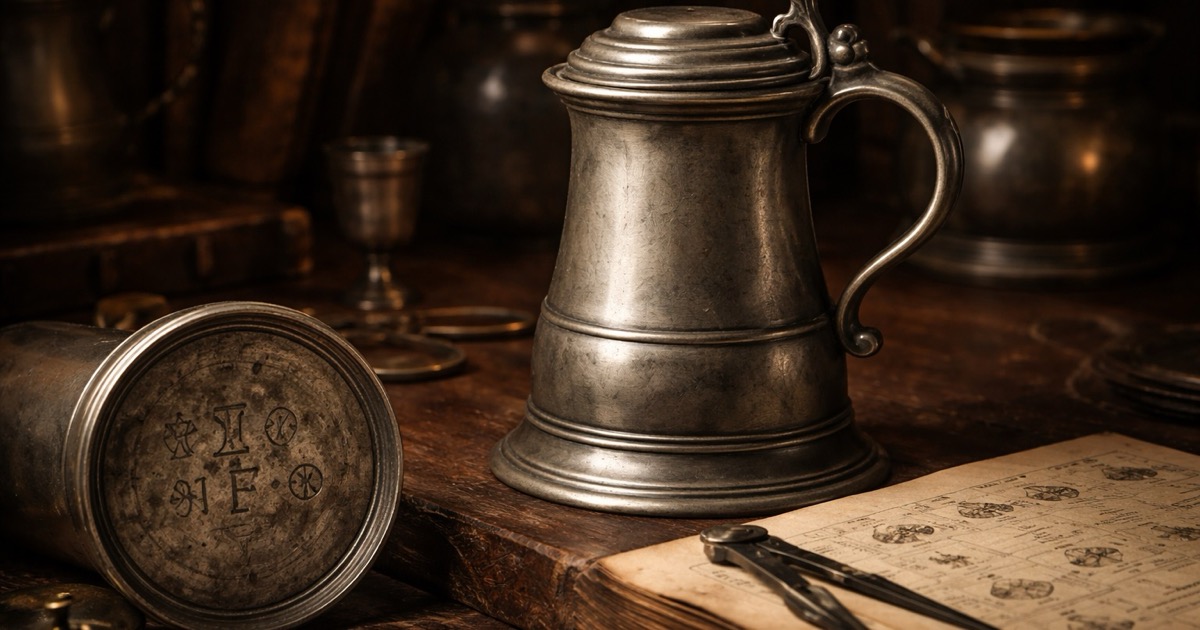
Antique pewter is identified by the marks struck into it: a maker’s touch mark (usually initials or a name), quality marks like the crowned rose or crowned X, and often a row of small pseudo-hallmarks that imitate silver. Look on the underside of plates, the base of tankards, and inside lids, then read the marks together with the metal’s color, weight, and casting seams before you settle on a date.
The hard part is that pewter marks were never as tightly regulated as silver hallmarks, and the two look deceptively alike. A row of four little stamps on a tankard is not proof of anything official. This guide gives you a first-pass workflow so you can tell a genuine early piece from a Victorian reproduction or a modern gift-shop cast, and know when a mark is worth chasing down in a maker reference.
Quick identification checklist
- Find the marks: check the underside of plates and dishes, the base and inside of tankards and measures, and the underside of lids and handles.
- Read the touch mark: the maker’s personal stamp, often initials or a full name inside a shaped cartouche.
- Read the quality marks: a crowned rose or crowned X signals a “better” alloy claim, not a fixed standard.
- Spot pseudo-hallmarks: a row of tiny silver-style stamps is decorative imitation, not an assay office guarantee.
- Judge the metal: dull grey with a soft, slightly warm feel and visible casting seams reads older than bright, seamless, spun metal.
- Weigh it in the hand: traditional cast pewter is dense and heavy; thin, light, seamless holloware is often later Britannia metal.
What pewter actually is
Pewter is an alloy made mostly of tin, hardened with small amounts of copper, antimony, bismuth, or lead (The Pewter Society). Older “fine” pewter for plates and spoons carried less lead, while “lay metal” for hollow-ware used more lead as a cheap bulking agent, which is one reason antique pewter drinking vessels are treated with caution today. From the 17th century a stronger “hard metal” added antimony.
That composition history matters for identification because it splits the field in two. Traditional pewter is cast in molds, so it shows casting seams, file marks where they were cleaned up, and a soft grey surface that oxidizes to a warm, slightly uneven patina. Britannia metal — tin, antimony, and copper with no lead, developed in Sheffield in the late 18th century — could be rolled, spun, and pressed for mass production. A thin, seamless, machine-bright teapot or tankard is far more likely Britannia metal or a modern cast than early cast pewter, even when the marks try to suggest otherwise.
Where the marks hide
Pewter makers marked their work in predictable but easy-to-miss places, so inspect the whole object under raking light. On plates, dishes, and chargers, check the back and the underside of the rim. On tankards, mugs, and measures, look at the base, the inside of the base, and the underside or interior of the lid. On candlesticks and holloware, check the underside and inside the foot. Photograph every mark straight on, then a wider shot showing where it sits, because position is itself a dating clue.
Before you photograph, write down exactly what you see — the letters, the shape of the cartouche, the number of little stamps, and the order they appear in. Tiny wording and layout differences separate one maker from another and one century from the next, and a good maker reference will only help if your transcription is precise.
Reading pewter marks by type
The marks fall into a few consistent families, and knowing which is which stops you from over-reading a decorative stamp as an official standard.
| Mark type | What it looks like | What it tells you |
|---|---|---|
| Touch mark | Maker’s personal stamp in a shaped cartouche, often with initials or a name | Identifies the maker; a date in it is when they set up in business, not when the piece was made |
| Crowned rose | A Tudor-style rose beneath a crown | A quality claim used from the mid-16th century onward; makers created their own variations |
| Crowned X | An X, usually crowned | Claims a harder, better alloy; appears by the late 17th century |
| Quality slogan | Words like “Superfine Hard Metal” | A maker’s own marketing from the 18th century on, not an official grade |
| Pseudo-hallmarks | A row of tiny stamps imitating silver hallmarks | Decorative; may include the maker’s initials but carries no assay-office meaning |
The single most useful correction for beginners: a touch mark that includes a date records when the pewterer went into business, not when your object was cast (The Pewter Society). A tankard stamped with “1740” may well have been made decades later by the same workshop, so treat that number as a floor, not a fixed date.
Quality marks and what they really promised
The crowned rose is the older of the two main quality marks, used from the mid-16th century to signal higher-quality metal, and individual pewterers developed their own versions of it. The crowned X arrived by the end of the 17th century to indicate a harder alloy (The Pewter Society). Both started as meaningful signals and both drifted: over time the trade lost control of the marks and applied them broadly, so a crowned rose or X tells you a piece is claiming quality, not that it meets a verified standard. From the 18th century makers added their own slogans like “Superfine Hard Metal,” which are advertising in metal rather than regulated grades.
If you have worked with silver, the discipline here is the reverse of what you are used to. On sterling, a hallmark is a legal guarantee you can decode with confidence; on pewter, the “quality” marks are closer to a maker’s assurance. Our guide to sterling silver hallmarks is a useful contrast for seeing how much more the silver system will actually tell you.
The pseudo-hallmark trap
The row of little stamps that makes a pewter piece look like silver is the most common source of confusion. These pseudo-hallmarks have no official significance, though they can still help identify the pewterer because they often include the maker’s initials (The Pewter Society). Pewterers typically struck four; some, like the makers of Wigan, used five. Customers wanted the marks so guests might think the household could afford real silver — the imitation was a selling point, not a fraud.
Two cautions follow. First, position can date a piece: on plates and dishes the pseudo-hallmarks usually sat on the front of the rim up to about 1730, and on the back of the well thereafter. Second, Dutch and American pewterers used pseudo-hallmarks too, so their presence is not conclusive evidence that a piece is British. Because these stamps look so much like silver marks, it is worth learning to photograph small hallmarks properly — the same close-up technique reads pewter touch marks and pseudo-hallmarks far better than a phone snapshot in room light.
Telling old from new
Marks alone will not settle age, so let the metal and the making corroborate them. Genuinely old cast pewter is heavy for its size, shows casting seams and hand-finishing, and carries an uneven grey patina that dulls into the recesses. It should never be polished to a mirror; a bright, flawless, seamless surface points to spun Britannia metal or a modern reproduction. Crisp, perfectly even marks on an otherwise “aged” surface are a warning that both the wear and the marks may be faked.
Watch for the classic mismatch: a piece that looks a century old on the outside but shows machine-tooled seams, modern solder, or a suspiciously clean underside was almost certainly made recently. When the marks say one thing and the construction says another, believe the construction. For a broader primer on metal color, weight, and surface, our guide to identifying antique brass covers the same read-the-metal-first discipline for a related material.
Watch-outs and common mistakes
- Reading a date in a touch mark as the manufacture date; it usually marks when the maker opened for business.
- Treating pseudo-hallmarks as silver-style guarantees; they are decorative and carry no assay meaning.
- Assuming a crowned rose or X proves quality; both were applied loosely once regulation lapsed.
- Confusing thin, seamless Britannia metal or modern casts with early cast pewter.
- Over-polishing before identifying; stripping the patina can erase evidence and hurt value.
Photo tips that improve identification
- Photograph every mark straight on and in focus, then a wider shot showing where each mark sits.
- Use raking light from the side so shallow, worn stamps cast a readable shadow.
- Capture the full object, the base, and the underside of any lid or handle.
- Include a shot of a casting seam or the interior so the making method is visible.
Common questions
How do you date antique pewter from its marks?
Start with the touch mark, but remember that any date inside it is when the pewterer set up in business, not when your piece was made, so treat it as an earliest-possible date. Then use supporting clues: crowned-rose quality marks appear from the mid-16th century and crowned X marks by the late 17th, and on plates the position of pseudo-hallmarks shifted from the front rim to the back of the well around 1730. The metal and construction should agree with whatever the marks suggest.
Are pewter hallmarks the same as silver hallmarks?
No. The small stamps on pewter that resemble silver hallmarks are pseudo-hallmarks with no official or legal meaning, added because customers liked the look of silver. Silver hallmarks are regulated assay-office guarantees of metal purity, while pewter’s marks are a maker’s own claim at most. Their presence does not even prove a piece is British, since Dutch and American makers used them too.
What is the difference between pewter and Britannia metal?
Traditional pewter is mostly tin hardened with copper, antimony, bismuth, or lead, and is cast in molds, so it shows seams and a soft grey patina. Britannia metal is tin, antimony, and copper with no lead, developed in Sheffield in the late 18th century, and it could be rolled, spun, and pressed for mass production. A thin, light, seamless, machine-bright object is far more likely Britannia metal than early cast pewter.
Related guides
- Sterling Silver Hallmarks: What the Marks Mean
- Silver Makers Marks Identification
- How to Photograph Silver Hallmarks
- How to Identify Antique Brass
- Silver Plate vs Sterling Silver
When to use the Antique Identifier app
Photograph the whole piece, the base, and every mark straight on under side light, then let the app narrow the likely type, era, and metal so you know which maker reference to open next. It is most useful for placing a piece into the right family — cast pewter, Britannia metal, or a modern reproduction — before you spend time decoding a touch mark. If it points to an early or notable maker, treat that as the start of verification against a marks reference, not a final answer.
Topics