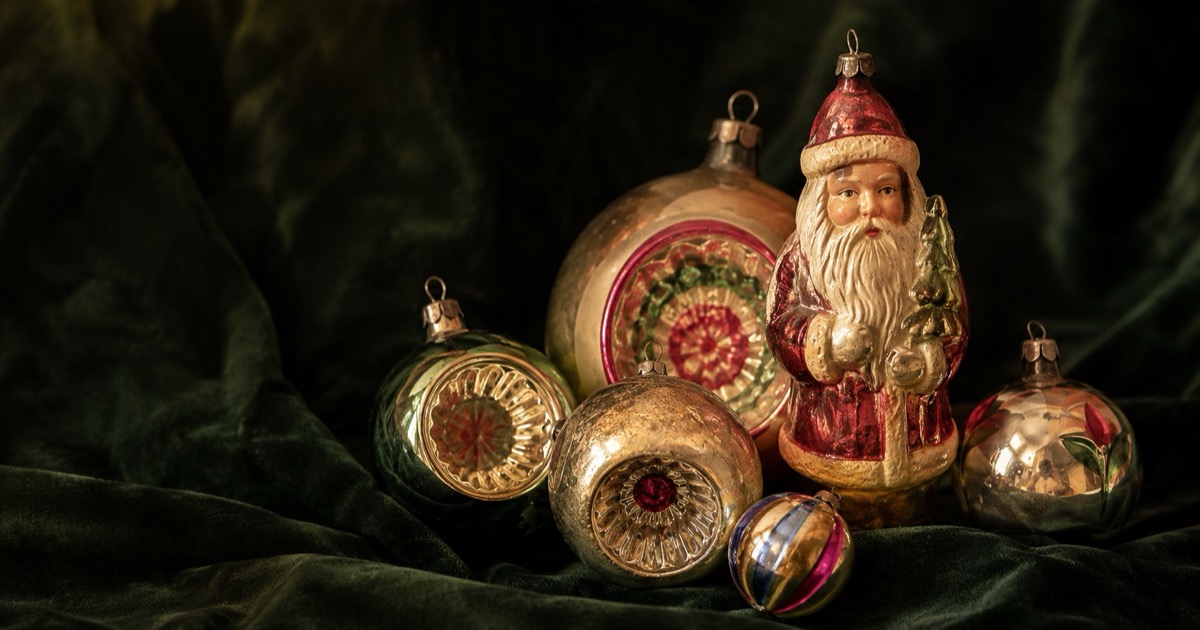
Vintage Christmas ornaments are among the most actively collected holiday objects, and the range of what counts as “vintage” or “antique” spans from pre-World War One German figural glass to mid-century Shiny Brite balls still found in their original boxes. Identifying vintage Christmas ornaments accurately means working through era, country of origin, and production method—because a glass ball from 1938 and one from 1958 require different analysis than a figural Santa from the 1890s or a bottle-brush tree from the late 1940s.
Vintage Christmas ornaments are identified mainly by glass weight and cap hardware. Pre-war German figurals use very thin, lightweight glass with a wire spring-clip cap on a glass pike; heavy, mirror-like balls with multi-part metal caps are early kugels; unsilvered glass with a cardboard cap marks wartime Shiny Brite. Handle the ornament and examine its cap first.
The most commonly encountered vintage ornaments at estate sales fall into several clear categories, each with its own physical tells. This guide covers the main categories in sequence, with the specific features that distinguish period examples from the numerous reproductions and reissues that have entered the market since the 1990s.
Quick identification checklist
- Check glass thickness. Antique German hand-blown ornaments have very thin, lightweight glass; modern reproductions are noticeably heavier. Kugels are the intentional exception—they are thick, heavy, and early.
- Examine the cap and hanger hardware. German ornaments use a spring-loaded wire cap inserted into a glass-tipped pike (the end of the blowing tube); Japanese ornaments use a different collar-and-wire system; US Shiny Brite-era ornaments use a distinctive metal cap with specific design elements.
- Look at the interior silvering. Pre-war ornaments were lined with a silver nitrate solution; wartime US production often has no silver lining at all (the glass remains clear or lightly tinted). Post-war silvering tends to be more complete and even.
- Read the box, if present. Original Shiny Brite boxes have a recognizable design and printing style; reissued boxes from the 1990s onward use modern printing and different paper stock.
- Assess the surface condition. Original paint on pre-war figural ornaments is often mica-dusted; paint loss, crackling, and natural aging look different from the even “distressed” finish applied to reproductions.
- Identify the form category. Standard glass balls, figural ornaments, kugels, indented reflectors, and foil-and-wire constructions each have their own production history and dating markers.
German hand-blown figural ornaments
The pre-war German glass ornament industry, centered in the Lauscha region of Thuringia, produced hand-blown figural ornaments in enormous variety from roughly the 1880s through the 1930s. The figures—Santas, fruits, vegetables, animals, birds, pickle ornaments, houses, and hundreds of other forms—were blown into metal molds to create embossed shapes, then silvered internally, painted by hand, and often dusted with mica for sparkle.
The key physical features of genuine early German figural ornaments: very thin, light glass that rings clearly when tapped; embossed surface detail from the mold, often quite fine; wire-wrapped construction where wire was wound around the form as a hanger anchor; and a glass-tipped pike at one end (the remnant of the blowing tube, snipped and fire-rounded). The cap is a small spring-loaded wire clip inserted onto the pike. Original paint on quality examples shows the variation of hand application and may include multiple colors and fine brushwork details.
Pre-war German ornaments from the 1880s–1930s are genuinely collectible and the rarest figural forms in excellent condition bring significant prices. Common forms (balls, basic fruits) are abundant and modestly priced; unusual subjects in excellent paint are what command collector premiums.
Kugels
Kugels are the earliest distinct ornament category most collectors encounter. These are thick, heavy, highly reflective glass balls (and in some cases other shapes—grapes, acorns, berries) that predate the lightweight figural ornament tradition. The name is German for “ball.” They are characterized by substantial weight compared to their size—a kugel feels dense and solid where a later glass ball feels nearly weightless—a very smooth, highly polished outer surface, and a brass or silver-metal cap with a distinctive multi-section construction.
Kugels were made primarily in Germany from at least the 1840s through the early twentieth century. The thick-walled glass and bright internal silvering give them an almost mirror-like reflectivity. The caps are a reliable dating reference: earlier caps tend to be more elaborately constructed with multiple components; later and lower-quality caps are simpler. Kugels in excellent condition with intact original caps are sought after, and their weight makes them easy to distinguish from later lightweight ornaments without any special knowledge.
The Shiny Brite story and its dating tells
Shiny Brite is the brand name most Americans associate with mid-century glass ornament sets. The company was founded by Max Eckardt and sold glass ornaments made using machinery developed in partnership with Corning Glass Works, which produced the blanks (the undecorated glass balls) at scale during the key period of the 1940s and into the 1950s.
The single most useful dating tell in Shiny Brite ornaments is the wartime production gap. During World War Two, materials restrictions affected ornament production in two ways that are visible today: silver nitrate for internal silvering became scarce, so many wartime ornaments were left unsilvered, with clear or lightly tinted glass rather than the reflective interior of pre- and post-war balls. Additionally, the metal caps were replaced with cardboard or paper caps because metal was rationed. A Shiny Brite-style ornament with an unsilvered or lightly tinted glass body and a cardboard cap dates to the wartime production window—typically 1942–1945. These unsilvered examples are a famous and well-documented dating marker in the hobby.
Post-war Shiny Brite production resumed with metal caps and silvered glass. The original Shiny Brite brand was active through the mid-1960s; the brand name has since been licensed and revived, so “Shiny Brite” appears on current production. Original boxes from the 1940s–1950s are identifiable by the period printing style and paper; reissued boxes from the 1990s and after are printed on different paper with modern production characteristics.
Cap and hanger styles as country-of-origin indicators
The cap-and-hanger assembly is one of the most useful quick-identification tools for country of origin, because different producing countries used different hardware systems at different periods.
| Origin / Era | Cap and hanger characteristics |
|---|---|
| German pre-war (to ~1940) | Wire spring-clip cap on glass pike; often fine brass wire |
| Japanese (1920s–1960s) | Collar cap, often simpler metal; sometimes lacquered |
| US Shiny Brite, wartime | Cardboard or paper cap |
| US Shiny Brite, post-war | Metal cap, distinctive Shiny Brite stamping |
| East German (post-1945) | Continued wire-cap tradition; quality varies |
Japanese-made ornaments flooded the American market from the 1920s through the 1960s and are common at estate sales. They range from glass balls to paper, cotton, and celluloid constructions. Japanese glass ornament quality is generally lower than equivalent German production of the same period—thicker glass, less precise painting—but Japanese holiday paper and cotton ornaments are a distinct collecting category in their own right.
Bottle-brush trees and putz village pieces
Bottle-brush trees—the small sisal-fiber trees on wire frames—and putz village accessories (cardboard houses, paper animals, paper-and-cotton Santas) are closely associated with Japanese production of the late 1930s through the 1950s. “Putz” refers to the German tradition of a miniature Christmas village scene set up beneath or around the tree.
Japanese-era bottle-brush trees have sisal fibers twisted onto a wire armature, often with a colored trunk wrapping, and a metal weighted or wooden base. Original examples are usually somewhat compressed from years of storage and may have lost some fiber tips. Post-war Japanese production continued; later American-made examples also exist. The construction method (sisal twist, wire core, base type) is the primary dating tool.
Radko-era reproductions and reissued boxes
Christopher Radko began producing ornaments in the late 1980s and through the 1990s popularized high-quality glass figural ornaments explicitly referencing the pre-war German tradition. Radko pieces are signed and dated (typically with a label on the cap and sometimes a signature on the ornament) and are a legitimate collecting category as contemporary glass art—but they are not antique German ornaments, and the two should not be confused.
Other reproduction and revival ornaments from the 1990s onward include factory-made pieces sold as “vintage-style” or even deliberately labeled to evoke pre-war German production. The tells are heavier glass than originals, even “distressed” paint that looks applied rather than aged, modern cap hardware, and box printing that does not match the paper and printing of the original period. Handle the object—weight and glass thinness are the fastest orientation.
Condition factors
Condition in vintage ornament collecting breaks into surface paint, internal silvering, and structural integrity.
Silvering loss is the most common issue. The silver nitrate lining in glass ornament balls gradually oxidizes and separates, leaving dark spots or complete loss. Minor silvering loss is accepted in the hobby; extensive loss significantly reduces value.
Paint flaking on figural ornaments reduces visual impact and collector appeal. Stable original paint with minor wear reads differently than flaking or peeling paint—look at the edges and high points of relief detail, where paint adheres least well.
Structural cracks or repairs in the glass body are generally fatal to value. Hold ornaments against light to check for hairlines.
Cap condition matters because original caps are not always replaceable with period-correct hardware. A missing or replaced cap reduces value on pre-war German figural ornaments more than on standard ball ornaments.
Watch-outs and common mistakes
- Unsilvered interiors are a feature, not damage. In wartime Shiny Brite production, clear or lightly tinted glass with no silvering is the intended appearance and a positive dating indicator—not a defect to be penalized.
- “Made in occupied Japan” marks date to a specific window. This marking, required on Japanese exports from 1947 and used until the occupation ended in 1952, is a precise date range tell; it is a collector asset, not a negative.
- Radko ornaments are not pre-war German. Both are glass figural ornaments but separated by 60+ years; the signed Radko label is the immediate indicator.
- Reissued Shiny Brite boxes are common. The brand name alone does not confirm period production; assess the paper, printing, and ornament themselves.
- Mica glitter was reintroduced on reproductions. Both original and reproduction ornaments may be mica-dusted; rely on glass weight and cap hardware rather than surface texture alone.
Photo tips that improve identification
- Backlight glass balls to show interior silvering. Hold a ball between you and a light source and photograph the result: even silvering, dark spots from loss, or the clear glass of an unsilvered wartime ornament all read clearly in transmitted light.
- Photograph the cap from directly above. Cap construction details—spring wire vs. cardboard vs. stamped metal collar—are clearest from a perpendicular shot with diffuse lighting.
- Capture embossed detail on figural ornaments under side light. Raking light from the side reveals the quality and sharpness of the mold embossing, which helps distinguish period German blown-and-molded pieces from reproduction castings.
- Show scale with a standard ornament or coin. Early German figurals in desirable subjects are often smaller than expected; size relative to a known reference helps remote identification.
Common questions
How can you tell how old a Shiny Brite ornament is?
The wartime tell is the most useful: an unsilvered or lightly tinted glass ball with a cardboard or paper cap dates to the World War Two materials restrictions, typically 1942–1945. Pre- and post-war production has silvered interiors and metal caps, and original boxes from the 1940s–1950s show period printing and paper. The brand has been revived, so “Shiny Brite” alone does not confirm age.
Are old Christmas ornaments without markings worth anything?
Yes, most genuinely old ornaments carry no marking at all. Pre-war German figurals and kugels are identified by construction—thin glass, wire spring-clip caps, mold detail, weight—rather than any stamp. Unusual figural subjects in strong original paint command collector premiums, while common balls and basic fruit forms are abundant and modestly priced regardless of age.
What is a kugel ornament and how do you recognize one?
A kugel is an early German glass ornament, made from roughly the 1840s into the early twentieth century, that is thick-walled, heavy, and almost mirror-like in reflectivity. Where a later glass ball feels nearly weightless, a kugel feels dense and solid, and it carries a distinctive multi-section brass or silver-metal cap. Weight alone usually separates kugels from everything that came after.
Related guides
- Vintage Halloween Collectibles Identification
- Antique Postcard Identification Value
- Common Signs of Antique Reproductions and Fake Antiques
When to use the Antique Identifier app
Photograph the ornament against a neutral background showing the full form, then a close shot of the cap and hanger assembly, and for figural ornaments a detail shot of the paint and mold work. The app can match the visible features—cap style, glass construction, figural form, and surface treatment—to the documented production categories, helping you place an ornament in the right era and country quickly. For high-value pre-war German figural examples, specialist confirmation from a holiday collectibles dealer or dedicated auction remains the appropriate next step.