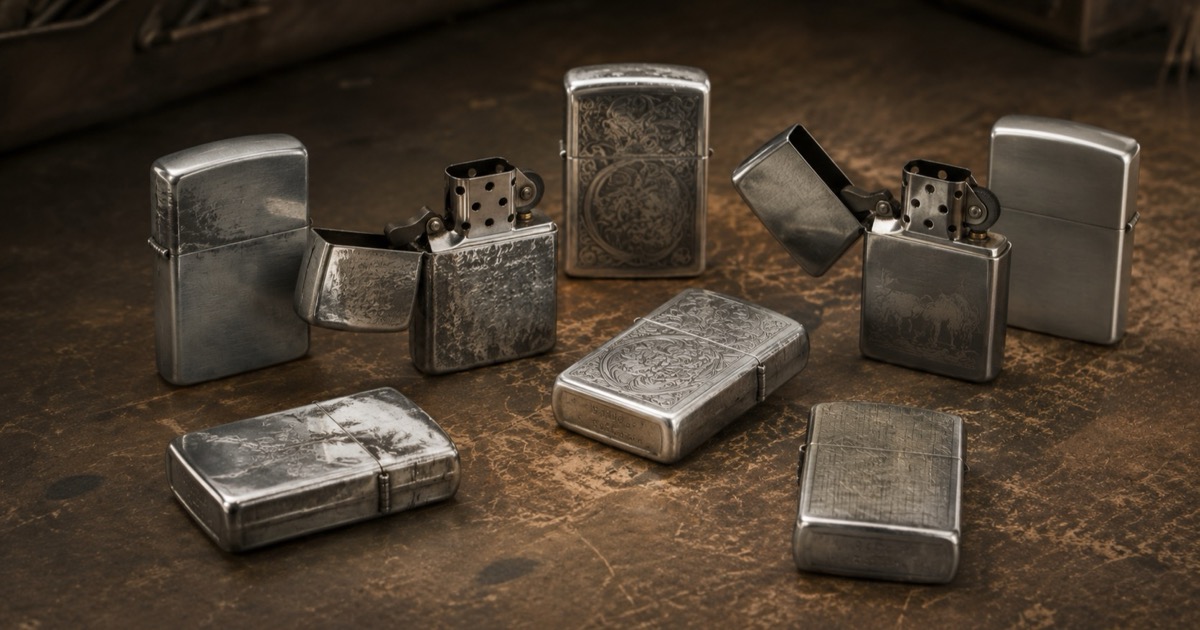
Zippo date codes turn one of the most common flea-market finds into one of the easiest to date: since the mid-1950s the factory has stamped the bottom of nearly every lighter with a code that places it within a year or two, and the stamps used before that narrow things almost as well. By the end of this guide you will be able to read the bottom of the case, pull and read the insert, and place both in the right era.
Zippo date codes are small marks stamped on the bottom of the lighter case — dots, vertical lines, slashes, or a month letter with a year — that place a Zippo within a year or two. To date yours, flip the lighter over and match the bottom stamp style to the era chart, then date the insert separately.
That second step matters more than most sellers realize. Zippos are modular, repairable, and heavily faked, so a straight answer about age usually means dating two parts and checking that the story engraved on the outside agrees with both.
Quick identification checklist
- Flip the lighter over and identify the bottom stamp style: patent wording, dots, slashes, or a letter paired with a Roman numeral.
- Pull the insert out of the case and date it separately from its own stamp.
- Open the lid and look at the hinge: solder quality and construction should match the era.
- For black-crackle lighters, test the case with a magnet — wartime cases are steel under the paint.
- Treat Vietnam-era engraving as unverified until the date code falls in the war years and the wear matches.
- Note monograms, dents, repairs, and refinishing before you think about value.
How Zippo date codes work
Zippo has made windproof lighters in Bradford, Pennsylvania, since the early 1930s, and the bottom stamp evolved in steps that collectors have mapped thoroughly. The earliest lighters carry only the company name and patent wording — “PAT. PENDING” on some, then the famous patent number 2032695, which stayed on bottom stamps from the mid-1930s into the 1950s. These pre-code lighters are dated by stamp layout, case shape, and hinge construction rather than by a code.
True date codes arrived in the mid-1950s. Zippo began stamping small dots around its name — initially four on each side — and removed them roughly one per year, so fewer dots means a later lighter within that run. When the dots ran out in the mid-1960s, vertical lines took their place and counted down the same way. Forward slashes followed in the mid-1970s, and backslashes in the early 1980s.
From mid-1986 the system became explicit. A letter on the left of the stamp gives the month, A for January through L for December, and a Roman numeral on the right gives the year, starting with II for 1986. In 2001 the Roman numerals gave way to plain two-digit years, the system still in use.
| Bottom stamp style | Rough era |
|---|---|
| Company name with patent wording or patent 2032695 | 1930s to mid-1950s |
| Dots flanking the name, counting down | Mid-1950s to mid-1960s |
| Vertical lines counting down | Mid-1960s to early 1970s |
| Forward slashes counting down | Mid-1970s to early 1980s |
| Backslashes counting down | Early to mid-1980s |
| Month letter plus Roman numeral year | Mid-1986 to 2000 |
| Month letter plus two-digit year | 2001 onward |
Stamp styles overlap slightly at the changeovers, so treat the code as placing a lighter within a year or two — except in the letter era, where the month is printed outright.
Date the insert as well as the case
The insert — the removable unit holding the wick, flint wheel, and packing — carries its own stamps, and from the code eras onward its own date marks. Inserts were swapped constantly. Zippo’s lifetime repair policy meant a damaged lighter went back to Bradford and often returned with new internals, and owners traded inserts between cases for decades before collectors cared.
So date both parts. A case and insert from the same era support each other and suggest an untouched lighter. A 1940s case with a 1970s insert is still a 1940s case, but it is no longer original, and collectors pay for originality. When buying, ask for a photo of the insert’s stamp, not just the case bottom.
Wartime black crackle and Vietnam-era lighters
Two Zippo categories attract the most money and therefore the most fakery. The first is the World War II “black crackle” lighter. With brass restricted during the war, Zippo switched to steel cases finished in rough black wrinkle paint, and essentially all production went to the military market. A magnet confirms the steel case under the paint, the bottom stamp should match wartime layouts, and the hinge should be the simpler period type rather than the modern five-barrel style. Repainted later lighters and outright replicas are common, and honest wear is hard to imitate down in the crackle texture.
The second is the Vietnam-era engraved lighter — cases cut with unit insignia, map outlines, and barbed slogans. Genuine examples exist and are seriously collected, but the market is saturated with engravings added decades later to period or even post-war lighters. Insist that the date code falls in the war years, then compare wear: an engraving carried through a tour shows softened edges and grime in the cuts, while bright, sharp cutting on an otherwise worn case is a red flag. Provenance from the veteran or family is worth more than any visual test.
Condition, originality, and realistic value
Once you have the date, judge the object. Look at the hinge for sloppy re-soldering, check whether the corners and stamp are crisp or rounded from buffing, and remember that a refinished or machine-polished case has lost both its surface history and some of its value. Monograms and gift engravings generally reduce collector interest. Factory repairs keep a lighter working but replace original parts.
Value-wise, keep expectations calm. Most plain lighters from the 1970s onward trade for modest money. Clean dot- and slash-era lighters do better, especially with attractive period advertising on the case. Verified black crackle examples, documented Vietnam pieces, and 1930s lighters with early construction can bring strong prices, but condition and originality dominate every tier, and stories without matching codes are just stories.
Watch-outs and common mistakes
- Dating only the case. The insert is the most common mismatch and the first thing an experienced buyer checks.
- Believing engraved history without checking that the date code, wear, and story all agree.
- Mistaking Zippo’s own replica editions of early models for originals — their bottom stamps identify them, but worn examples get misdescribed.
- Assuming any black-painted lighter is wartime crackle; the magnet and the bottom stamp have to agree.
- Buying a buffed, gleaming “mint” lighter with softened stamp edges — that shine removed metal.
Photo tips that improve identification
- Shoot the bottom stamp dead-on in raking light so dots, slashes, and letters read clearly; this is the single most important photo.
- Pull the insert and photograph its stamped markings separately.
- Open the lid and take a close-up of the hinge from above.
- Photograph engraving at a low angle so wear inside the cuts is visible.
Common questions
What do the dots on the bottom of a Zippo mean?
The dots are a date code. Starting in the mid-1950s, Zippo stamped small dots on either side of its name and removed roughly one per year, so the number of dots remaining tells you where the lighter falls within that run. Fewer dots means a later lighter. Vertical lines, then slashes, continued the same counting-down system in later decades.
How can you tell a fake Vietnam Zippo?
Check that the bottom date code actually falls within the war years first — many faked pieces are engraved on lighters made later. Then compare the engraving to the rest of the case: a genuine carried piece shows softened edges and grime down in the cuts, while bright, sharp engraving on an otherwise worn case is a red flag. Provenance from the veteran or family carries more weight than any visual test.
Are old Zippo lighters worth anything?
Most plain Zippos from the 1970s onward trade for modest money, so age alone does not guarantee value. The stronger tiers are clean dot- and slash-era lighters, examples with attractive period advertising, verified World War II black crackle cases, and documented Vietnam pieces. Condition and originality dominate every tier — a matching case and insert from the same era is worth more than a mismatched pair.
Related guides
- How to Identify Vintage Fountain Pens
- How to Identify a Pocket Watch by Serial Number
- How to Identify Military Medals and Insignia
When to use the Antique Identifier app
Photograph the whole lighter from both sides, then take tight shots of the bottom stamp, the insert stamp, and the hinge. The app reads those details to narrow the era and series quickly, which saves you from paging through stamp charts. If it suggests a wartime, Vietnam, or otherwise rare lighter, treat that as a reason to verify further with code charts and provenance, not as a final answer.