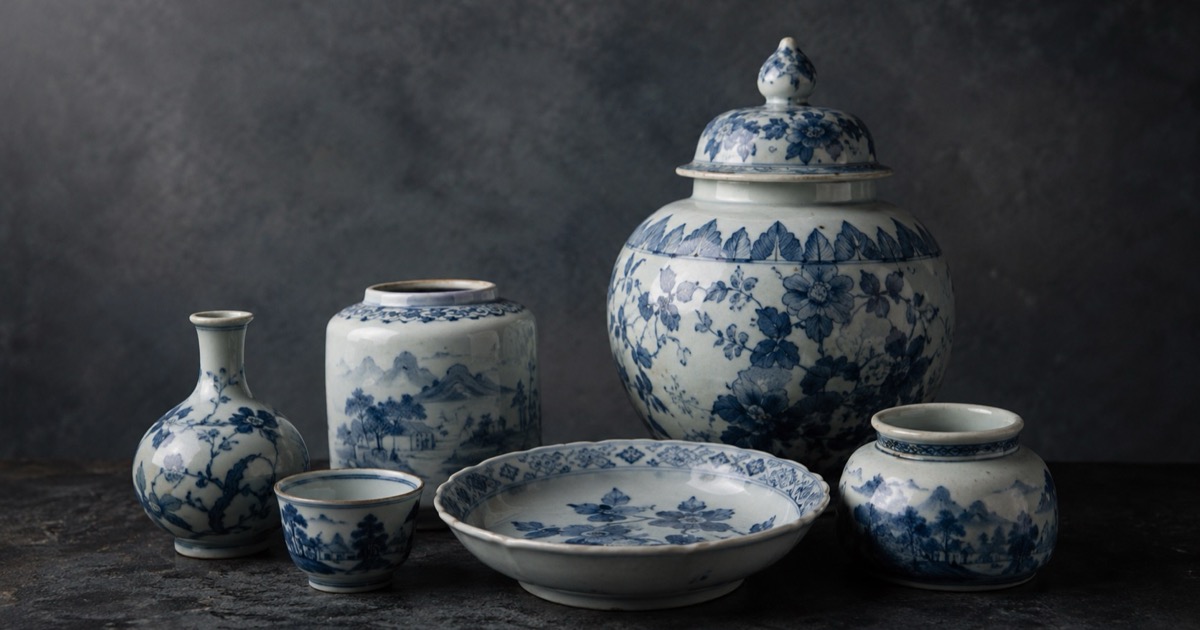
Chinese porcelain marks are among the most misread features in all of antiques, and the single most important rule — that a reign mark is not a date — undoes almost every assumption a beginner brings to the table. Reign marks are reign marks: they name a dynasty and an emperor, but they do not mean the piece was made during that reign. Once that is understood, the marks become genuinely useful as evidence rather than misleading as proof.
Chinese porcelain marks are typically four or six hand-painted characters, usually in underglaze blue, naming a dynasty and emperor — but the mark honors a reign and does not date the piece. Read the characters top to bottom, right column first, then weigh the mark against the glaze, body, painting, and foot rim before drawing any conclusion.
By the end of this guide you will understand how a reign mark is structured, why apocryphal marks were applied without deceptive intent, which emperors’ marks appear on the most pieces, how export and 20th-century pieces differ in their markings, and when the evidence on a piece justifies seeking expert advice.
Quick identification checklist
- Count the characters on the base: four characters or six characters are both standard formats for reign marks; two-character hall marks and other inscriptions also appear.
- Read the mark in the traditional order — top to bottom in the right column, then top to bottom in the left column — to understand what dynasty and emperor is named.
- Look at the script style: seal script (archaic, pictographic) and regular script (cleaner, more rectangular strokes) are both used and indicate nothing about authenticity on their own.
- Check whether the mark is under the glaze (the usual location for reign marks), above the glaze (unusual and worth noting), or impressed into the clay.
- Look for the words “China” or “Made in China” in Latin characters — these are reliable 20th-century tells when they appear.
- If the base mark is printed in transfer rather than hand-painted, the piece is almost certainly 20th century.
Reign mark structure: what the characters say
A standard Chinese porcelain reign mark consists of six characters arranged in two vertical columns of three, read from top to bottom and right to left. The first two characters name the dynasty. The next two name the emperor (using the name of his reign period, not his personal name — emperors took on a reign period name when they acceded). The final two characters read, in standard translation, “year of” or “made in the period of,” completing the formula.
The most common abbreviation is a four-character mark, which drops the dynastic name and goes straight to the reign period and the “made” suffix. Both formats are correct and appear on legitimate period and later pieces alike.
Marks are typically written in underglaze blue — applied before the transparent glaze is added — and fired into the piece. The quality of the brushwork in the mark often reflects the tier of the piece: fine imperial porcelain tends to show confident, well-formed characters, while lower-tier production and later copies can show hesitant or clumsy strokes. This is one useful diagnostic, but it is far from definitive on its own.
The single most important rule: a mark is not a date
Chinese potters used reign marks to honor earlier emperors whose reigns were associated with quality and prestige. This practice was widespread, traditional, and not considered forgery. The two most frequently honored emperors — whose marks appear on more porcelain than any others — are the Kangxi Emperor of the Qing dynasty, whose reign covered a long span in the late 17th and early 18th centuries, and the Qianlong Emperor, whose reign occupied most of the 18th century. Both reigns were prolific for porcelain, influential in taste, and regarded as golden eras.
Porcelain bearing Kangxi and Qianlong marks was made throughout the 19th century, the Republic period (roughly the first decades of the 20th century), and into the present. A piece with a Kangxi mark on the base could have been made within Kangxi’s reign, a generation later in homage, a century later as an aspiration, or last year as a reproduction. The mark alone is not evidence of age. The correct approach is to read the mark as one piece of evidence and weigh it against the glaze, the body, the painting style, the foot rim character, and the overall quality of the piece.
Kangxi and Qianlong as the most-copied examples
The Kangxi period is associated with a specific set of colors, particularly a deep cobalt blue used under the glaze and a family of enamels known in the West as famille verte. Genuine Kangxi blue-and-white has a particular quality of blue — often described as a slightly grey or violet-tinged, clear tone — and a body that shows specific characteristics at the foot rim. The Qianlong period brought the famille rose palette to its mature form and is associated with dense, elaborate decoration and extremely fine painted enamels on export and imperial pieces.
Because both reigns are widely known and admired, their marks are the most copied. When a collector or dealer looks at a piece with one of these marks, the first question is never “is this genuinely from this reign?” — it is “is this a good, period piece that happens to bear a reign mark, or is this a later piece, and if so, how much later and of what quality?” Republic-period porcelain with a Qianlong mark can itself be collectible and well-made. A 1980s tourist piece with the same mark is not.
Export wares and 20th-century markings
A practical dating shortcut for the estate sale context: if the base of a Chinese porcelain piece shows the word “China” or “Made in China” in Roman letters (English), the piece was made for export and the marking dates the piece to the 20th century in most cases. The requirement that export goods be marked with country of origin in legible characters developed through the late 19th and early 20th centuries under various trade and tariff regulations.
Some pieces show both a reign mark and a Western origin stamp — the reign mark was applied as a style homage, while the trade stamp reflects the actual production date. These are not forgeries in any meaningful sense; they are ordinary commercial items. Their value is the value of 20th-century Chinese export porcelain, which varies considerably by quality and type, and is generally distinct from the value of genuinely old Chinese porcelain.
Seal-script versus regular-script marks
Reign marks appear in two main calligraphic styles. Seal script is the older, more archaic form, in which characters resemble their early pictographic ancestors — rounder, more compact, somewhat abstract to modern eyes. Regular script (kaishu) uses the cleaner, more legible block-style characters familiar from modern printed Chinese. Both appear on genuinely old Chinese porcelain as well as on later copies, so the script style does not itself date a piece. What it does provide is another layer of evidence to match against the decoration, glaze, and body type — a piece whose mark, painting, and porcelain body all align with a specific tradition is more coherent than one where these elements point in different directions.
Double circles around the mark are common on many production eras; a solid double square border is found on certain types; some marks appear without any border at all. The surround is one more detail to note and compare, but again, no single feature settles the question of authenticity or age.
When to seek a specialist
For the vast majority of Chinese porcelain that turns up at estate sales, antique shops, and thrift stores, the realistic value category is modest and the decision is whether you like the piece and find it worth the asking price. The reign mark tells you what style tradition the maker was working in and perhaps what period they were emulating.
The exception is a piece that presents as potentially genuinely imperial or high-tier period: a piece with exceptional painted quality, an unusual form or palette, fine foot rim work, and a coherent high-tier appearance. If you have found such a piece and the stakes are significant, the correct move is a specialist — a major Asian art auction house, a dealer who handles only Chinese ceramics, or a museum curator. A photograph sent for an opinion is a reasonable starting point. The reward for correct identification of a genuine early imperial piece can be extraordinary; the cost of guessing wrong can be equally significant in the other direction.
Watch-outs and common mistakes
- Treating a reign mark as a date — it is not, and this mistake is nearly universal among beginners.
- Assuming “China” or “Made in China” in English means a fake — it means export ware, which has its own collectible value but is not old Chinese porcelain.
- Reading only the mark and ignoring the glaze, body, and painting — each of these carries more age information than the mark alone.
- Confusing the script style of the mark (seal vs regular) with its authenticity — both appear on both genuine and later pieces.
- Paying imperial prices for what a specialist would identify as late Qing or Republic-period commercial ware; the gap in value is enormous.
Photo tips that improve identification
- Photograph the base mark straight-on with the camera level to the base, in good diffuse daylight, so all characters are sharp and the brushwork quality is visible.
- Add a raking-light shot of the base to show whether the mark is under the glaze (appears slightly blurred by the glass layer over it) or on top.
- Photograph the foot rim — the unglazed ring at the base — since its character, color, and refinement are key dating and quality indicators.
- Capture the main decoration in full: color palette, painting style, and overall composition are as diagnostic as the mark.
Common questions
Does a reign mark mean the porcelain was made during that reign?
No. Chinese potters routinely applied the marks of earlier, admired emperors — especially Kangxi and Qianlong — as an homage, a practice that was traditional and not considered forgery. A piece bearing a Kangxi mark could date from his reign, from the 19th century, from the Republic period, or from last year. The mark is one piece of evidence to weigh against the glaze, body, and painting.
What does “Made in China” on the bottom of porcelain mean?
It means the piece was made for export, and in most cases it dates the piece to the 20th century, when trade regulations required country-of-origin marking in legible Roman letters. It does not mean the piece is fake — a piece can carry both a reign mark applied as a style homage and a trade stamp reflecting the actual production date.
How do you read a Chinese porcelain reign mark?
A full reign mark is six characters in two vertical columns, read top to bottom starting with the right column: two characters for the dynasty, two for the emperor’s reign period, and two meaning roughly “made in the period of.” The common four-character version drops the dynasty. Marks appear in both seal script and regular script, and neither style indicates age or authenticity on its own.
Related guides
- Antique Porcelain Marks: How to Read Backstamps
- Satsuma Ware Identification
- Meissen Marks: How to Identify Real Crossed Swords
When to use the Antique Identifier app
Photograph the base mark clearly alongside the full decoration and a shot of the foot rim. The app can match the mark style, color palette, and form to likely production traditions and periods quickly — which is especially useful when you do not read Chinese characters and cannot parse the mark text directly. If the result points to a potentially high-value attribution, treat it as a cue to seek specialist verification rather than a final answer.