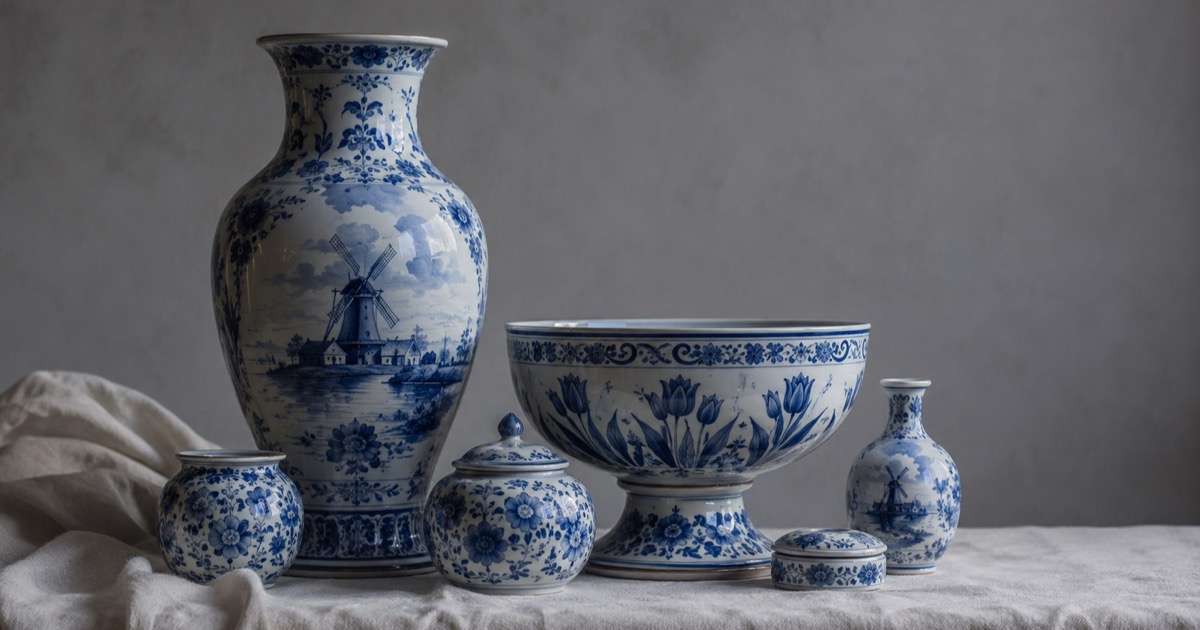
When someone brings home a blue-and-white piece from a trip to the Netherlands and asks whether it is “real Delft,” decoding delft pottery marks is only part of the answer. The more important question is what kind of Delftware you are actually looking at, because the word covers three very different categories: historical tin-glazed earthenware made by Dutch factories centuries ago, modern pieces from the one remaining traditional factory (De Porceleyne Fles, trading as Royal Delft), and the vast ocean of souvenir “delft blue” ceramics that fill Amsterdam gift shops and estate sales around the world. By the end of this guide you will be able to distinguish all three with basic physical inspection.
Genuine delft pottery marks appear on tin-glazed Dutch earthenware and are hand-applied, such as Royal Delft’s jar emblem with painter initials and a year-letter code. The two diagnostic tells are a buff to cream clay body at the unglazed foot ring and slightly irregular hand-painted brushwork. Check the foot ring first; a bright white body means souvenir ware.
Genuine Delftware, in other words, is a porous clay body covered in an opaque white glaze made with tin oxide, then hand-painted and fired. Most blue pieces sold as souvenirs today are hard white earthenware or porcelain with transfer-printed decoration applied at high volume; they are not Delftware in the traditional sense, just “delft-style” blue-and-white ware.
Quick identification checklist
- Check the clay body at the foot ring. True tin-glazed Delftware shows a softer, buff to cream-colored clay when the glaze is absent; souvenir ware shows a bright white, dense, hard body.
- Hand-painted vs. transfer-printed. Under a loupe or strong light, hand-painted brushwork shows slight irregularities, varying line width, and pooling of pigment at stroke ends; transfer prints show fine dot matrices or perfectly uniform line weight.
- Bottom mark legibility. Royal Delft pieces carry the De Porceleyne Fles jar emblem with painter initials, a year-letter code, and other marks—all hand-applied. Souvenir pieces often have a simple stamped or printed “Delft Holland” with no factory structure.
- Weight and sound. Tin-glazed earthenware is lighter than equivalent porcelain and gives a duller tap; dense souvenir porcelain rings more clearly.
- Glaze surface. Authentic older Delftware may show fine crazing, a slightly uneven surface, and areas where the glaze has pooled; modern souvenir pieces are usually uniform and smooth.
- Condition of enamel colors. Traditional Delft decoration is applied under the glaze (in-glaze); souvenir pieces often have on-glaze prints that can wear at raised points.
What genuine tin-glazed Delftware looks like
Delftware as a category began in the Netherlands in the seventeenth century as Dutch potters adapted the techniques of imported Chinese blue-and-white porcelain. Because they lacked the raw materials for true porcelain, they applied a tin-oxide-opacified lead glaze over a clay body to mimic the white background. The result fires to a soft, slightly chalky white that looks nothing like the glassy surface of Chinese export porcelain—but it was close enough to satisfy northern European demand.
The characteristic features are consistent across centuries of production: a buff to light reddish clay body (visible at the foot rim or any chip), an opaque white glaze that can show fine surface crazing with age, and cobalt-blue decoration applied directly to the raw glaze before a single firing. Polychrome Delftware also exists, using manganese, copper green, iron red, and other oxides. The weight is moderate — noticeably heavier than porcelain of the same size — and the foot ring often shows traces of kiln furniture or sand firing pads.
Historical Dutch factory marks and why they are tricky
Delft was home to dozens of potteries during its seventeenth- and eighteenth-century peak, each with its own mark. The factories used names like De Klaauw (The Claw), De Paauw (The Peacock), De Drie Klokken (The Three Bells), and many others, often marking their wares with initials, factory symbols, or stylized monograms.
The critical caution: these historical marks were widely imitated—by other Dutch factories during the period, by later nineteenth-century revival potters, and by foreign manufacturers who wanted the prestige of the Delft name. A mark that looks like a historical De Paauw or De Klaauw mark does not confirm authenticity without broader evidence. The clay body, glaze character, and painting style all need to be consistent with the claimed period. Genuine eighteenth-century pieces are rare on the open market; what is commonly called “old Delft” at estate sales is usually nineteenth-century or early twentieth-century production.
Royal Delft (De Porceleyne Fles) marks
De Porceleyne Fles, founded in 1653 and the only Dutch Delftware factory to survive continuously into the present, is the source of what most people mean when they say “Royal Delft.” Their marks evolved over the centuries but the modern system uses a jar (or “bottle” shape) emblem, the initials of the painter, a year-letter code identifying the production year, and the words “Delft” and sometimes “Holland” or “Made in Holland.”
The year-letter coding system means a single letter below the jar indicates the specific year within a cycling sequence. This makes Royal Delft pieces reasonably dateable if you know the key—collector references and the factory’s own published guides explain the correspondence. Pieces also carry the painter’s personal initials, which adds a layer of traceability unusual in factory wares. All of this marking is hand-applied, so there is a slight imprecision compared to machine printing.
Royal Delft produces both historical-style blue-and-white pieces and original-design work. It is authentic Delftware by any definition—tin-glazed earthenware, hand-painted, made in Delft. It is also modern factory production, not antique, so values reflect contemporary craft rather than historical rarity.
The souvenir ware problem
The overwhelming majority of blue-and-white “Delft” pieces at estate sales, flea markets, and online auctions are twentieth-century souvenir or decorative production with no relationship to the Delftware tradition except the color scheme. These are typically made of dense white earthenware or porcelain, transfer-printed with windmill, tulip, or canal-house motifs, and marked simply “Delft Holland” or “Made in Holland” or sometimes not marked at all.
The tell is the clay body: bright white, hard, smooth where unglazed, with no hint of the buff earthenware underneath. The decoration, under magnification, shows the regular dot matrix of photographic transfer printing rather than brushwork. These pieces have no meaningful collector value—they were produced in enormous quantities through most of the twentieth century and beyond—but they are not fake in a deceptive sense, since they were always sold as souvenirs rather than as genuine Delftware. The confusion happens when they are inherited or found and assumed to be antique.
English delftware: a related tradition
England had its own parallel tradition of tin-glazed earthenware, made primarily in London, Bristol, and Liverpool from the late sixteenth century onward. English delftware (lowercase) shares the basic technology—tin glaze over buff earthenware—but differs in painting style, typical forms, and clay body color (often more pinkish). English delftware is generally unmarked or very inconsistently marked, which makes attribution rely heavily on form, palette, and stylistic analysis. It is a separate collecting category from Dutch Delftware, and the two are sometimes confused because the name is applied to both.
Value honesty
Most “delft” at antique malls and estate sales is twentieth-century souvenir production that trades at modest souvenir-tier prices even for clean decorative pieces. Genuine Royal Delft (De Porceleyne Fles) production from the twentieth century has modest collector interest, with more elaborate signed and dated pieces commanding higher prices. Documented eighteenth-century Dutch Delftware in good condition is genuinely rare and valuable—but it almost never surfaces at general estate sales without provenance. English delftware of comparable age is similarly collectible. The honest advice is to calibrate expectations by the clay body test first: if it is not buff earthenware, it is probably souvenir ware regardless of the mark on the bottom.
Watch-outs and common mistakes
- “Delft Holland” stamped in blue does not mean antique. This phrase appears on souvenir ware produced well into the late twentieth century and is not a mark of age.
- Old factory marks were widely copied. A De Paauw or De Klaauw-style mark on a piece does not confirm an eighteenth-century factory origin; check the clay body and glaze character first.
- Polychrome Delftware is often misdated. Nineteenth-century revival production used similar palettes to earlier work; rely on glaze crazing, weight, and foot-ring character rather than decoration alone.
- Do not confuse Royal Delft with tourist Delft. Both carry “Delft” marks and are made in the Netherlands, but one is a continuously operating traditional factory; the other is mass souvenir production.
- English delftware is often sold as Dutch. The two traditions look similar; English pieces typically have a slightly different clay color and are almost never factory-marked.
Photo tips that improve identification
- Photograph the foot ring and any unglazed areas. The clay body color is the single most diagnostic detail; a clear close-up shot showing whether the clay is buff/cream or white resolves most questions immediately.
- Shoot the decoration under raking light. Brushwork and transfer printing look identical at normal viewing angles but differ clearly when light skims the surface at a low angle—brushwork shows slight texture variation, prints appear uniform.
- Capture the full bottom mark. Every symbol, letter, and numeral matters; a straight-down shot with even diffuse lighting avoids reflections that obscure stamped details.
- Include a scale reference. Delftware forms have characteristic size ranges; a coin or ruler in the frame helps confirm whether dimensions are consistent with the claimed period and type.
Common questions
What does “Delft Holland” stamped on the bottom mean?
It usually means twentieth-century souvenir production, not antique Delftware. The phrase was stamped or printed on mass-produced blue-and-white ware sold to tourists for decades, often over a hard white porcelain or earthenware body with transfer-printed decoration. It indicates where the style comes from, not that the piece is old or hand-painted.
How can you tell real Delft from fake or souvenir Delft?
Check the clay body at the unglazed foot ring. Genuine tin-glazed Delftware shows a softer buff or cream-colored clay, while souvenir pieces show a bright white, dense body. Then examine the decoration under magnification: hand-painted brushwork has irregular line widths and pigment pooling, whereas transfer prints show uniform lines or a fine dot pattern.
Is Royal Delft pottery valuable?
Royal Delft (De Porceleyne Fles) is authentic hand-painted Delftware, but most twentieth-century pieces trade at modest collector prices reflecting contemporary craft rather than antique rarity. Larger, more elaborate signed and dated pieces attract stronger interest. The hand-applied jar emblem, painter initials, and year-letter code on the base let you date a piece against published factory guides.
Related guides
- Antique Pottery Marks
- Meissen Marks: How to Identify Real Crossed Swords
- Blue Willow China Identification
When to use the Antique Identifier app
Photograph the full piece, then take a second tight shot of the foot ring showing the clay body color and glaze edge, and a third shot of any bottom marks. The app can cross-reference the visual signature of the mark, the piece’s form, and the clay body color to suggest factory, era, and production type quickly—narrowing the field before you spend time in reference books. For pieces with apparent age and significant value, use app results as a starting hypothesis and verify against specialist references or a pottery dealer.