Rookwood pottery marks give collectors something rare in the antiques world: a precise, well-documented dating system that was built into the pottery itself from an early date. Once you understand how to read the marks on Rookwood’s base, you can usually pin a piece to a specific year, identify the glaze line it belongs to, find the shape number in catalog records, and sometimes even identify the individual artist who decorated it. That level of documentation is one reason Rookwood is one of the most extensively researched American art pottery lines.
Rookwood pottery marks center on a reversed conjoined RP monogram pressed into the base, with flame points above it counting the year — one flame per year from 1887 to fourteen flames in 1900 — and a Roman numeral below it for later pieces, added to 1900. Start by counting the flames under strong raking light.
This guide explains how to read Rookwood pottery marks step by step, covering the flame-mark dating system, Roman numeral year codes, artist ciphers, and the major glaze eras that define Rookwood collecting.
Quick identification checklist
- Look at the base: find the reversed conjoined RP monogram (the R and P interlock, facing in opposite directions).
- Count the flame points rising above the monogram — the bare monogram means 1886, then one flame was added each year from 1887 until the mark reached fourteen flames in 1900.
- Below the monogram, look for a Roman numeral — from 1901 onward the fourteen-flame mark stayed fixed and a Roman numeral below it gives the year (I = 1901, II = 1902, and so on).
- Note any impressed shape number (a number, sometimes with a letter suffix indicating size).
- Look for an artist cipher — an incised or painted initial, monogram, or symbol near the mark.
- Identify the glaze type from the body’s surface: brown/amber (Standard), soft matte or vellum, or production matte.
The Rookwood dating system: flames and Roman numerals
Rookwood was founded in Cincinnati, Ohio in 1880 by Maria Longworth Nichols. The central mark is a reversed conjoined RP monogram — the letters R and P facing outward from each other, pressed or incised into the base. The monogram was adopted in 1886, and beginning in 1887 Rookwood added one flame point above it for each year of production:
| Flames above mark | Year |
|---|---|
| No flames (bare monogram) | 1886 |
| 1 flame | 1887 |
| 2 flames | 1888 |
| 4 flames | 1890 |
| 6 flames | 1892 |
| 8 flames | 1894 |
| 10 flames | 1896 |
| 12 flames | 1898 |
| 13 flames | 1899 |
| 14 flames | 1900 |
After 1900 the flame count stopped growing. From 1901 onward, the fourteen-flame mark stayed the same and Rookwood added a Roman numeral below the monogram. Roman numeral I = 1901, II = 1902, and so on. To date any post-1900 piece, add the Roman numeral to 1900. A piece with fourteen flames and XIV below the monogram was made in 1914.
Shape numbers and size letters
Rookwood maintained a shape catalog, and each form was assigned a shape number impressed into the base. Shape numbers are typically four digits (sometimes three for early pieces) and can be cross-referenced against catalog records to confirm what a piece was intended to be and how common the form is.
A letter suffix indicates size — A being the largest, descending to smaller sizes. The specific letter system varied somewhat across the production run but is documented in Rookwood reference books.
Artist ciphers and signed pieces
Many Rookwood pieces, particularly in the prestige glaze lines, were decorated by individual artists who signed their work with personal ciphers — usually an incised initial, monogram, or small symbol on the base. These ciphers are documented in multiple reference sources, and identifying the artist adds meaningful collector interest to a piece.
Artist-signed pieces in the Standard and Vellum lines carry significant premiums. Certain artists command higher prices than unsigned production work, but any cipher should be confirmed against documented cipher references rather than accepted at face value.
The major glaze lines as collecting eras
Rookwood’s output is broadly organized by glaze type.
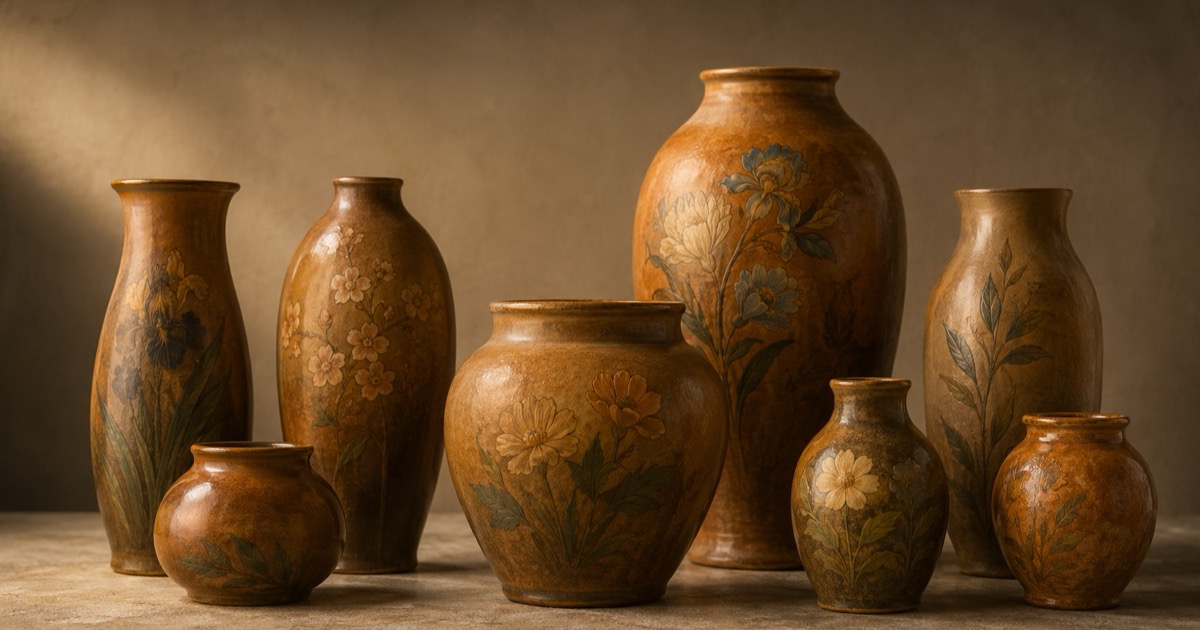
Standard glaze — the rich amber-to-brown ware with underglaze slip-painted decoration — was the primary prestige line from the late 1880s through the early 1900s. Designs typically covered botanical, portrait, or animal subjects. Standard glaze pieces are the most widely recognized Rookwood on the secondary market.
Vellum, introduced in the early 1900s, is a soft, slightly translucent matte that gives painted decorations a watercolor-like quality. Landscape and floral vellum pieces are among the most sought-after Rookwood.
Matte production ware covers later pieces, often with molded rather than hand-painted decoration. They are genuine Rookwood, common on the market, and generally more accessible in price than the earlier hand-decorated lines.
Later company revivals
Rookwood ceased original operations in the mid-20th century. The name and marks have passed through several revival efforts, and pieces from later ownerships carry the Rookwood marks. Later pieces can generally be distinguished by comparing the Roman numeral date against the known production timeline, along with differences in clay body, glaze quality, and finish.
Step-by-step date-reading workflow
- Find the base mark and confirm it is the reversed RP monogram — this confirms it is (or claims to be) Rookwood.
- Count the flame points above the mark. A bare monogram means 1886; one flame means 1887; each added flame moves the date forward one year up to fourteen flames for 1900.
- If there are fourteen flames, check below the monogram for a Roman numeral. No numeral means 1900.
- If there is a Roman numeral below the fourteen-flame mark, add it to 1900 for the production year.
- Record the shape number and any size letter for catalog cross-referencing.
- Identify any artist cipher and cross-reference against a documented cipher list.
- Note the glaze type to place the piece in its production era.
Watch-outs and common mistakes
- Miscounting flames. The flames can be difficult to read on worn or dirty bases. Clean the base gently and count under strong raking light, tracing each point with a fingertip if needed.
- Confusing 1900 with later years. A fourteen-flame mark alone means 1900; a fourteen-flame mark with a Roman numeral below it is later. Always check below the monogram before settling on 1900.
- Assuming all artist-signed pieces are equally valuable. Artist identity, glaze type, subject matter, and condition all interact. A signed piece in poor condition or a less desirable glaze line may not carry the premium a clean vellum example would.
- Overlooking later revival marks. Post-revival Rookwood exists and is sometimes misrepresented. If the Roman numeral date implies very recent production, verify the provenance.
- Condition underestimation. Crazing, chips to the rim, and repairs significantly affect Rookwood values. Examine under strong light and run a fingernail around the rim and foot ring.
Photo tips that improve identification
- Photograph the base under raking light from a low angle to make the impressed marks (flames, monogram, shape number, ciphers) read clearly.
- A single strong directional light source is essential for counting flames — flat overhead light washes them out.
- Photograph the decorated side in diffuse even light to show the glaze type and painted decoration accurately.
- If the varnish or glaze has any crazing, capture it with a slight raking angle on the decorated surface.
Common questions
What do the Roman numerals on Rookwood pottery mean?
The Roman numeral below the fourteen-flame mark is the production year, counted from 1900. Add the numeral to 1900: I means 1901, XIV means 1914, XXX means 1930. A fourteen-flame mark with no numeral below it means the piece was made in 1900 itself, so always check below the monogram before settling on a date.
Is Rookwood pottery valuable today?
It varies widely by glaze line, artist, subject, and condition. Hand-decorated Standard glaze and Vellum pieces, especially artist-signed landscapes and florals, attract the strongest collector demand, while later molded matte production ware is genuine Rookwood but generally far more accessible in price. Crazing, rim chips, and repairs reduce value substantially, so compare against sold examples of similar pieces rather than asking prices.
How can you tell if Rookwood pottery is artist signed?
Look near the marks on the base for an incised or painted initial, monogram, or small symbol separate from the RP monogram and shape number. These artist ciphers are documented in Rookwood reference books and collector resources, and confirming one against a published cipher list matters — a cipher adds a premium only when the attribution holds up.
Related guides
- Roseville Pottery Marks Identification
- Studio Pottery Marks Identification
- Hull Pottery Marks Identification
When to use the Antique Identifier app
Photograph the base in strong raking light to capture the mark clearly, then take overall shots of the piece showing glaze type and decoration. The app can help confirm the mark style, narrow the glaze era, and flag any inconsistencies worth investigating. For pieces with artist ciphers or rare glaze lines, use the app’s identification as a starting point and verify against a documented Rookwood reference before drawing conclusions about value.