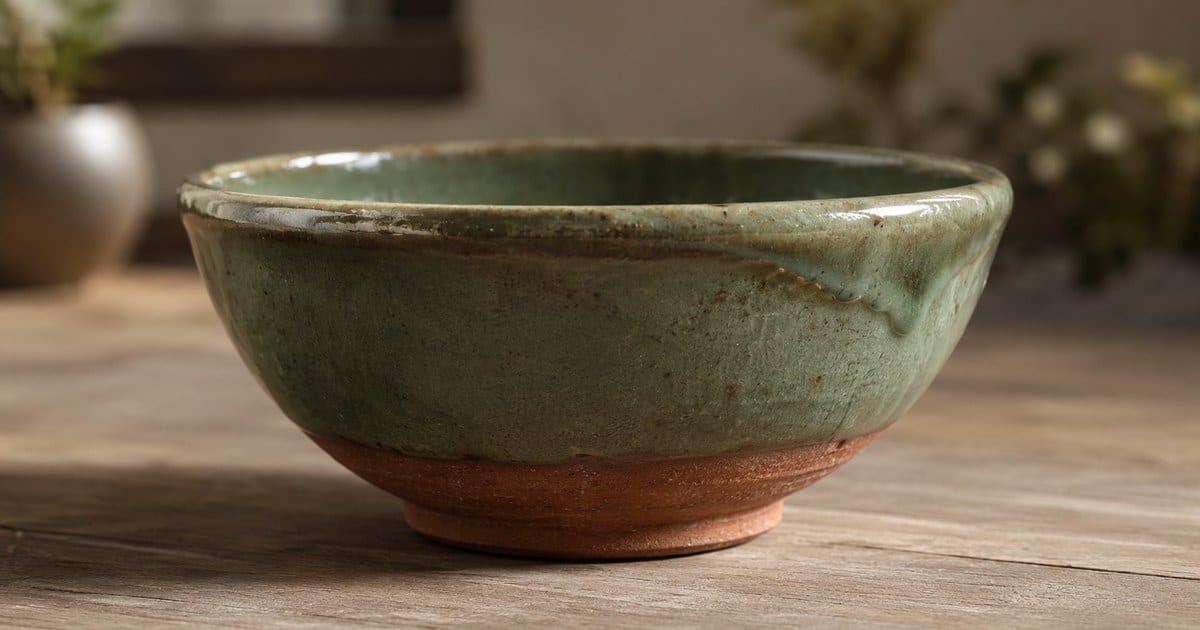
Most articles about Frankoma pottery marks work through mark shapes and lettering variants and bury the one thing that actually dates a piece. Frankoma is unusual among American potteries because the clay body itself changed, visibly and permanently, partway through the company’s life. That means you can often bracket a Frankoma piece into a broad era by looking at the raw, unglazed foot ring for two seconds, before you have read a single letter of the mark. Anyone who leads with mark trivia is making the job harder than it needs to be.
To date Frankoma pottery, look at the unglazed clay on the base first. A pale honey, tan, or cream body indicates the earlier Ada clay used until the mid-1950s. A distinctly red or brick-colored body indicates the Sapulpa clay adopted afterward. The impressed FRANKOMA mark and any paper label then refine the estimate within that range.
Quick identification checklist
- Turn it over and look at the bare clay, not the glazed surface. The foot ring, the dry base, and any chip that exposes the body all show the true clay color.
- Sort into honey or red. Pale tan or cream means earlier production. Red brick means later production. This is the primary date split.
- Read the impressed mark. FRANKOMA impressed into the base is the standard, and its layout, size, and accompanying wording vary across the run.
- Look for a very early pictorial mark. The scarce earliest pieces carry a figural device alongside the name rather than plain lettering.
- Check for label remnants. A ring of dried adhesive or a lighter patch of glaze means the piece was originally paper-labeled, which is common.
- Note the glaze family. The palette shifted over the decades, and the later years brought a recognizable change in the standard colors.
- Check the shape number. Frankoma used a consistent model numbering system, and the number ties the piece to a documented catalog form.
The clay-body test, explained properly
John Frank founded the pottery in Oklahoma in the early 1930s, initially trading under a version of his own surname, and the operation adopted the Frankoma name, a compound of the founder’s surname and the state, during that same decade. In February 1938 the pottery relocated to Sapulpa, and a fire that November destroyed the new Sapulpa plant before it had been running long. The operation rebuilt on the same site and stayed in Sapulpa afterward.
The clay change came later and for practical reasons. Through the early decades the pottery worked with a clay sourced from the Ada area of Oklahoma, a pale material that fires to a soft honey, tan, or cream color. In 1954 the works switched to a clay dug much closer to Sapulpa, which fires to a strong red brick color. The change is not subtle. Set an Ada-clay piece and a Sapulpa-clay piece side by side with their bases up and the difference reads instantly across a room.
Two practical notes make this test more reliable. First, look at genuinely unglazed clay. Frankoma glazed most surfaces, so the foot ring, an unglazed base panel, or a chip is where the evidence sits. Second, remember that the red Sapulpa body shows through certain glazes, giving later pieces a warmer, deeper cast in the same nominal color than their earlier equivalents. If a familiar Frankoma glaze looks unusually rich or slightly ruddy, the clay underneath is often the reason.
Because Ada-clay production covers a much shorter and earlier window, collectors generally pay a premium for it, which is another reason to check the base before you check anything else.
Reading Frankoma pottery marks on the base
The workhorse mark is straightforward: the word FRANKOMA impressed into the clay on the base, usually in plain capitals. It is a die mark pressed into the wet body rather than a stamp applied over the glaze, so it survives well and reads clearly on most pieces.
What varies is the surrounding detail. On many pieces the mark stands alone. On others it appears with a shape number, with wording indicating the place of manufacture, or with additional line or pattern references. Later production also carries commemorative and dated marks on specific items such as annual plates and mugs, which are useful anchors when they appear because they state a year outright.
The scarce and genuinely early material carries a different mark entirely: a pictorial device showing a large cat rendered as a pacing leopard, used alongside the name during the pottery’s first Oklahoma years. Pieces with this mark are uncommon, sit at the top of the collector interest range, and are worth confirming carefully against documented photographs rather than accepting on a glance.
Paper labels complicate the picture in the usual way. Frankoma used labels alongside impressed marks, and labels do not survive decades of washing and dusting. A base with an adhesive ghost and no readable mark is not an anomaly, and the clay-body test carries the identification in that case.
Glazes and the later years
Frankoma’s glaze palette is part of its identity, running through desert-toned browns and tans, greens, turquoise, and a warm rutile-influenced family that shades within a single piece. Recognizing the standard glaze names is a real advantage in listings and reference searches.
A second fire hit the Sapulpa plant in the early 1980s and, by widely repeated collector accounts, destroyed a great deal of equipment and records. Production resumed afterward, but the glazes that followed do not match the earlier ones exactly, and collectors treat post-fire output as a distinct chapter. In practice this means a piece in a glaze that looks close to a classic color but slightly off, on a body that is not the pale Ada clay, is likely late production. Ownership of the pottery changed several times in the decades that followed, and output continued intermittently well beyond the founder’s era.
For most sorting jobs, the sequence that works is: clay color first for the broad era, then mark and shape number to place the form, then glaze character to refine within the era.
Building a defensible date range
Treat the base as three independent clues and see where they overlap.
Pale honey clay plus an impressed FRANKOMA mark generally puts you in the pre-1954 window, though it is not quite absolute: from around 1980 the pottery adjusted its clay additives and produced a lightened body again, so a pale base paired with later-style glazes or a paper label should be checked against the mark layout and shape number rather than taken as pre-1954 on its own. Pale clay plus a pictorial leopard device puts you at the very beginning of the company’s history and warrants careful verification. Red brick clay plus an impressed mark puts you after the clay switch, and the glaze quality then tells you whether you are looking at the long middle period or the later post-fire production.
When the clues conflict, the clay usually wins, because a clay body cannot be applied after the fact the way a mark can. If a base reads pale honey but everything else about the piece suggests recent manufacture, look harder at whether you are actually seeing bare clay or a pale glaze or slip over a darker body.
Watch-outs and common mistakes
- Judging clay color through glaze. A cream glaze over red clay is not an Ada-clay piece. Find genuinely bare body before you call it.
- Assuming an unmarked base rules Frankoma out. Label-only pieces exist, and the clay plus the form usually resolves them.
- Treating a familiar shape as a date. Frankoma kept popular molds in production for long stretches, so recognizing the form dates the design rather than your example.
- Ignoring the post-fire distinction. Later pieces are genuine Frankoma, not fakes, but the market prices them differently and describing them as early material is misleading.
- Trusting one published mark chart as gospel. Sources disagree on the exact years for several transitions. Treat any single date you read, including the ones here, as a working approximation to confirm against a specialist reference.
Photo tips
- Shoot the entire base square-on in soft, even daylight so the true clay color is recorded without a warm indoor color cast.
- Take a second base frame at a low, raking angle so the impressed lettering and shape number throw a shadow and become legible.
- Get one close frame of bare, unglazed clay at the foot ring, since that single detail carries most of the dating weight.
- Photograph any label remnant or adhesive ring rather than cleaning it away.
- Add a full profile against a plain background so the form can be matched to a catalog shape number.
Common questions
How can I tell Ada clay from Sapulpa clay on Frankoma pottery?
Look at unglazed clay on the base or foot ring in natural daylight. Ada clay fires to a pale honey, tan, or cream color. Sapulpa clay fires to a clear red brick color. The difference is obvious once you see the two side by side. The switch happened in 1954, so the clay alone splits Frankoma production into an earlier and a later half.
What is the rarest Frankoma mark?
The pictorial device showing a pacing leopard, used alongside the name during the pottery’s earliest Oklahoma years, is the mark collectors chase hardest. It appears on a small quantity of surviving pieces, sits on the pale early clay body, and commands significant collector attention. Because it is desirable it is also worth verifying carefully against documented photographs before drawing conclusions.
Is later Frankoma pottery worth collecting?
Yes, though the market clearly separates it from early production. Pieces on the pale Ada clay body, and especially the earliest marked examples, generally sit well above later output. Later Sapulpa-clay pieces and post-fire production remain collected for their forms and colors, particularly complete dinnerware services and the annual commemorative items. Condition and completeness matter more in that tier than the mark does.
Related guides
- Van Briggle Pottery Marks: How to Identify and Date Van Briggle
- Roseville Pottery Marks Identification
- Hull Pottery Marks Identification
- Antique Pottery Marks
When to use the Antique Identifier app
Frankoma turns up in volume at estate sales and thrift stores, often as a shelf of mixed dinnerware and small vases, and sorting a shelf one piece at a time is slow. Photograph each base square-on and at an angle, include the bare foot ring and one full profile, and the app can suggest the maker, the likely era, and the probable form for each piece at once. That gives you a shortlist of the two or three items worth researching properly. Confirm the promising ones against shape references and completed auction results before you price anything.